
Visiting Luxor independently on a budget is easier than most travellers think and far more rewarding than joining an organised tour. Often called the world’s greatest open-air museum, Luxor is home to some of the most extraordinary ancient sites on Earth: the Valley of the Kings, Karnak Temple, the Mortuary Temple of Hatshepsut, and miles of temples, tombs, and monuments that stretch across both banks of the Nile.
Luxor stands on the site of ancient Thebes, once the grand capital of Egypt during the height of its power. For over 1,500 years, Thebes was the heart of the New Kingdom. It was a city of immense wealth, religious significance, and architectural marvels, home to the vast temple complexes, where pharaohs legitimised their rule in the eyes of the gods. However, as Egypt’s power declined, Thebes fell into ruin, its temples buried under layers of sand and time.
You don’t need a guide or a group to experience any of it. This guide covers exactly how to do it yourself: how to get there on a budget, how to navigate the West Bank without a tour, which tombs are worth the extra ticket cost, and what nobody else tells you about visiting Luxor independently.
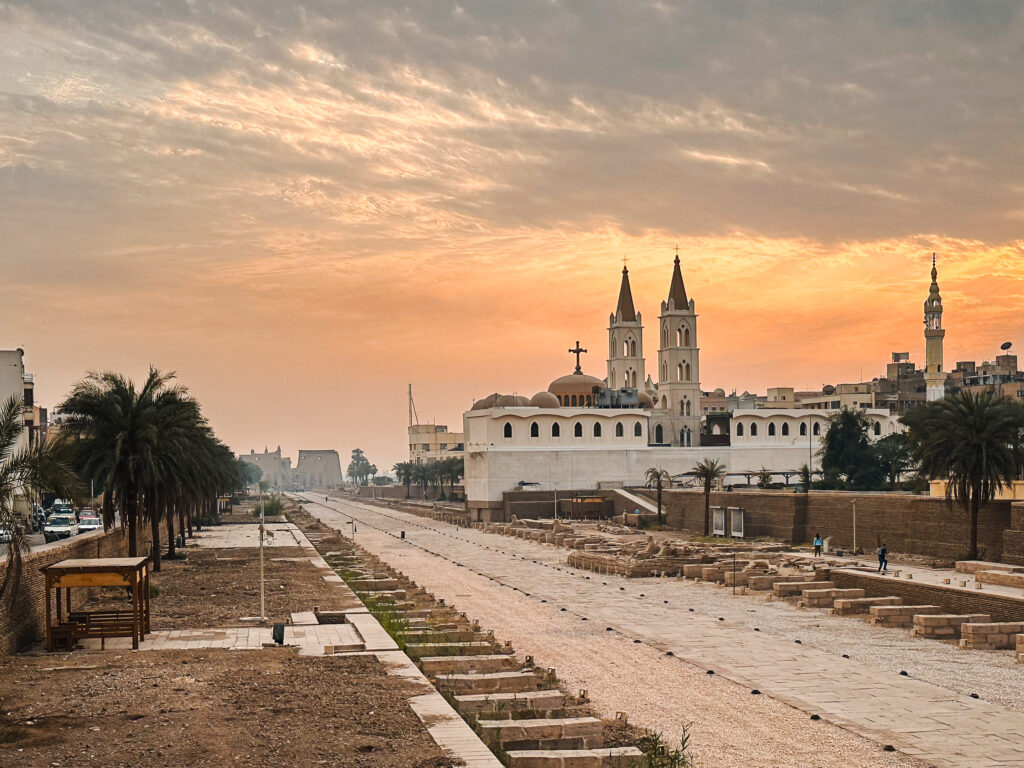 Luxor – Avenue of the Sphinxes
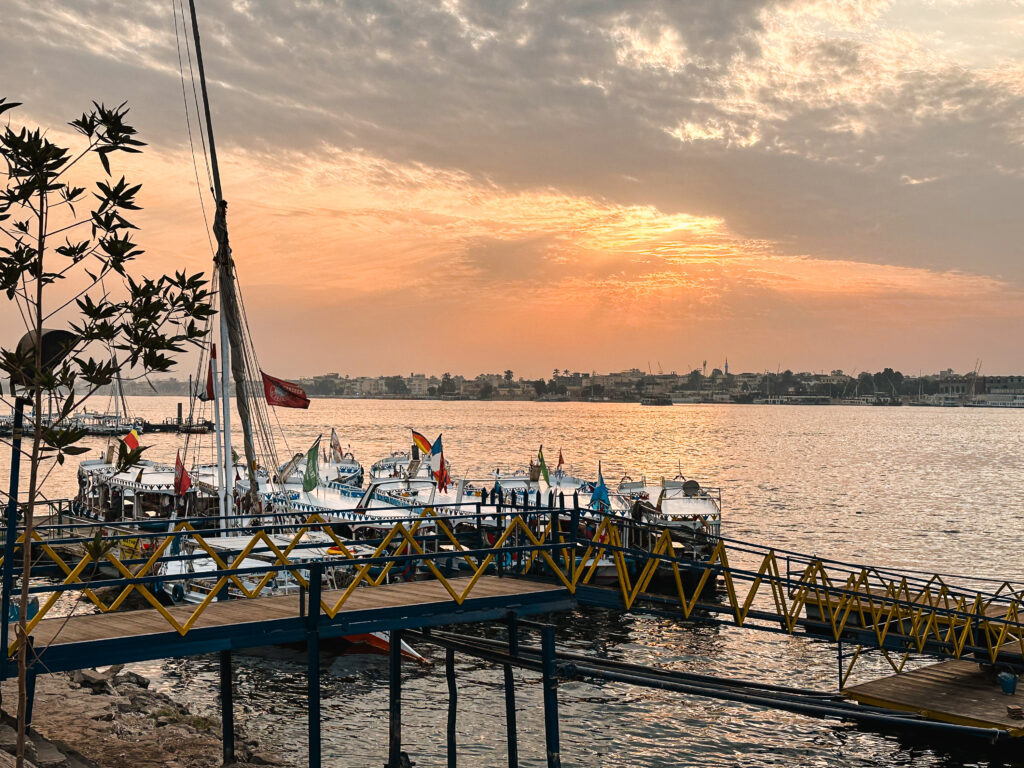 Strolling along the Nile at Sunset
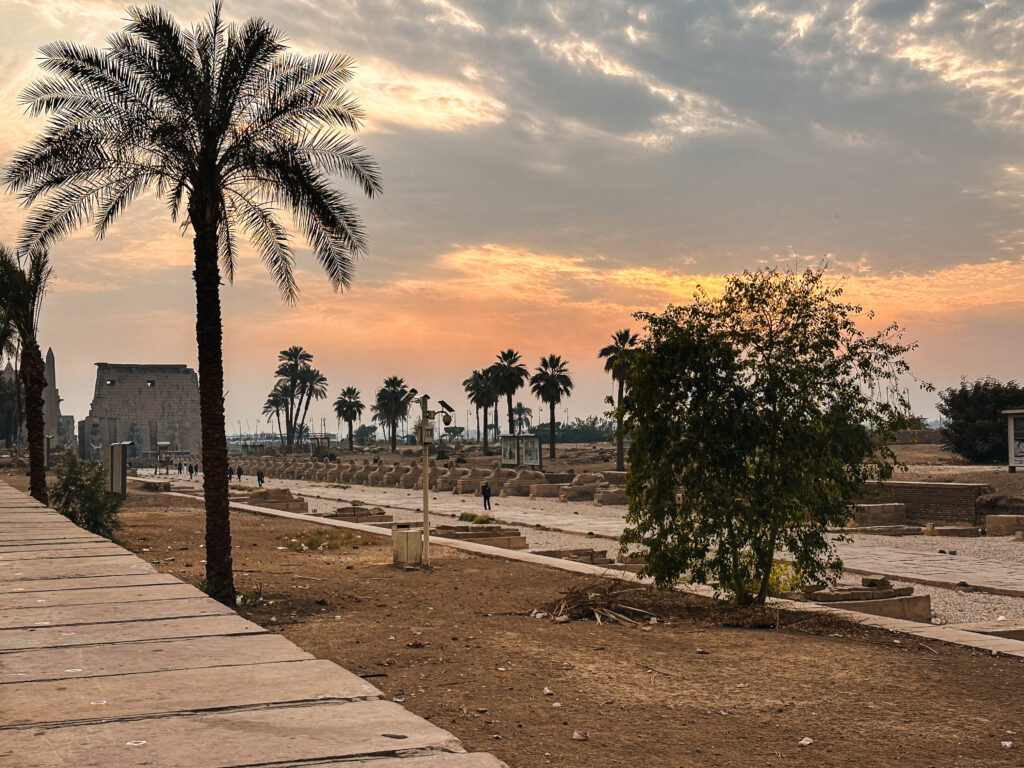 Avenue of the Sphinxes and Luxor Temple
The Luxor Survival Guide: How to Avoid the Hustle
Luxor is a magnificent open-air museum, but it is also the “hustle capital” of Egypt. To visit independently without losing your mind (or your budget), you need to follow these four golden rules:
1. Mastering the “No” (La, Shukran)
You will be approached by horse-carriage (caleche) drivers, felucca captains, and shopkeepers every ten seconds.
The Secret: Don’t just ignore them, that can sometimes lead to more persistence. Make brief eye contact, say “La, Shukran” (No, thank you) firmly, and keep walking. If you hesitate or ask “how much?”, the negotiation has begun.
2. The West Bank Ticket Office Trap
If you are visiting the West Bank independently, remember this: You cannot buy tickets at the entrance of most sites.
The Secret: You must go to the central ticket office on the West Bank (near the Colossi of Memnon) to buy tickets for smaller sites like the Habu Temple or the Valley of the Queens. However, the Valley of the Kings and Hatshepsut Temple have their own dedicated ticket booths at their respective entrances. For these you can also buy the tickets online to avoid the queues.
3. Connectivity is Your Best Weapon
Scams thrive on travellers being lost or uninformed. Having a working map and access to real-time taxi rates is essential. That way you can use the inDrive app (similar to Uber) to get taxis without having to negotiate price.
The Secret: Don’t rely on spotty hotel Wi-Fi. I use a Saily eSIM to stay connected. It allows you to check Google Maps while in the back of a taxi to ensure you’re going the right way and to look up official government entry prices if a “guide” tries to overcharge you.
Need data before you land? Try Saily eSIM
Use code RITAHE1486 for $5 off your first plan.
4. Small Change (The “Baksheesh” Stash)
In Luxor, “Baksheesh” (tipping) is a way of life. People will expect a tip for opening a door, pointing you toward a tomb, or even for letting you take a photo.
The Secret: Never show a full wallet. Keep a “dummy” pocket with small 5, 10, and 20 EGP notes. If you pull out a 200 EGP note to pay for a 10 EGP water, you will suddenly find that the vendor “has no change.”
How Much Does It Cost to Visit Luxor Independently? (2026 Prices)
Luxor is incredibly affordable for food and accommodation, but your biggest expense will undoubtedly be entrance fees. In 2026, the Egyptian Ministry of Tourism has moved toward higher pricing for major archaeological sites. On average, a budget backpacker should plan for €30 – €45 (1,700 – 2,400 EGP) per day.
Daily Budget Breakdown
| Category | Budget (Backpacker) | Mid-Range |
| Accommodation | 450 – 750 EGP | 1,500 – 3,000 EGP |
| Food & Water | 250 – 400 EGP | 750 – 1,200 EGP |
| Local Transport | 150 – 250 EGP | 600 – 900 EGP |
| Sightseeing (Avg) | 750 – 1,200 EGP | 1,500 – 2,500 EGP |
| Daily Total | ~1,900 EGP (€30) | ~4,500 EGP (€70) |
Where Your Money Goes
1. Sightseeing: The Ticket Reality
This will be your largest daily expense. Most major temples now cost between 400 and 750 EGP. If you plan on visiting the Valley of the Kings (750 EGP) plus a special tomb like Ramesses V & VI (220 EGP) and the Hatshepsut Temple (440 EGP), you could easily spend over 1,400 EGP in a single morning.
The ISIC Hack: If you have a valid Student ID (under 30), you get 50% off every single ticket. This is the ultimate budget-saver in Luxor.
2. Accommodation: East Bank vs. West Bank
The East Bank is home to the cheaper hostels (like Bob Marley House) where you can find a dorm bed for as little as €10. However, I preferred staying on the West Bank in a local guesthouse. For around €15 – €25, you can get a private room with a Nile view and a much quieter atmosphere. It’s worth the extra few euros to avoid the constant noise and touts of the city centre.
3. Food: Koshary and Street Eats
Luxor is a paradise for cheap, delicious food. A massive bowl of Koshary (Egypt’s national dish of pasta, rice, and lentils) at a local spot like El-Zaeem will only cost you about 80 – 120 EGP (around €2). If you stick to local falafel (ta’ameya) sandwiches and street shawarma, you can easily keep your food budget under €10 a day. Dining at the fancy Nile-side restaurants will push this closer to €20 per meal.
Money-Saving Tips for Luxor
The Ferry over the Bridge: Never take a taxi from the East Bank to the West Bank (the bridge is far away and drivers overcharge). Use the Public Ferry for 20-25 EGP and then use the inDrive app from the other side.
Drink the Tea, Skip the Alcohol: Alcohol is heavily taxed and only served in specific hotels. A beer can cost as much as a full dinner. Stick to the delicious local tea or Egyptian coffee.
Withdraw Large Amounts: Most ATMs in Luxor charge a flat fee. Use the ATMs and withdraw the maximum amount possible to minimise these fees.
Avoid ATM fees with Wise
The card I use for all my travel withdrawals – real exchange rate, low fees.
Use Revolut to avoid ATM fees
Good alternative to Wise – I carry both as a backup.
How to Get to Luxor Independently on a Budget
There are plenty of ways to reach Luxor from Cairo, including day trains, night trains, and various bus companies. I took a 10-hour night bus with GoBus, which cost me around €10. It was a budget-friendly option, but if you prefer more comfort, the sleeper train is also a popular choice, although a lot more expensive.
What to See in the East Bank in Luxor Independently
Pro Budget Tip: Buy the tickets online to most ancient sites to avoid the queues.
The East Bank of Luxor is home to some of the most iconic ancient sites, where history comes to life through its magnificent temples. Here are some of the sites you shouldn’t miss.
Karnak Temple Complex
Karnak Temple, located on the East Bank of the Nile in Luxor, was the principal religious centre of ancient Egypt, dedicated to the god Amun-Ra. Construction began in the Middle Kingdom, around 2000 BCE, but it was during the New Kingdom that the temple grew into a vast complex under pharaohs like Thutmose III and Ramses II. Over 2,000 years, successive rulers added monumental structures, including the famous Hypostyle Hall, which boasts 134 towering columns, and several pylons, obelisks, and chapels.
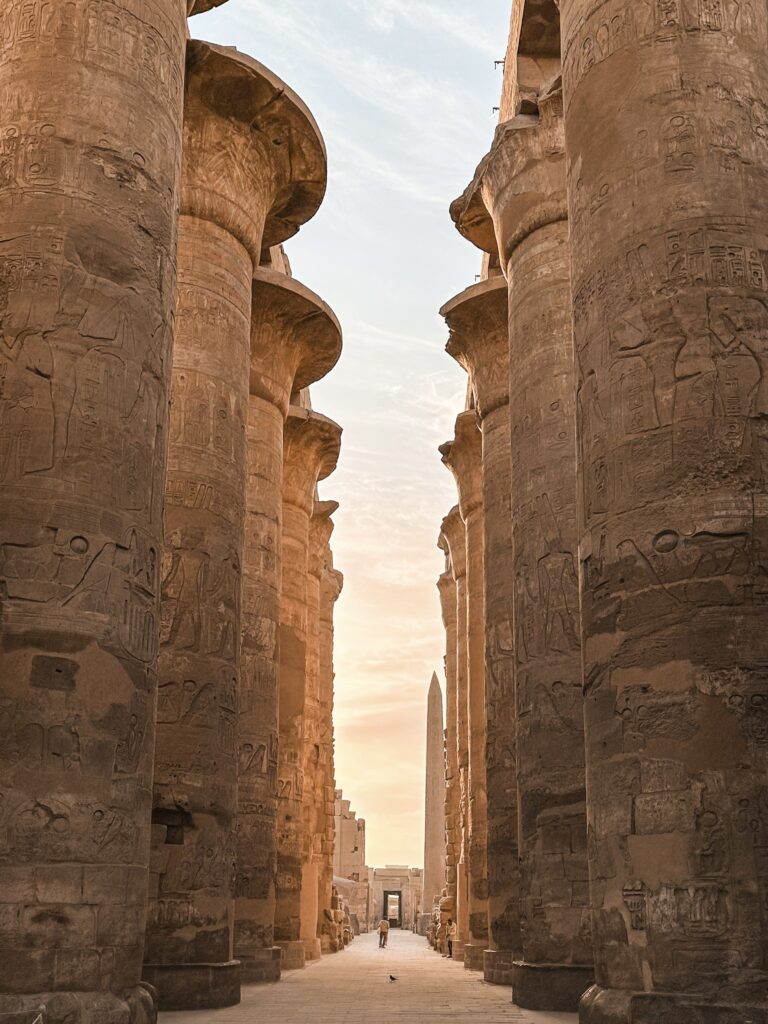 Columns of the Hypostyle Hall
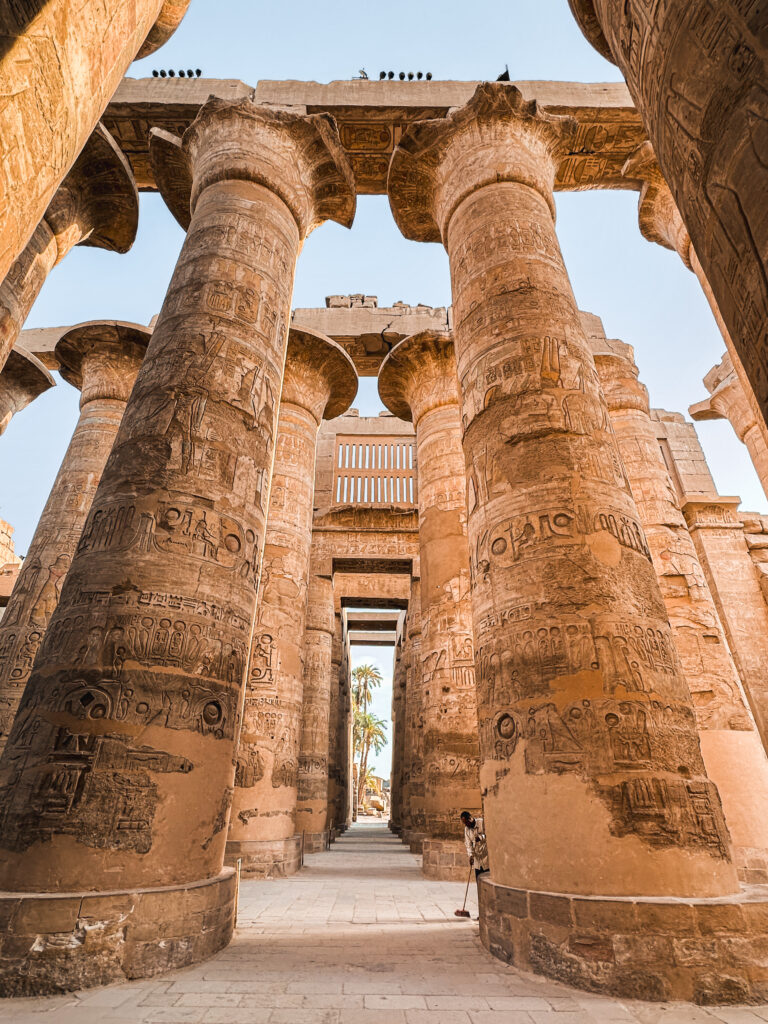 Columns of the Hypostyle Hall
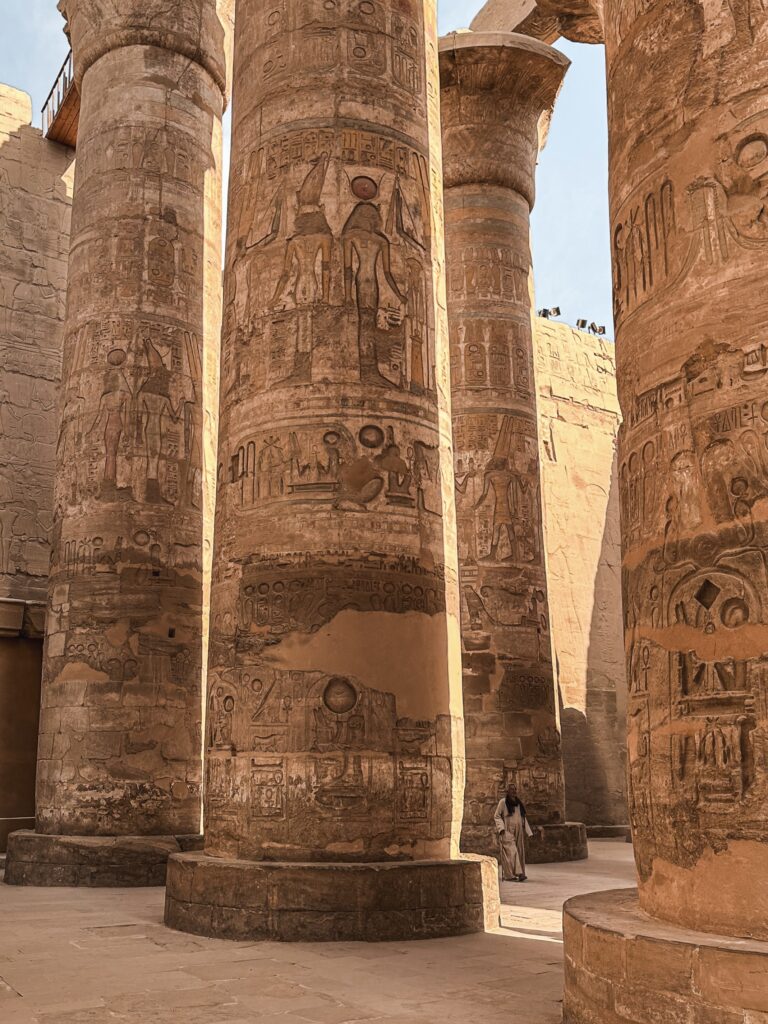 Columns of the Hypostyle Hall
The temple complex spans over 200 acres, making it the largest religious building in Egypt and one of the largest in the world today. Karnak symbolised Egypt’s religious and political power, serving as both a place of worship and a platform for pharaohs to immortalise their reigns through inscriptions and statues. Its vast scale and intricate carvings made it one of the most impressive sites of ancient Egypt.
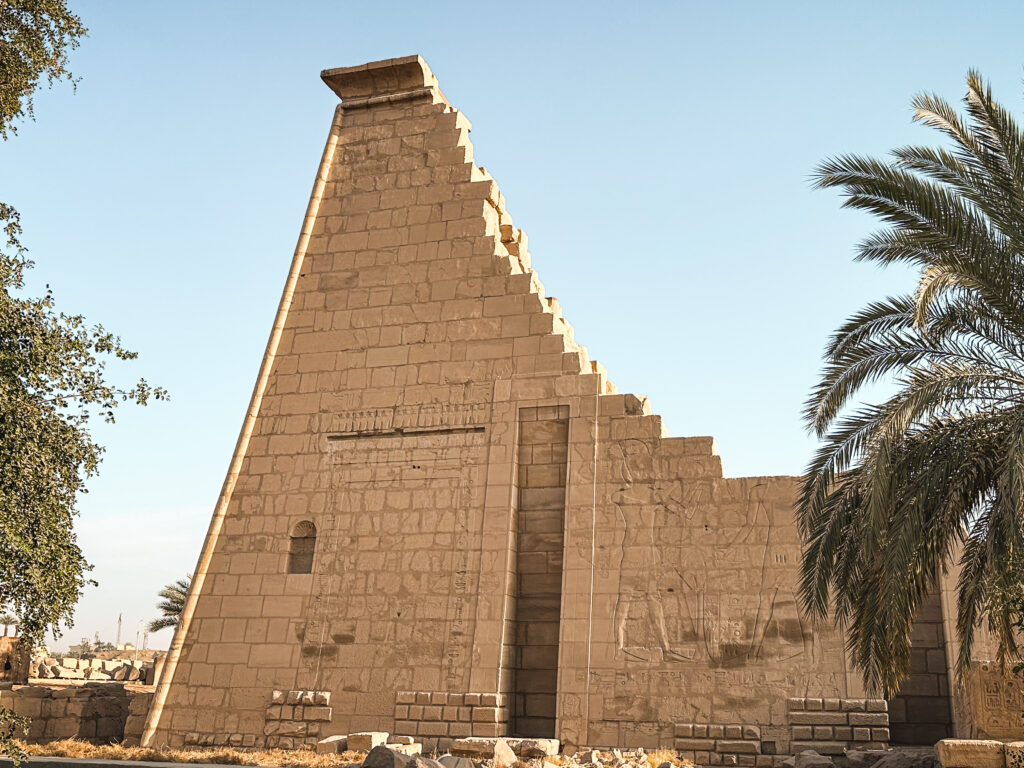 Temple inside Karnak Complex
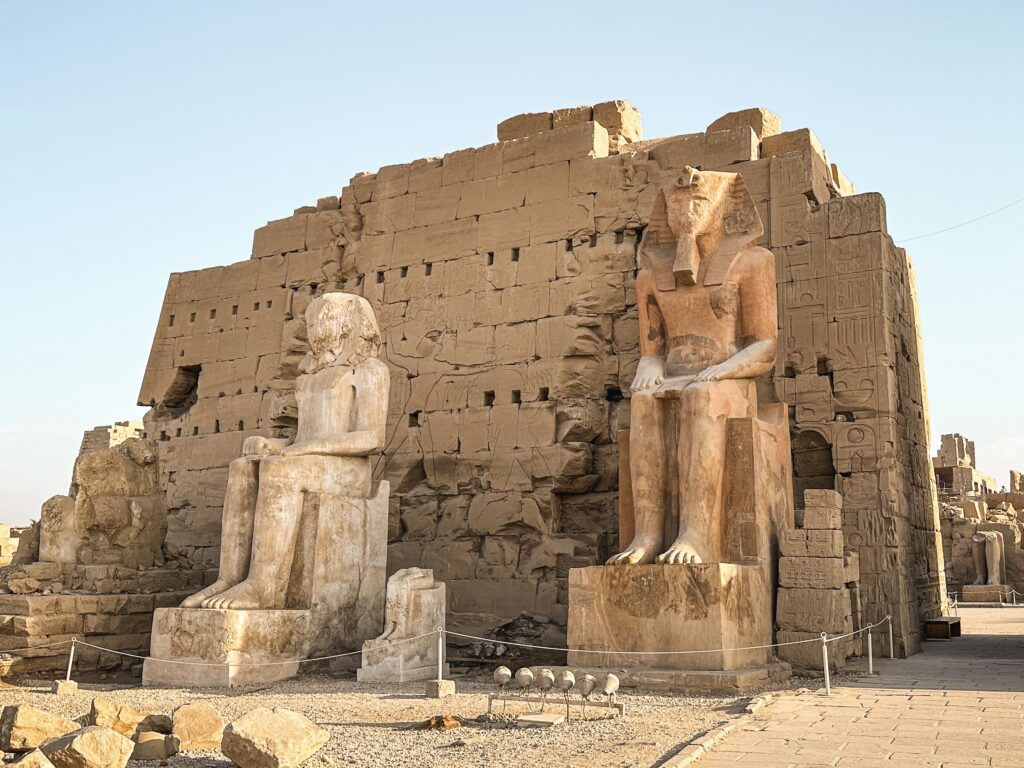 Another Temple Entrance Karnak Comple
The best time to visit the Karnak Temple Complex to avoid the crowds is at sunrise. You’ll have a more peaceful experience as the site gradually comes to life with the morning light. Plan to spend around 2-3 hours exploring the vast complex. While there are some informative signs throughout, you can also hire a guide outside the entrance if you’d like to learn more about the history and significance of the site. There’s also a nightly Sound and Light Show that narrates the history of Thebes, the temple complex, and its gods, with dramatic lighting effects illuminating the ancient structures.
Avenue of the Sphinxes
After visiting the Karnak Temple Complex, take a stroll down the Avenue of the Sphinxes, which leads you all the way to Luxor Temple. This ancient pathway, once used for religious processions, is lined with hundreds of sphinxes, each with a human head and a lion’s body. The avenue was recently restored, and walking along it offers a unique opportunity to experience a part of ancient Thebes as it once was. As you make your way towards Luxor Temple, you’ll be transported back in time, imagining the grand ceremonies that would have taken place here.
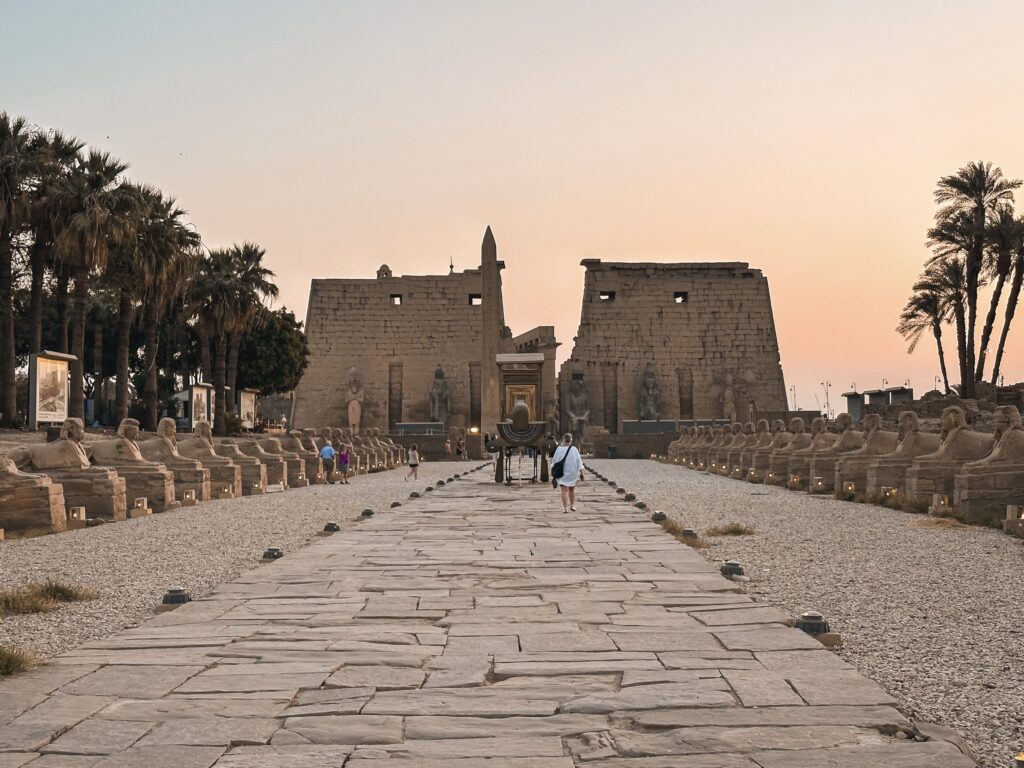 Avenue of the Sphinxes with Luxor Temple in the background
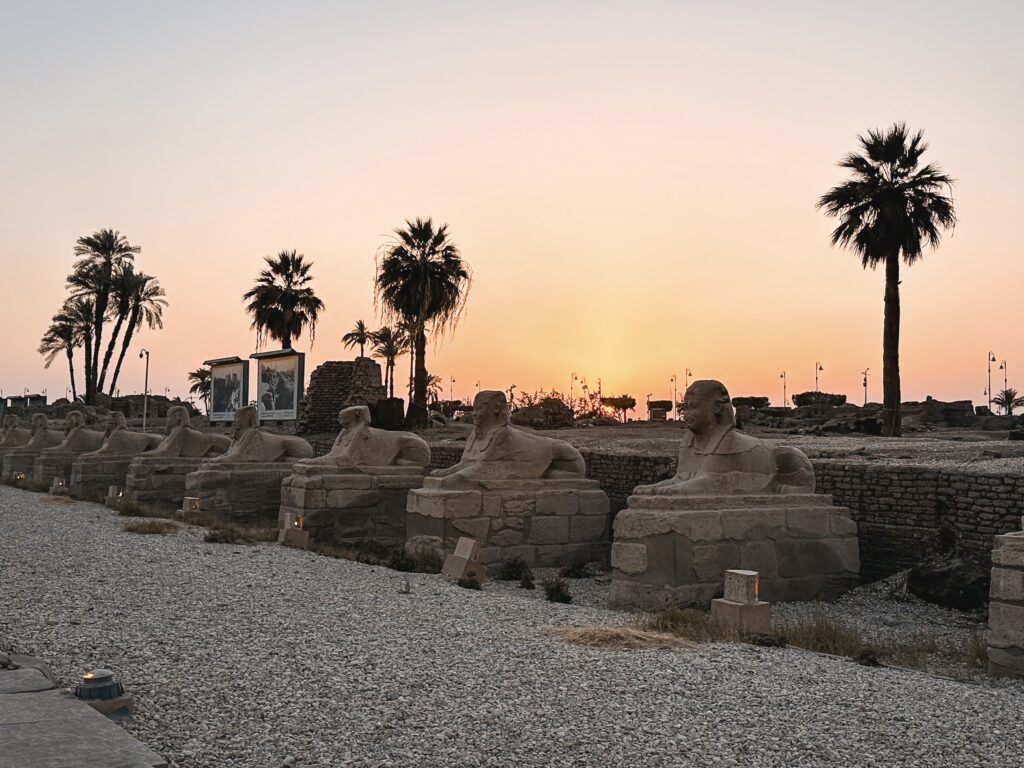 Sphinxes outside Luxor Temple
Luxor Temple
Luxor Temple, one of the most significant temples of ancient Egypt, was built on the East Bank of the Nile and dedicated to the rejuvenation of kingship rather than a specific deity. Unlike other temples that focused on worshipping gods, Luxor Temple was believed to be the place where pharaohs were crowned and their divine legitimacy reinforced. Constructed primarily by Amenhotep III in the 14th century BCE and later expanded by Ramses II, the temple showcases grand pylons, colossal statues, and intricate carvings that highlight its importance in Egyptian religious and political life.
One of its most striking features is the grand entrance, marked by a massive pylon adorned with battle scenes of Ramses II and flanked by towering statues of the pharaoh. Originally, two obelisks stood at the entrance, but today, only one remains, while the other was gifted to France and now stands in Place de la Concorde in Paris. Over the centuries, Luxor Temple remained an important religious site, even being used as a Roman military base and later as a place of worship for early Christians and Muslims. A mosque, built over part of the temple during the medieval period, still stands today, demonstrating the site’s continuous significance throughout history.
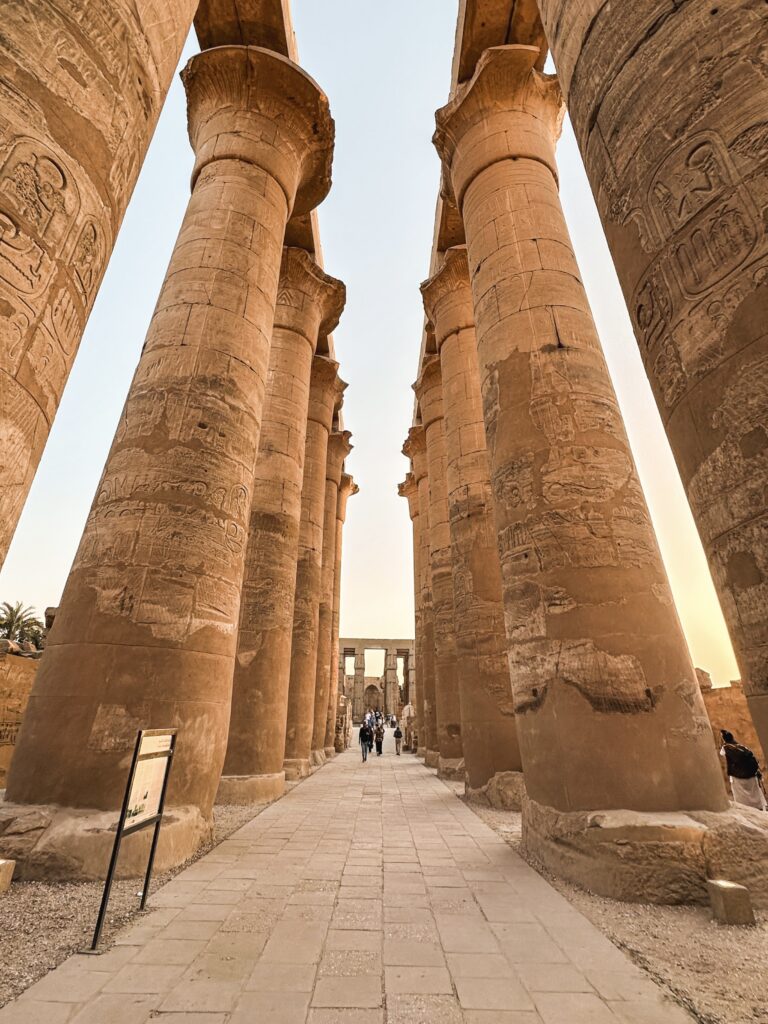 Luxor Temple at Sunset
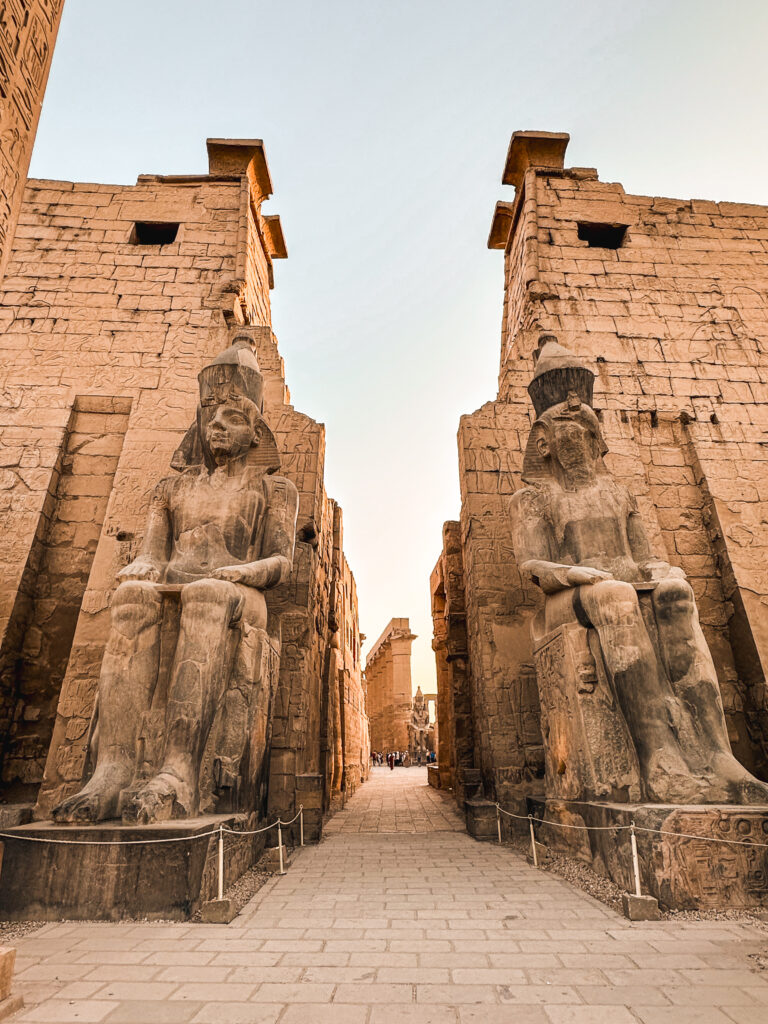 Entrance to Luxor Temple
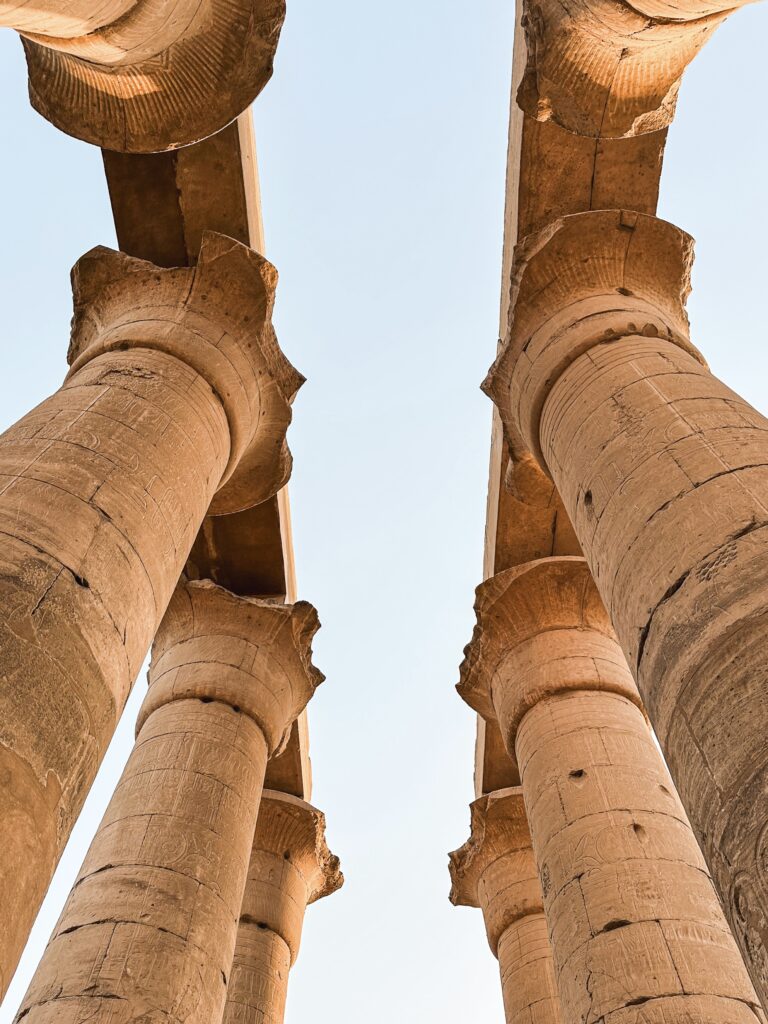 Luxor Temple Columns
The best time to visit Luxor Temple is in the late afternoon when the sun casts a golden glow over the ancient stone, creating a magical atmosphere. However, for an enchanting experience, consider visiting at night as well when the temple is beautifully illuminated. The towering statues and intricate carvings take on a dramatic presence under the lights.
Museums
The Luxor Museum offers a more intimate look at Egypt’s history, showcasing a collection of artefacts, including statues and mummies. I visited hoping for a quiet escape from the busy temples, but it turned out to be just as crowded. The museum itself is quite small, with no explanatory signs to provide context for the exhibits. Everything feels very outdated, as if it was designed in the early 90s and never updated since, giving it a somewhat neglected atmosphere. In my opinion, given the entry price, it doesn’t offer enough value to be a must-visit.
The Mummification Museum offers fascinating insights into the ancient Egyptian process of mummification. With well-preserved artefacts and informative displays, it’s a great place to learn about the rituals and beliefs surrounding death and the afterlife.
How to Visit the West Bank in Luxor Without a Tour
The main reason travelers feel “forced” into booking a tour for the West Bank is a simple lack of clear logistics. The archaeological sites are spread miles apart across the desert, and with no scheduled public transport, the distance can feel intimidating.
While some travellers choose to rent a bicycle (approx. 150-200 EGP per day), I only recommend this in the cooler winter months. The ride to the Valley of the Kings is a steady uphill climb with zero shade, it is exhausting and can be dangerous in the Egyptian heat.
The Modern Strategy: Using inDrive
Instead of the traditional (and often stressful) method of hiring a private driver for a full day, I visited the West Bank by using the inDrive app. This was a game-changer for my budget and my freedom. Using an app avoids the “negotiation fatigue” that comes with street taxis and allows you to move at your own pace without a driver waiting on you.
How I did it: I took the public ferry across from the East Bank and simply called an inDrive whenever I finished a site. Because my hotel was on the West Bank, my fares were incredibly low:
If you are staying on the East Bank, don’t pay for a taxi to drive you across the bridge! Take the public ferry (20-25 EGP) and order your first ride from the West Bank ferry landing. You’ll save hundreds of pounds in “bridge crossing” fees.
West Bank Independent Logistics & Price Cheat Sheet
If you don’t have data to use inDrive, or prefer to negotiate with local drivers at the ferry port, use these baseline rates to ensure you are getting a fair price.
| Method | Route / Duration | Approx. Price (EGP) | Why Choose This? |
| Public Ferry | East Bank ➔ West Bank | 20 – 25 EGP | The cheapest way; runs 24/7. |
| inDrive (App) | Per Site-to-Site Trip | 60 – 100 EGP | Best for total flexibility & no haggling. |
| Bicycle Rental | Full Day | 150 – 200 EGP | Great for solo travelers in Winter. |
| Private Taxi | Half Day (3-4 hours) | 600 – 800 EGP | Best for 2-3 people; driver waits for you. |
| Private Taxi | Full Day (6+ hours) | 900 – 1,200 EGP | Easiest for a 4+ site “Marathon” day. |
The Major Advantage: Beating the “Tour Rush”
By traveling independently, you can flip the standard tour schedule on its head. Most tours arrive at the Valley of the Kings at 8:00 AM and follow a rigid path. By planning your own day, you can choose to visit the smaller, stunning sites like Medinet Habu or the Tombs of the Nobles during the peak hours and save the big sites for late afternoon when the crowds (and the heat) begin to dissipate.
Valley of the Kings
The Valley of the Kings is one of the most famous archaeological sites in Egypt. It served as the royal burial ground for Pharaohs of the New Kingdom (c. 1539–1075 BCE), including some of the most iconic rulers of ancient Egypt, such as Tutankhamun, Ramses II, and Seti I. The valley is home to over 60 tombs, which were carved into the rock to provide the deceased rulers with a secure resting place for their journey into the afterlife.
The tombs in the Valley of the Kings are renowned for their elaborate decorations and inscriptions, which depict scenes from the pharaohs’ lives, religious rituals, and their journey through the afterlife. The tombs were originally constructed with great care, designed to protect the mummies and their valuable belongings from tomb robbers. Despite this, many tombs were looted in antiquity, though some, like that of Tutankhamun, were discovered largely intact, offering incredible insight into the burial practices and wealth of the pharaohs.
Understanding the Valley of the Kings Ticket Structure
Before you start exploring, it is crucial to understand how the ticketing works so you don’t waste money or time:
Pro Tip: Buy Your Ticket Online (The “Unlimited” Hack)
I highly recommend purchasing your tickets in advance via the official Ministry of Tourism website. Not only does this allow you to skip the long queues at the physical ticket window, but it also has a major “logistical” advantage.
The Digital Loophole: When you have a paper ticket, the guards at the entrance of each tomb will punch a hole in it to track your three-tomb limit. However, they cannot “punch” a digital ticket on your phone. While you are technically limited to three tombs, I found that I was able to scan my way into five or more tombs without any issues. If you have the energy, you could likely see them all, though it does get repetitive after a while!
Which Tombs are Worth Your Time?
With over 60 tombs, choosing your “three” (plus any extras) can be overwhelming. Here is my strategic breakdown based on the 2026 experience:
The “Must-See” Standard Tombs (Included in your 750 EGP ticket)
The “Special” Tombs (Is the extra cost worth it?)
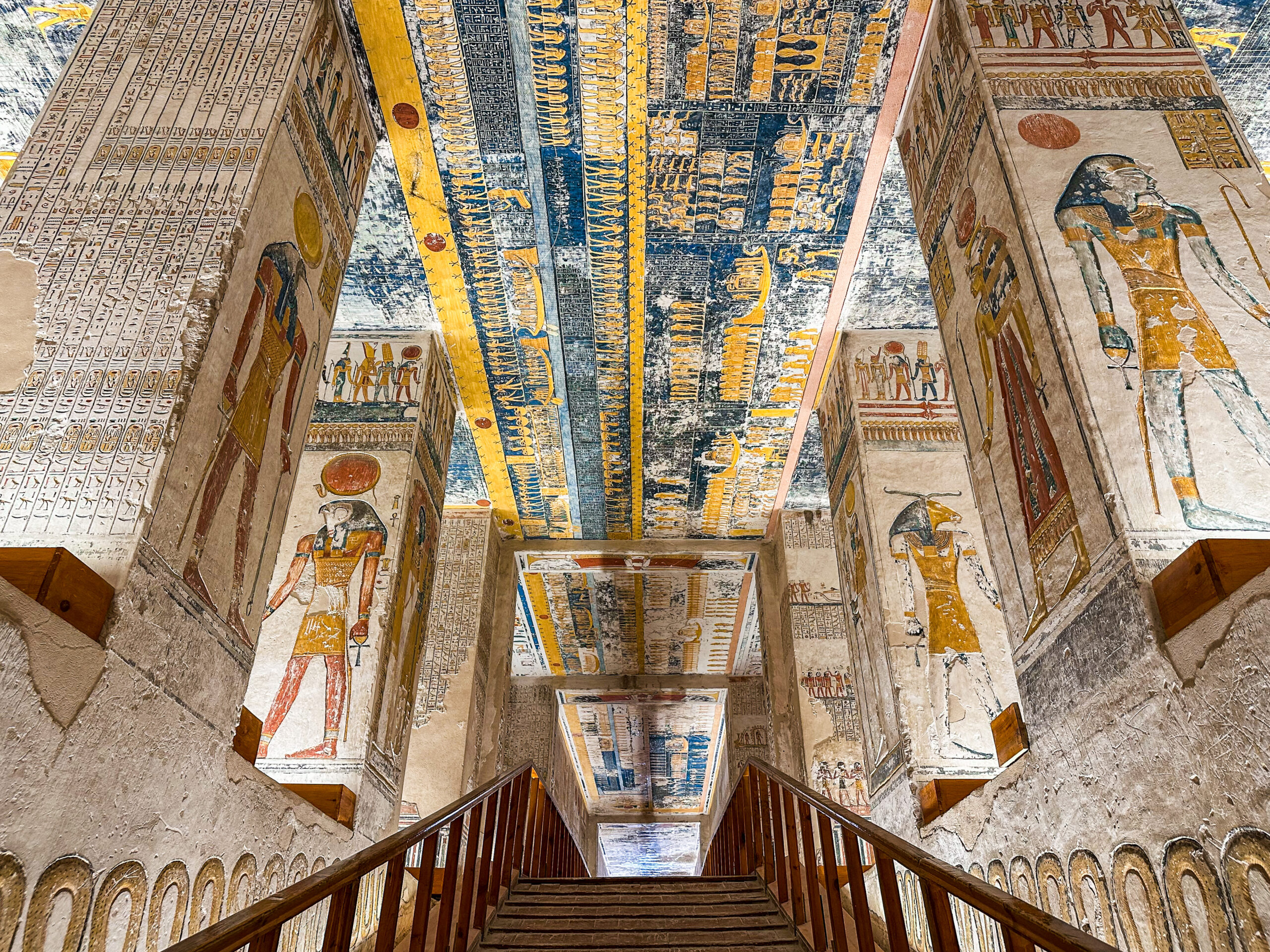
Ramesses V & VI (KV9) — Price: 220 EGP
Verdict: 100% Worth It. This is one of the most beautiful tomb in the valley. The walls are completely covered in dense, perfectly preserved hieroglyphs and astronomical scenes. It’s the best “value for money” splurge.
Tutankhamun (KV62) — Price: 750 EGP
Verdict: Only for History Buffs. The tomb itself is much smaller and less decorated than the ones above. You pay for the “fame” and the chance to see the boy king’s mummy in person. If you’re on a tight budget, skip this and see his treasures in the Cairo Museum instead.
Seti I (KV17) — Price: 2,000 EGP
Verdict: The Ultimate Splurge. This is the largest and most spectacular tomb in Egypt. The detail is unmatched, but at ~$40 USD just for one tomb, it’s for serious enthusiasts only.
Inside the Valley: My Experience and Tomb Reviews
If you’re on a tour, you’ll be taken to the same set of tombs, and you won’t need to choose which ones to visit. However, if you’re visiting independently, I recommend doing some research beforehand to know which tickets to buy. I visited seven different tombs during my stay. Here is my take on the ones I found most impressive.
Tomb of Seti I (KV17)
The Tomb of Seti I is one of the most extraordinary and beautifully decorated tombs in the Valley of the Kings. Known for its stunning artwork and intricate carvings, it is the longest tomb in the valley, extending over 130 metres. Seti I, the father of Ramses II, was one of Egypt’s most powerful pharaohs, and his tomb reflects his grandeur. The walls of the tomb are adorned with vivid scenes depicting various religious texts, including the Book of the Dead and Scenes of the Afterlife, along with detailed illustrations of the gods and pharaohs in their journey to the afterlife. The tomb’s artwork is considered some of the finest in Egypt, with exceptional colour and detail. The tomb is rarely open to the public due to its fragility, and entry is expensive and typically restricted to a limited number of visitors.
I was incredibly fortunate to experience this tomb all alone, allowing me to admire the intricate artwork and vivid colours without any interruption. While the ticket is quite pricey, I definitely felt it was worth the cost, and it ended up being my favourite tomb by far.
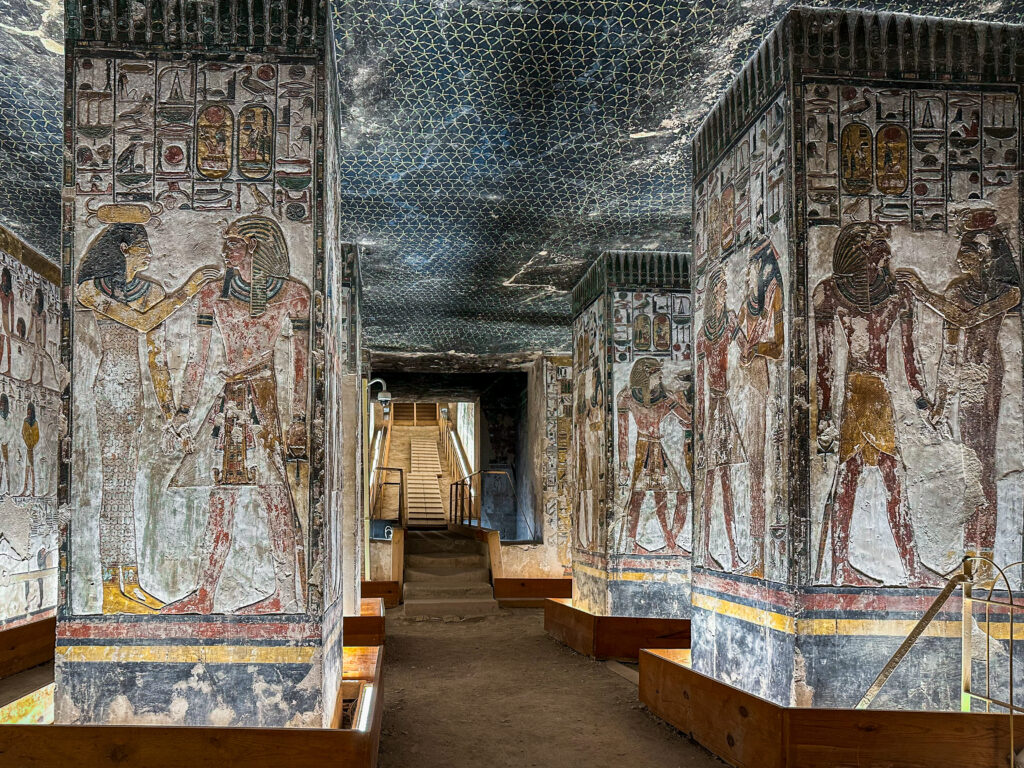 Tomb of Seti I
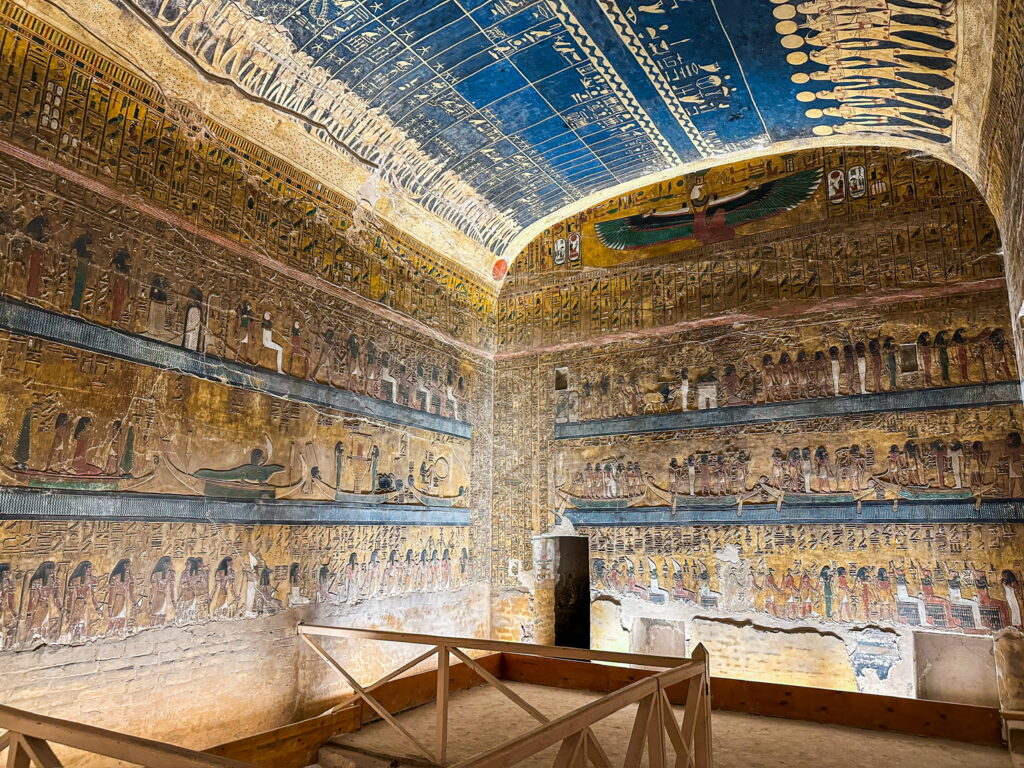 Burial Chamber in Tomb of Seti I
Tomb of Ramses V and VI (KV 9)
The Tomb of Ramses V and VI also requires an additional ticket, but since it’s only a few euros, I highly recommend purchasing it. In my opinion, it’s great value for money, since this tomb is one of the largest and most spectacular in the Valley of the Kings. Originally constructed for Ramses V, it was later extended for his successor, Ramses VI, who was also buried there. The ceilings are particularly striking, adorned with astronomical and religious symbols. Due to the additional ticket cost, it’s much less crowded than other tombs, providing a more peaceful experience. When I visited, there were only two other people, so I had plenty of space to fully appreciate the grandeur and beauty of this remarkable tomb.
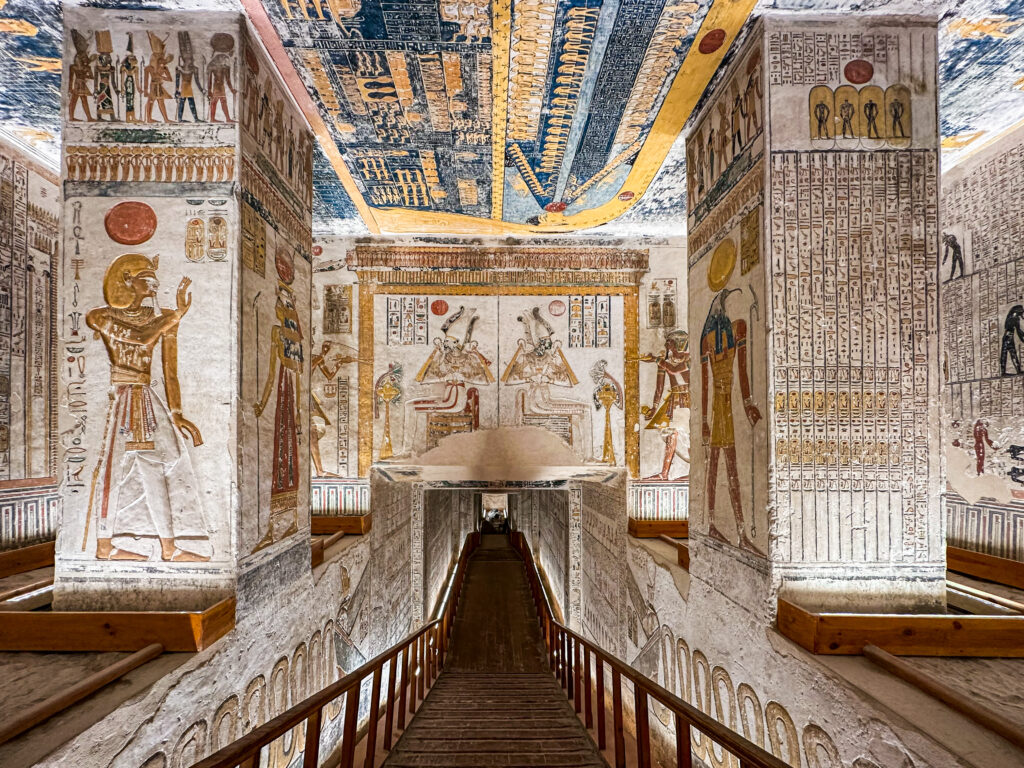 Tomb Ramses V and VI
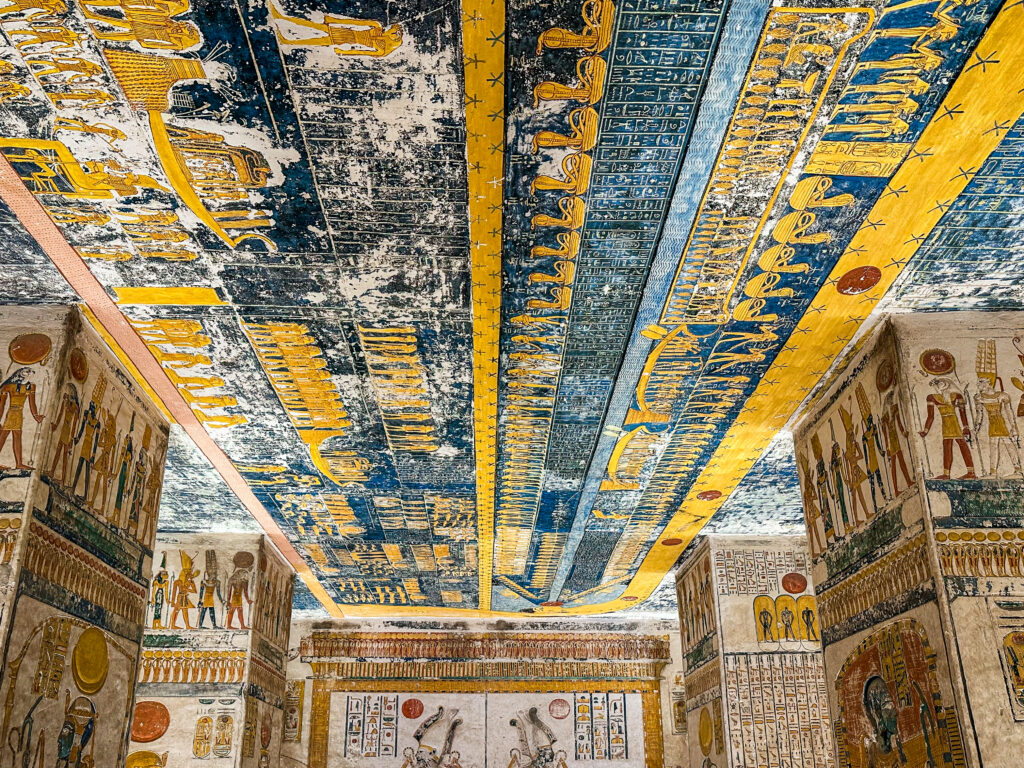 Ceiling details
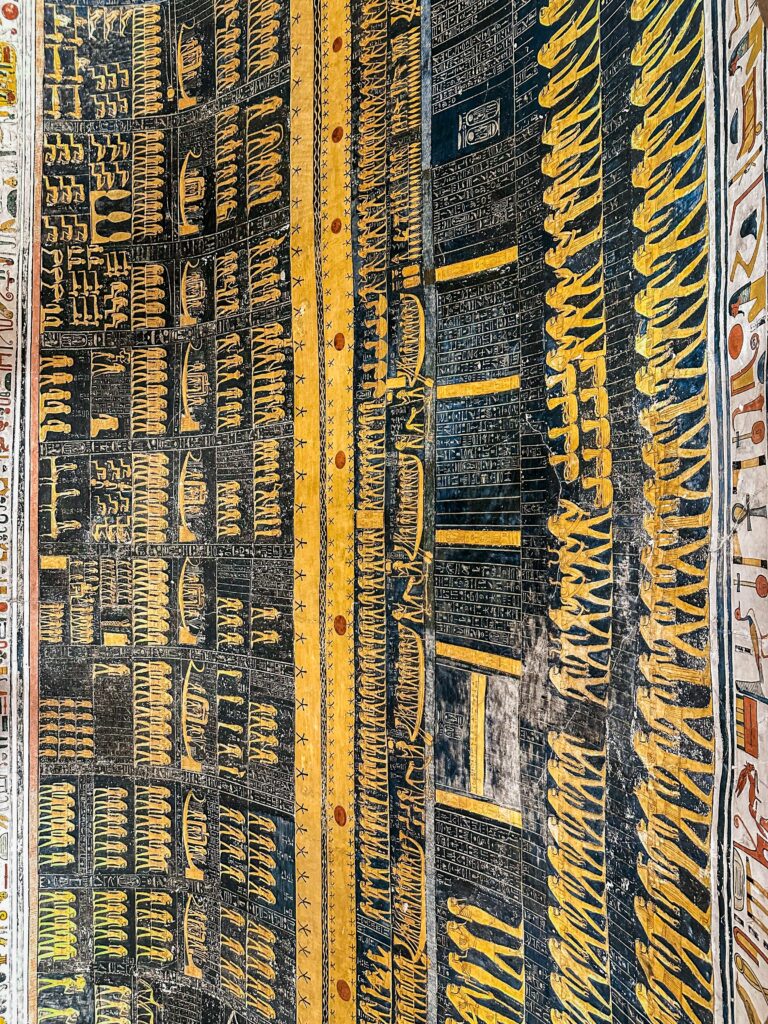 Ceiling details Burial Chamber
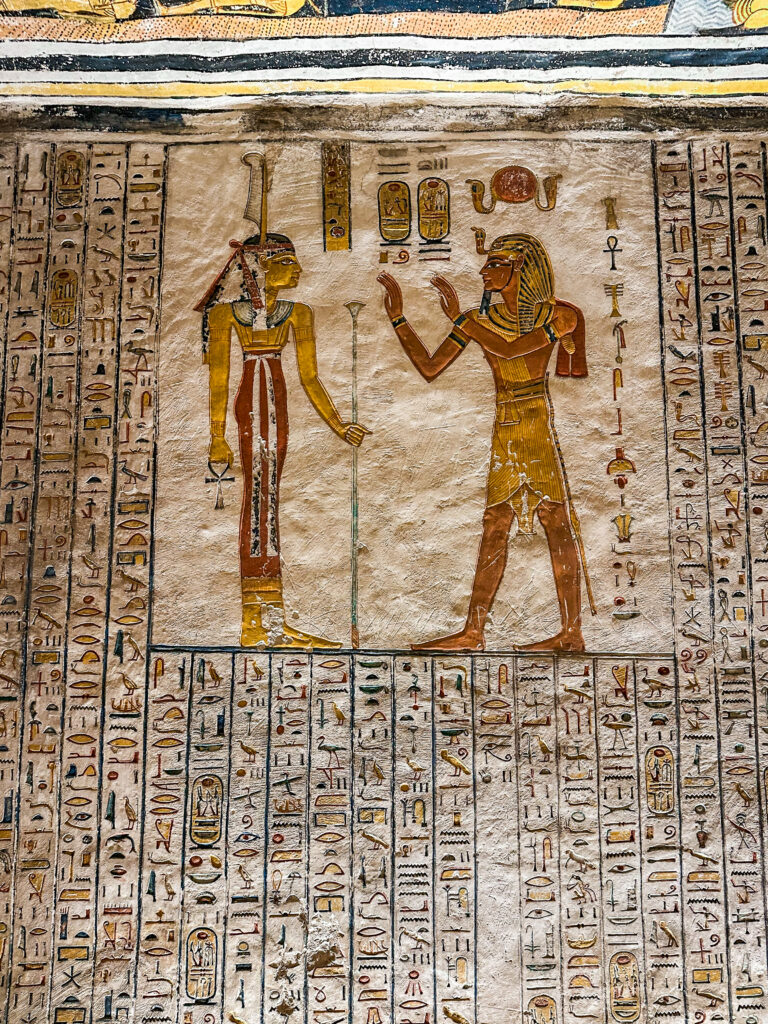 Intricate Wall Carvings
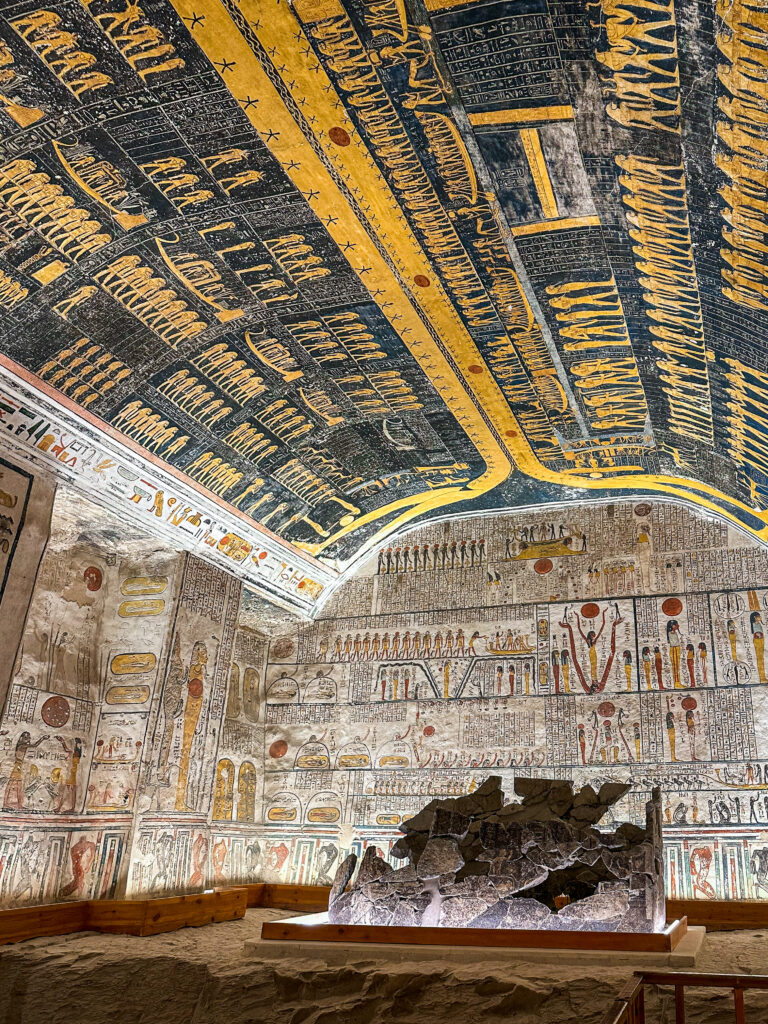 Burial Chamber
After visiting the Tombs of Ramses V and VI and Seti I, I decided to explore the tombs included with the general ticket. I managed to visit five of them before I got a bit tired of it. I must admit, after seeing the most stunning tombs, the others felt somewhat underwhelming. They were also very crowded, with people pushing in every direction, which, in my opinion, really diminished the experience.
I also opted not to visit the famous Tutankhamun’s Tomb due to its overwhelming popularity. During my research, I found it a bit disappointing – famous for its treasures, which are no longer there, except for the pharaoh’s mummy. The tomb itself is quite empty, with only a few wall paintings at the end, which, in my opinion, don’t compare to the incredible artwork in Seti I’s tomb. So, I chose to save the money for that one instead. However, if you don’t mind the extra cost and elbowing your way through the crowds, it’ll likely be worth the visit.
What’s the Best Time to Visit Valley of the Kings?
I arrived at the Valley of the Kings around 6:45 am, thinking I’d be one of the first there. Well, I was wrong. Apparently, the tours start a lot earlier than I expected. You live and you learn, I guess. While it wasn’t exactly empty, it was still a lot quieter than it was when I left around 9 am, when the place had turned into a mini tourist frenzy. So, if I were to go again, I’d either show up right at 6 am when it opens and just accept it’ll get busy soon, or more likely, I’d go in the afternoon. All the tours seem to hit the valley in the morning, so I’m betting the afternoon would be much less chaotic and a lot more peaceful.
Mortuary Temple of Hatshepsut
The Mortuary Temple of Hatshepsut is one of the most striking and well-preserved monuments in Luxor, standing out for its unique architecture and dramatic setting. Built for the only female pharaoh of ancient Egypt, it’s a breathtaking sight with its long, terraced structure, rising from the desert floor against the backdrop of steep cliffs. The temple is dedicated to Hatshepsut’s reign and her divine birth, and it’s adorned with intricate reliefs that tell the story of her life and achievements.
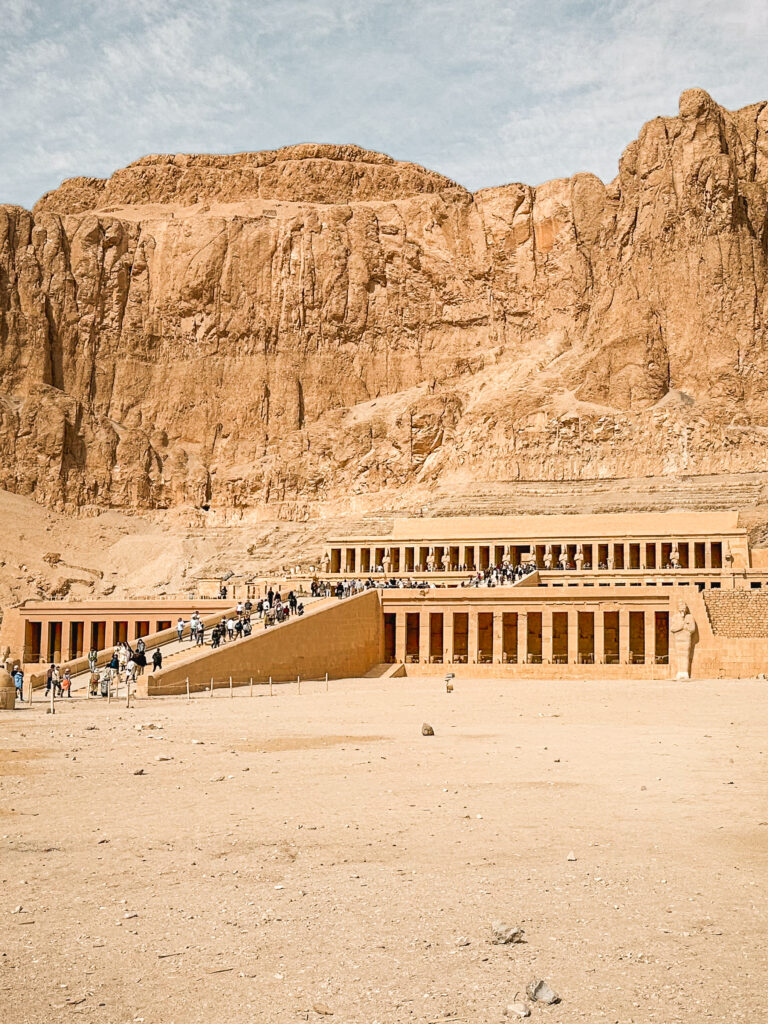 Mortuary Temple of Hatshepsut Setting
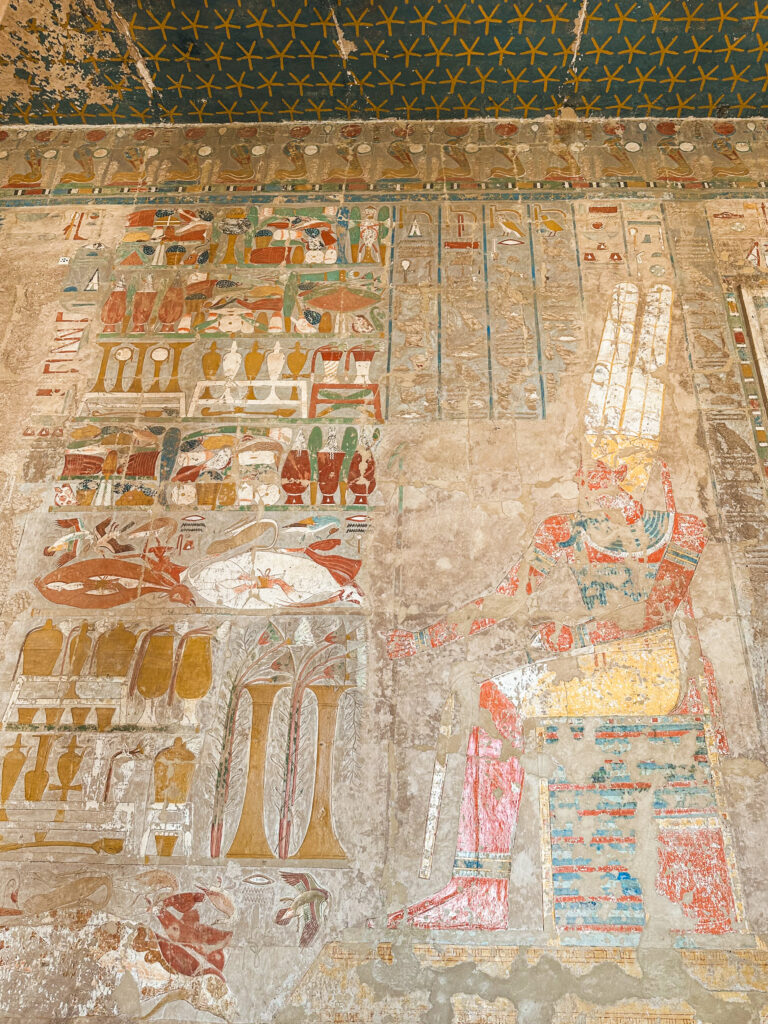 Some of the colourful details that remain
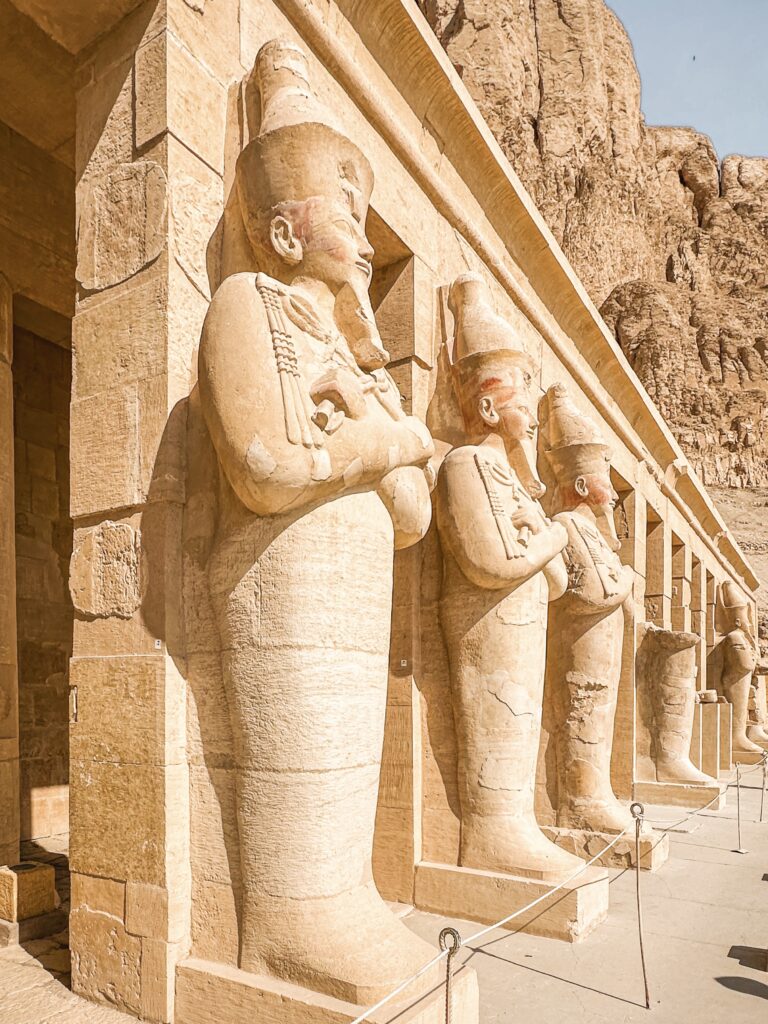 Details of the statues of Hatshepsut
Since I visited the Mortuary Temple of Hatshepsut after the Valley of the Kings, like most tours do, it was already quite crowded. To avoid the crowds and experience the best light, I’d recommend visiting at sunrise. This way, you’ll enjoy a more peaceful atmosphere and the temple in its most stunning light.
Medinet Habu (Temple of Ramses III)
Medinet Habu is one of the most impressive and well-preserved temples in Luxor, dedicated to the great Ramses III. Built during the 20th Dynasty, it served as a mortuary temple and was designed to honour the king’s reign, his military victories, and the gods. The temple’s most striking feature is its massive walls, adorned with intricate reliefs depicting the pharaoh’s battles.
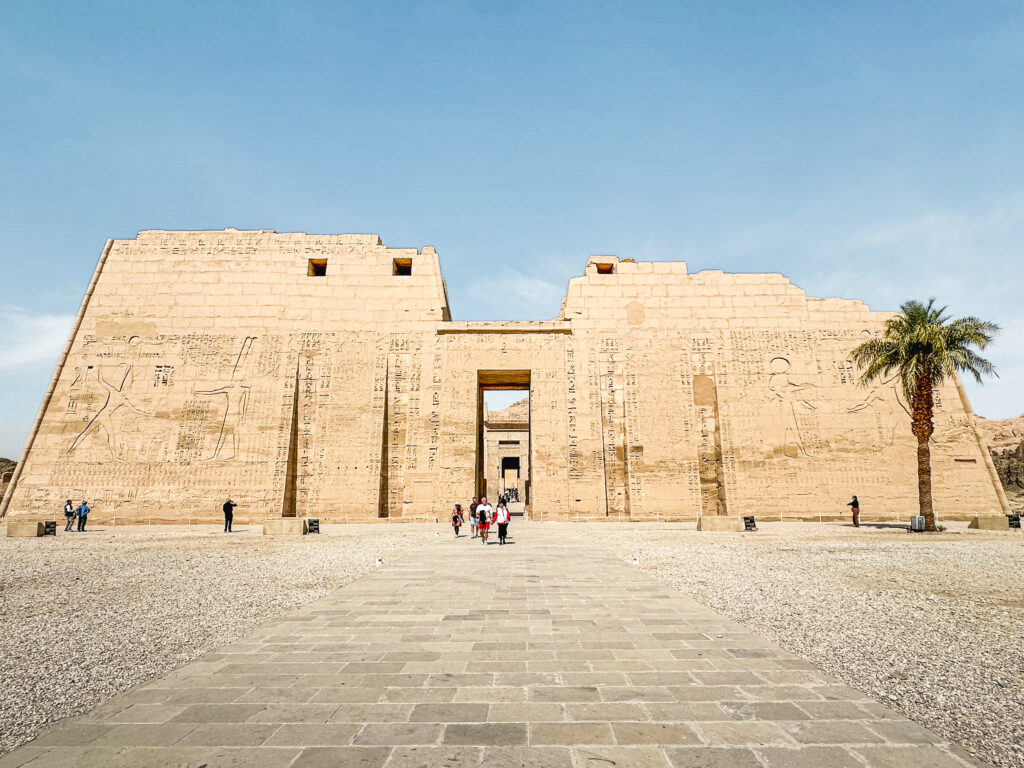 Medinet Habu Entrance
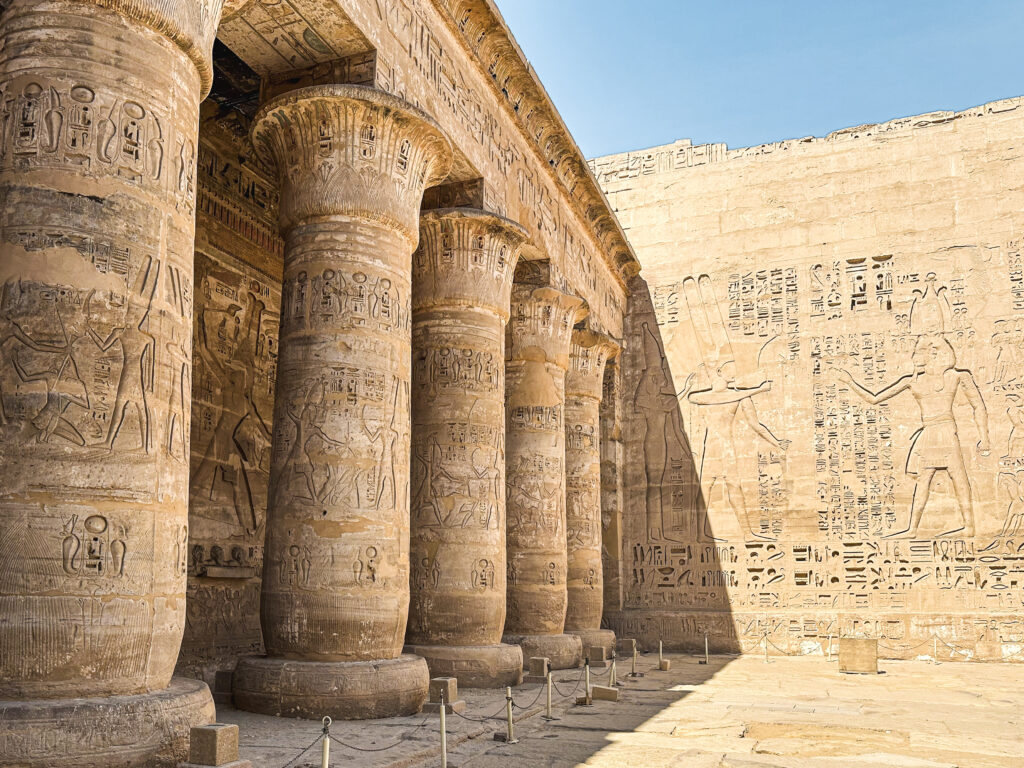 Medinet Habu Details
This temple is one of my personal favourite in Egypt, especially because of its sheer size and the fact that it’s much less crowded. This peaceful atmosphere allows you to explore its vast courtyards, pillared halls, and intricate and colourful decorations in a more peaceful setting.
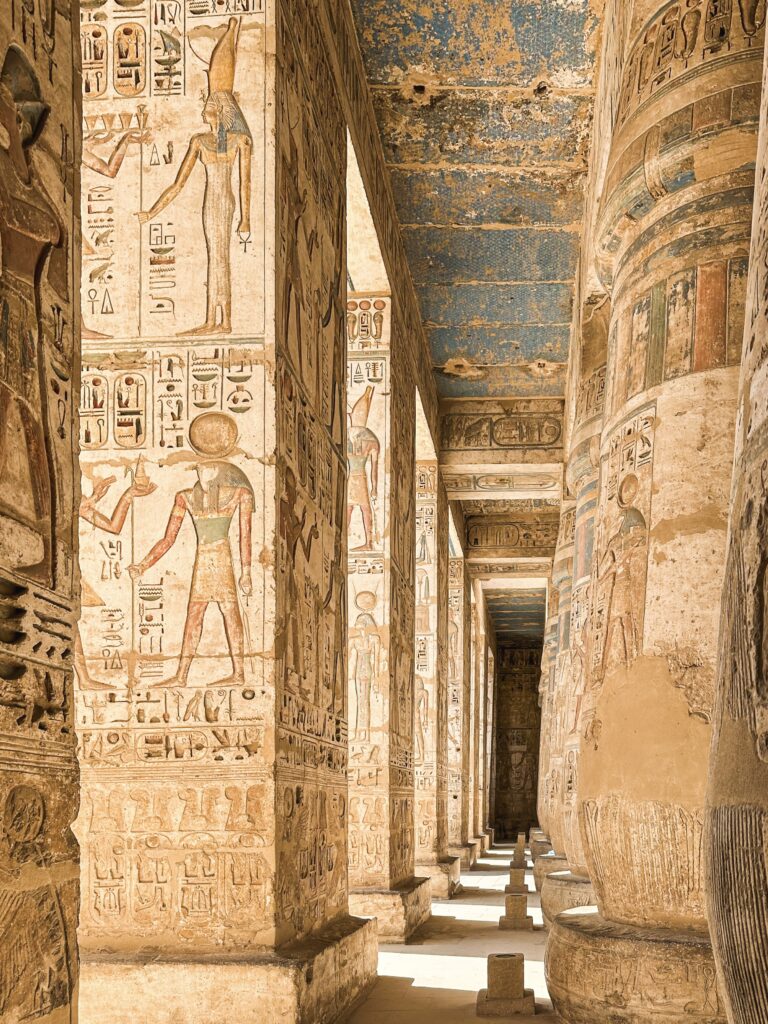 Colourful Details in the Columns
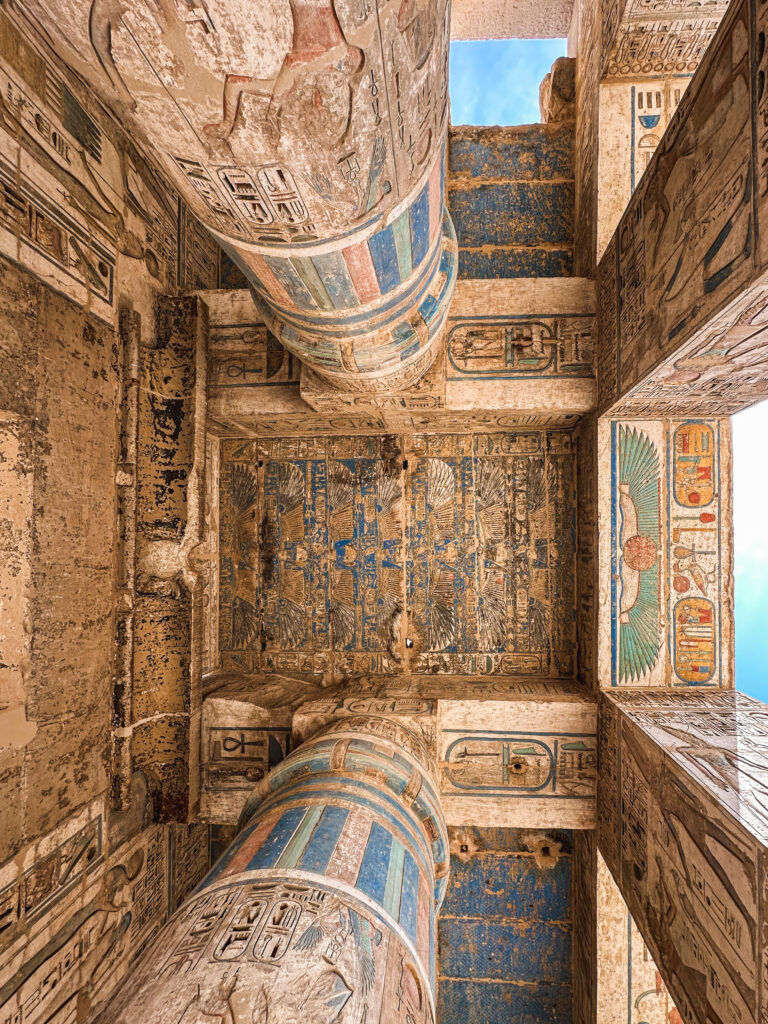 Colourful Details in the Ceilings
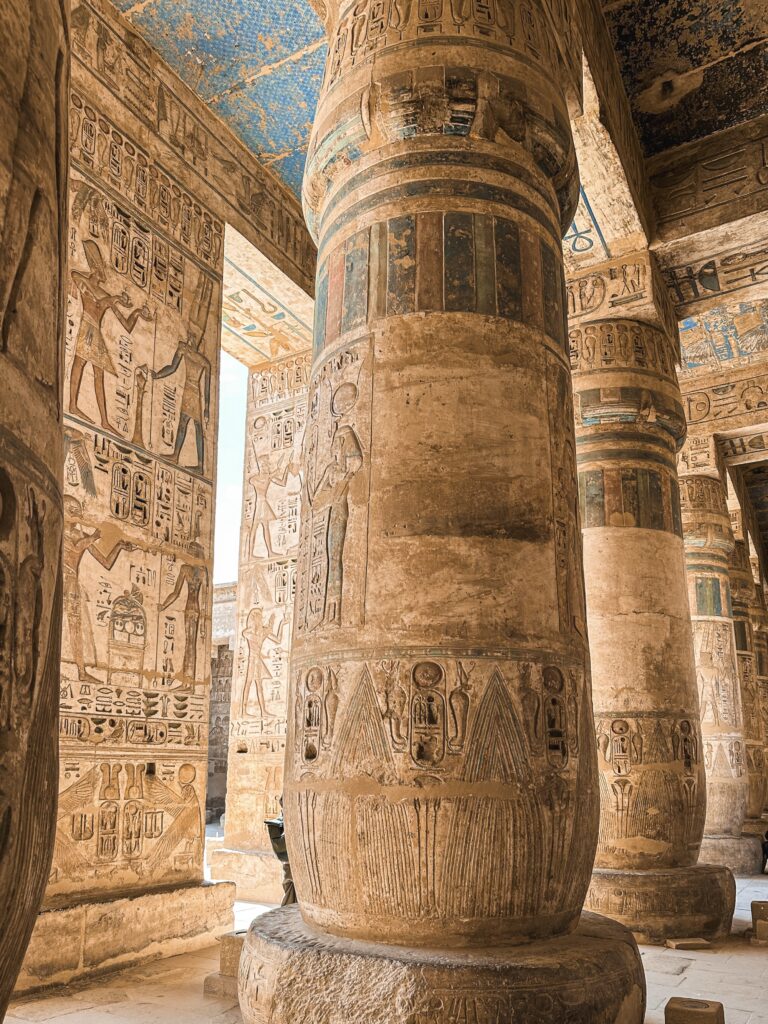 Colourful Details in the Columns
Other Places of Interest
Valley of the Queens – This necropolis served as the burial site for the wives and children of Pharaohs during the New Kingdom. The valley is home to around 80 tombs, with intricate wall paintings and well-preserved carvings that provide a glimpse into the lives of royal women from ancient Egypt. It offers a quieter, more peaceful experience, allowing visitors to appreciate the beauty and significance of these tombs in relative solitude. The tomb of Nefertari, wife of Ramses II, is the most famous and considered one of the finest examples of Egyptian tomb art. However, this tomb was closed during my visit (Feb 2025) and that’s I ended up skipping the Valley of the Queens.
Ramseum – The mortuary temple of Ramses II, also known as Ramses the Great. Although now partially ruined, it remains one of the most significant temples on the West Bank. The temple was once grand, with towering pylons and walls adorned with vivid reliefs and scenes of Ramses’ military triumphs. One of the most famous features of the site was the colossal statue of Ramses II, which once stood 20 metres tall but now lies shattered.
Tomb of the Nobles – A group of tombs belonging to high-ranking officials, scribes, and priests from the New Kingdom period. Located on a hill just outside the Valley of the Kings, these tombs are less visited but contain some of the most remarkable artwork in Egypt. The tombs feature colourful and well-preserved wall paintings that depict scenes of daily life, including agricultural activities, religious ceremonies, and royal visits.
Deir el-Medina – The village of the artisans who worked on the tombs in the Valley of the Kings. This small, well-preserved settlement offers a fascinating look into the lives of the craftsmen who created the royal tombs. Their tombs are decorated with intricate scenes, often showing their daily life, religious practices, and family dynamics. The village itself also has remains of homes, streets, and workshops, giving visitors a sense of how the workers lived and worked.

Colossi of Memnon – Two giant statues of the pharaoh Amenhotep III, standing proudly at the entrance of his now-destroyed mortuary temple. Each statue originally stood about 18 metres tall and depicted Amenhotep in a seated position. Though the statues have weathered significantly over the centuries, they still dominate the landscape.
Howard Carter’s House – The former home of the British archaeologist Howard Carter, who discovered the tomb of Tutankhamun in 1922. The house has been preserved with many of Carter’s original belongings, including photographs, maps, and tools used in his excavation.
Entrance Tickets Prices in 2025
You can buy the tickets online here.
Other Popular Things to Do in Luxor
Apart from all the archaeological sites, there are plenty of other activities to enjoy while in Luxor. The most popular experiences include the breathtaking sunrise hot air balloon ride, which offers stunning panoramic views of the Valley of the Kings and the surrounding desert landscape. Another highlight is sailing the Nile on a traditional felucca at sunset, where you can relax and take in the serene beauty of the river. Additionally, visitors can explore the bustling local markets, take a stroll along the Nile, or enjoy a traditional Egyptian meal.
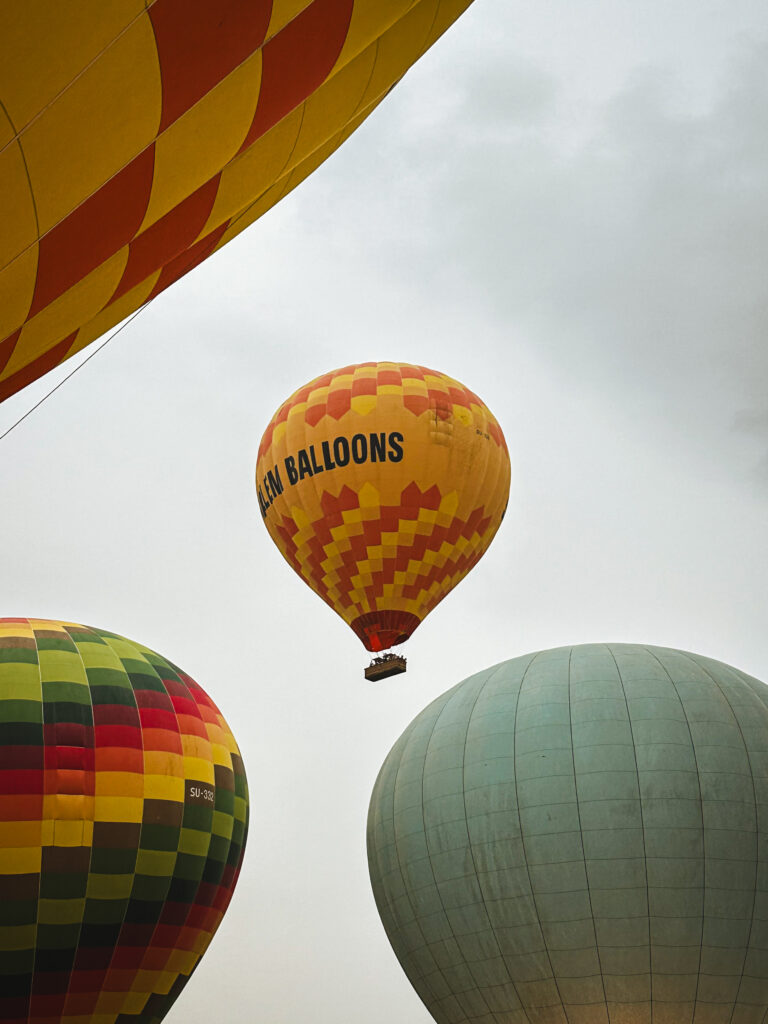 Hot Air Balloons
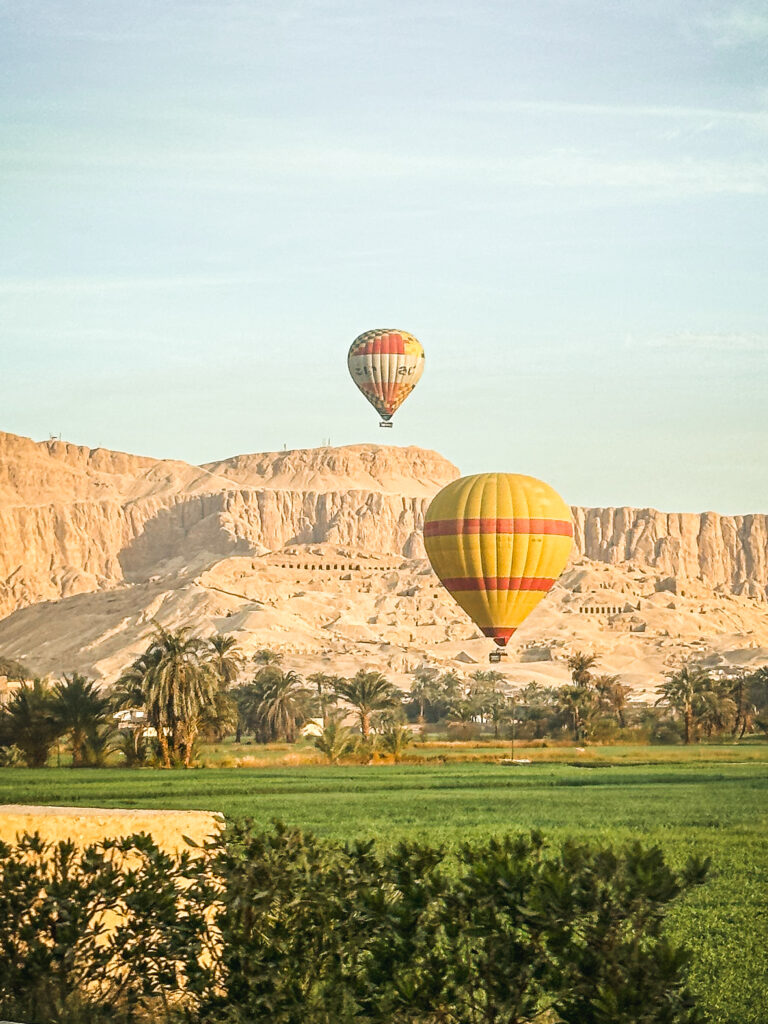 Hot Air Balloons at Sunrise
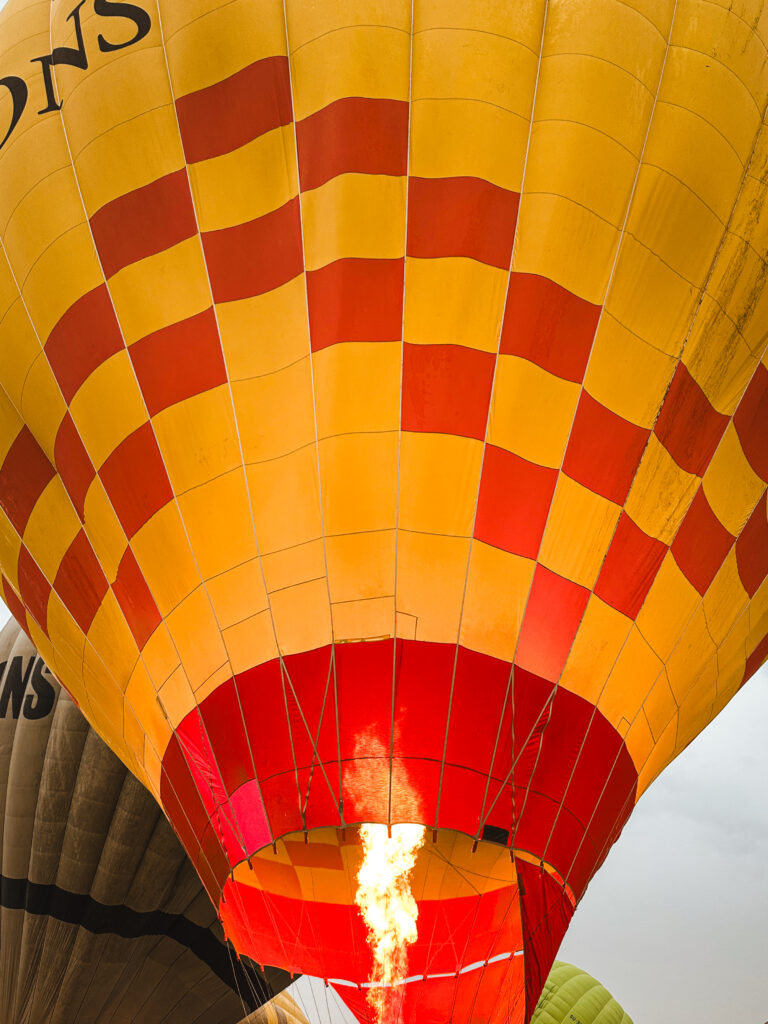 Hot Air Balloon
Frequently Asked Questions About Visiting Luxor Independently
How many days do you need in Luxor?
Allow at least 3 full days to cover the main sites without rushing. Day one works well for the East Bank: Karnak Temple in the morning and Luxor Temple at sunset. Days two and three can be dedicated to the West Bank, which has more ground to cover: the Valley of the Kings, the Mortuary Temple of Hatshepsut, and Medinet Habu at minimum, with other sites depending on your interests. If you want to add the Valley of the Queens, the Tomb of the Nobles, or Deir el-Medina, factor in an extra day.
How do I get from Cairo to Luxor on a budget?
The cheapest option is the night bus. I took GoBus for around €10 and it’s perfectly comfortable for the journey. The sleeper train is also popular and more comfortable but significantly more expensive. Flying is the fastest option but defeats the budget purpose. The night bus makes the most sense for independent budget travellers – you save on a night’s accommodation and arrive in the morning ready to explore.
Can you visit the Valley of the Kings without a tour?
Yes, completely. Most people book tours simply because they don’t know how easy it is to get there independently. Take the public ferry from the East Bank (20 EGP, around €0.40), then use the inDrive app to get a taxi to each site as you go. It’s cheaper than hiring a driver for the day and gives you full control over your itinerary. See the West Bank section above for exact transport costs.
How much does it cost to visit Luxor?
Entry fees add up quickly. The main sites alone can cost €40-60 per person if you visit everything including special tombs like Seti I. Budget roughly €10 for transport across a full day on the West Bank using inDrive, and factor in accommodation and food on top. Overall, a comfortable budget for 3 days in Luxor (excluding getting there) is around €100-150 depending on which tombs you visit and where you stay. Make sure you’re withdrawing with a card that doesn’t charge high foreign transaction fees.
Is Luxor safe for solo female travellers?
The ancient sites themselves are safe. The bigger challenge in Luxor is the relentless harassment and scamming in and around town: vendors, touts, and even some site workers will target tourists aggressively. It’s exhausting but not dangerous. Walking confidently, ignoring approaches without engaging, and using inDrive rather than street taxis significantly reduces the friction. Read the honest reflection section at the bottom of this post for a fuller picture.
Don’t skip travel insurance!
I use SafetyWing for most trips – solid coverage for adventure travel.
What is the best time to visit Luxor?
October to April is the most comfortable window temperature-wise. Summer (June to August) is brutally hot (40°C+), which makes walking between sites genuinely unpleasant. For the Valley of the Kings specifically, go as early as possible (6am when it opens) to get ahead of the tour groups, which flood in from around 8am onwards. For Luxor Temple, late afternoon into evening is ideal for the light and the atmosphere.
Do you need to book tickets in advance?
You can buy on the day, but booking online at egymonuments.com is worth it for two reasons: you skip the queues, and digital tickets can’t be hole-punched by guards, which gives you more flexibility at the Valley of the Kings. Special tomb tickets (Seti I, Ramses V and VI) should be secured early as availability is limited.
Reflection: Why I’d never go back to Luxor
Luxor is home to some of the most jaw-dropping ancient sites I’ve ever explored. The temples and tombs truly live up to the hype and standing before them feels like stepping into another world. But as breathtaking as they are, I can honestly say I’ll never go back. Luxor is the kind of place that’s incredible to see once, but the overall experience of being there? Terrible.
Walking anywhere – by the Nile, through town, even near your hotel – without being hassled is nearly impossible. Within seconds, someone is trying to sell you something, scam you, or drag you into some bizarre interaction. Scams are everywhere, sometimes so absurd you can’t even figure out what the end goal is. One of the most common ones happened to me multiple times, and I heard similar stories from other travellers. A man would approach and say:
“Hey! How are you? Good to see you again! I’m the chef at your hotel.”
It was obviously nonsense – I’m a backpacker, not staying anywhere with a chef. I’d brush them off and walk away, but it always left me wondering: What was the actual scam here? And that’s just one example. There were weirder encounters, more aggressive tactics, and, of course, the constant harassment.
If you think visiting the ancient sites gives you a break from all this, think again. The hassle only intensifies. Pushy vendors, relentless scammers, and even the very people who work there (guards, ticket sellers) join in on trying to scam you too. The monuments are incredible, but the experience of being there is exhausting.
As someone who dreamed of seeing these places since childhood, it was deeply disappointing. Egypt’s history deserves better, and so do its visitors. I truly hope that one day, both locals and the government realise that this culture of relentless scamming and harassment only hurts their tourism industry in the long run.
More Egypt Travel Guides
If you’re continuing your independent adventure through Egypt, these guides cover everything you need to travel the country on a budget without joining a tour:
you got a very superb website, Glad I detected it through yahoo.