
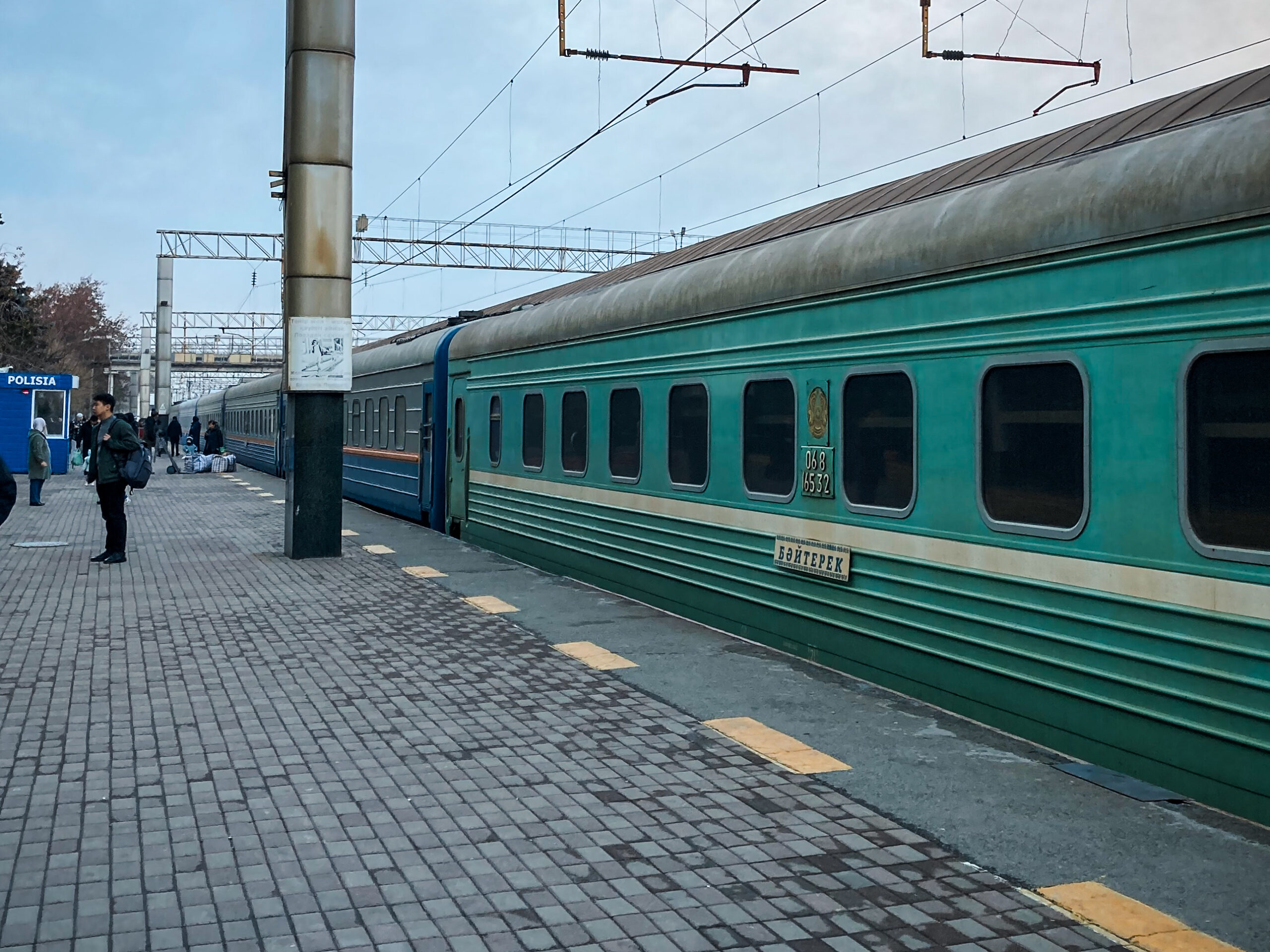
Travelling Kazakhstan by train is, depending on your perspective, either the most efficient way to get around the world’s ninth-largest country or a test of patience you didn’t know you needed. Probably both. I spent several weeks crossing Kazakhstan entirely by rail in November, riding overnight and multi-day trains between Tashkent, Almaty, Astana, Atyrau, and Aktau, covering somewhere in the region of 7,000 kilometres on Soviet-era tracks. By the end of it I understood, in a very literal way, just how enormous this country is.
This guide covers everything you need to know before you board: how the trains work, the different classes, how to book tickets, what to bring, and what to expect from the journey itself. If you’re planning to travel Central Asia overland, the Kazakh rail network is one of the region’s great underrated experiences.
Why Travel Kazakhstan by Train
Flying between Kazakh cities is perfectly possible and sometimes makes sense, but it means missing the country entirely. Kazakhstan isn’t a destination where the highlights are concentrated in one corner. It stretches from the Tian Shan mountains in the southeast to the Caspian shore in the west, and most of that distance is steppe: flat, treeless, enormous, and surprisingly hypnotic once you stop expecting something to happen. The train is the only way to actually feel that scale.
It’s also cheap. A 24-hour journey from Almaty to Astana in platzkart class costs roughly €10-15. The 55-hour ride to Aktau runs to around €25-35. For the distances involved, nothing else comes close on price.
And then there’s the social dimension. A platzkart carriage in Kazakhstan is a shared living space for however long your journey takes. People bring food, share it, ask you where you’re from and seem genuinely pleased that a foreigner has ended up in their compartment rather than alarmed by it. Some of my clearest memories of Kazakhstan aren’t of any particular place but of a middle-of-the-night station stop, the smell of instant noodles, and someone’s grandmother pressing homemade bread into my hands.
The Kazakh Train Network: An Overview
Kazakhstan Railways (KTZ, or Қазақстан Темір Жолы) operates an extensive network connecting all major cities. The main routes relevant to independent travellers are:
Almaty to Astana: roughly 18-24 hours depending on the train. Several departures daily, including the faster Talgo service.
Almaty to Shymkent: around 12-13 hours. Useful if you’re coming from or continuing to Uzbekistan.
Almaty to Atyrau: this is the big one. Around 55 hours westbound, crossing the full width of the country through the steppe. There’s a connection via Astana or a more direct western routing depending on the specific train.
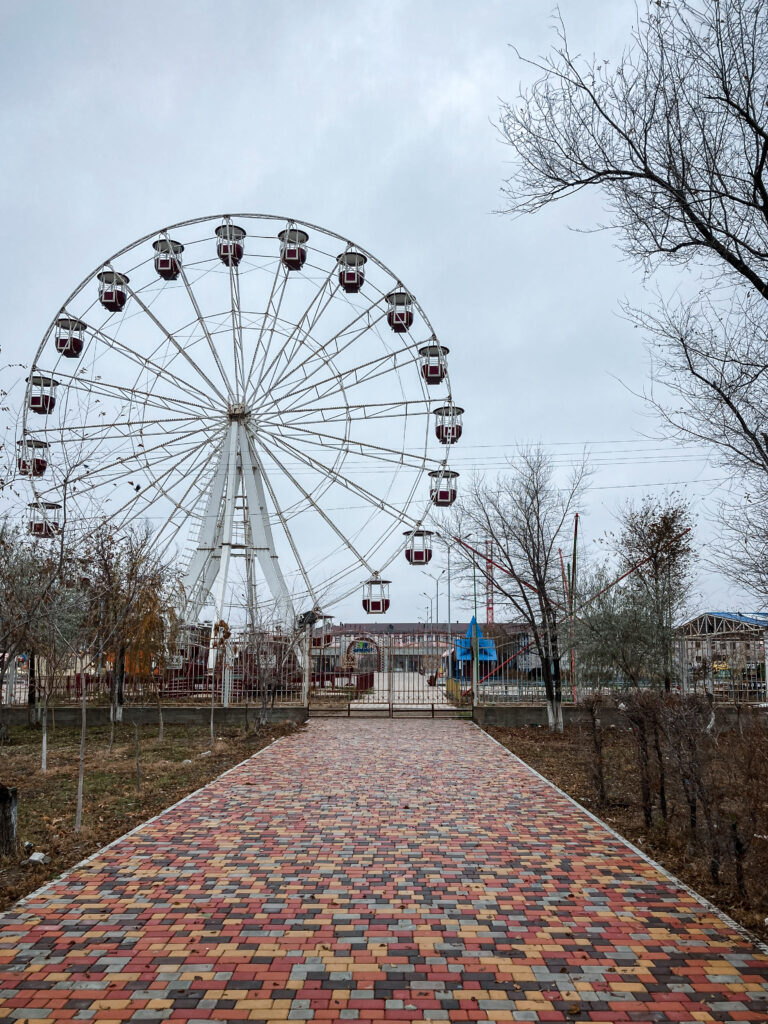 Soviet-style amusement park in Atyrau
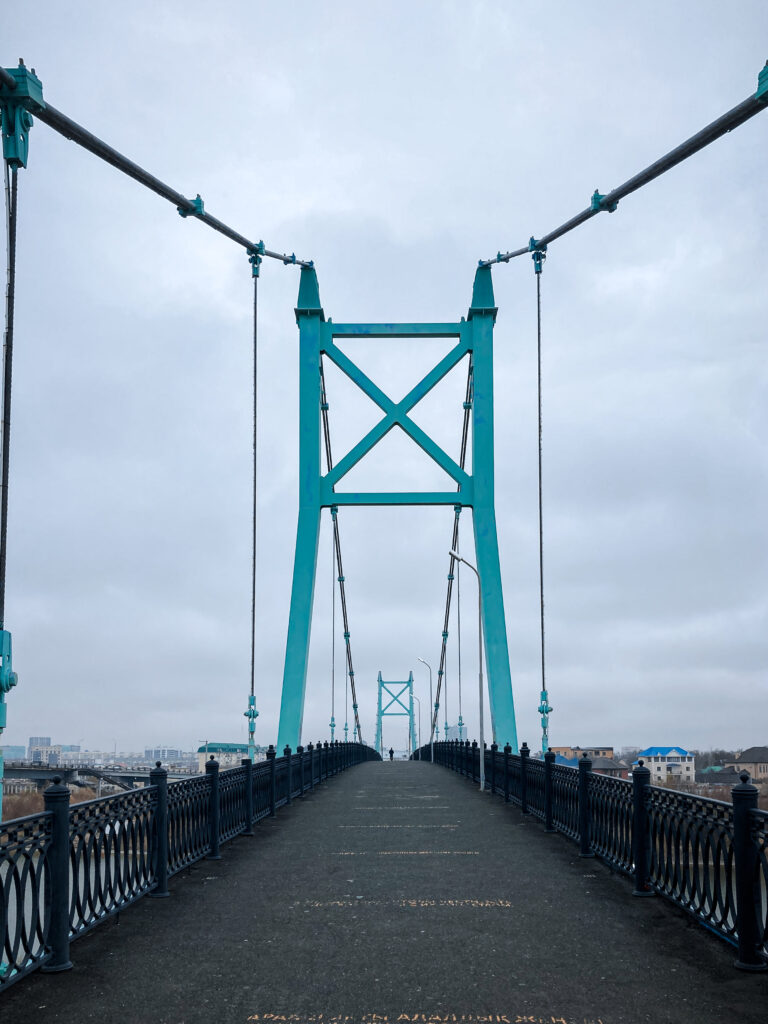 Bridge crossing the Ural River Atyrau
Atyrau to Aktau: 17 hours along the northern Caspian. The final leg if you’re heading for the Azerbaijani ferry crossing.
Almaty to Tashkent: around 18 hours, crossing into Uzbekistan. A comfortable way to transition between the two countries.
There are also trains connecting Kazakhstan with Russia (useful for the Trans-Siberian corridor), and local elektrichka services for shorter regional hops, though these are slower and of limited use to most travellers.
The two main train types in Kazakhstan
Soviet-era trains (the ones worth taking)
The majority of long-distance routes run on older rolling stock that hasn’t changed much since the Soviet period. This is where the real train experience is. They’re slower and less polished than the Talgo, but considerably more interesting. The carriages are divided into two main classes:
Platzkart is the open-plan sleeping carriage, the one you want. Rows of bunks line both walls, with additional fold-down bunks across the corridor. There’s no door separating you from the rest of the carriage, which means you’re sharing the space with whoever else is on board: families, soldiers, traders, people travelling for work or for funerals or for weddings. It’s communal in the best possible way. Lower bunks are preferred (more space, easier to use the fold-down table) and also slightly more expensive when booking. Upper bunks are fine for sleeping but can get warm and leave you with little headroom.
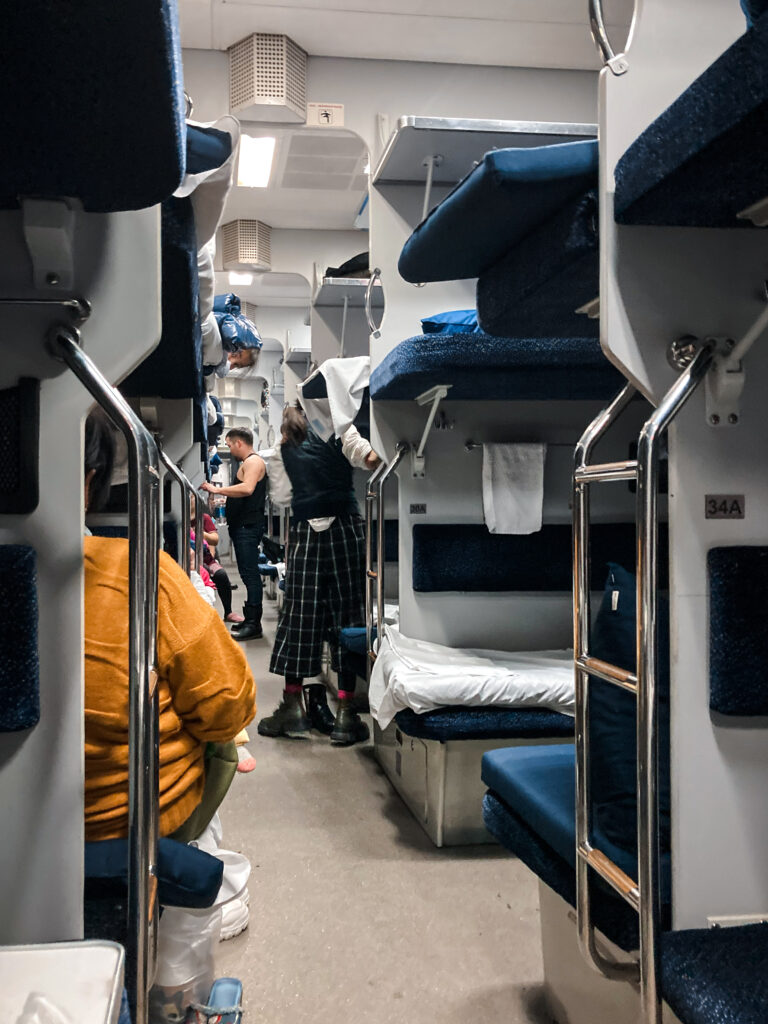 Platzkart in a soviet-era train across Kazakhstan
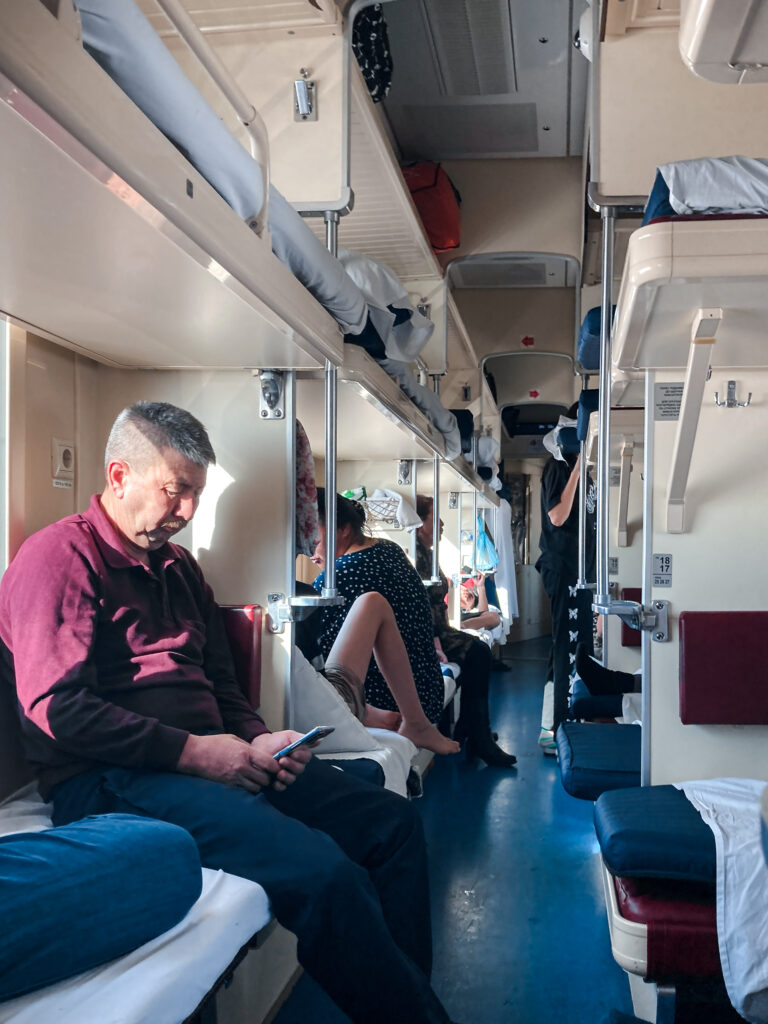 Platzkart in a soviet-era train across Kazakhstan
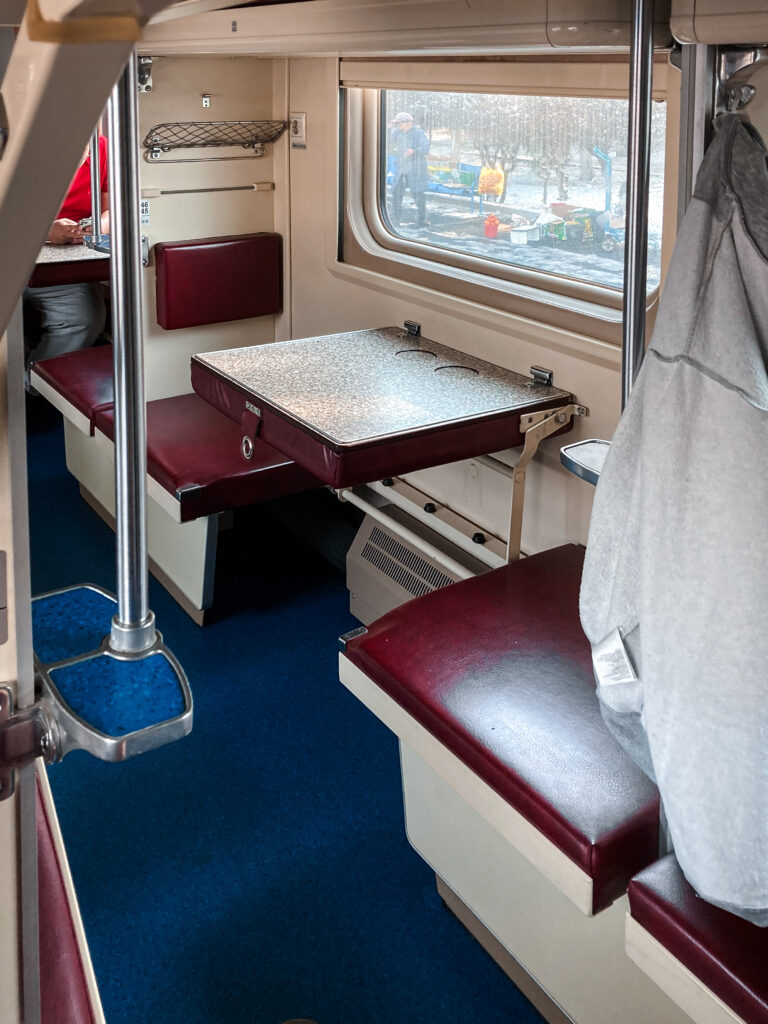 Platzkart in a soviet-era train across Kazakhstan
Kupé is the four-bunk closed compartment. More privacy, slightly higher cost, but you lose the social atmosphere that makes platzkart worth it. If you’re travelling as a couple or simply need better sleep, it’s a reasonable choice. As a solo female traveller I personally preferred platzkart: the openness of the carriage meant I was never alone in an enclosed space with strangers.
Talgo trains
The modern Talgo trains run primarily on the Almaty-Astana-Shymkent corridor. They’re fast, air-conditioned, have power outlets, and feel closer to a European intercity service than anything Soviet. They’re also more expensive and less atmospheric. Worth knowing they exist if you’re short on time, but for the full Kazakhstan experience, the older trains win.
How to Book Tickets for Kazakh Trains
The official KTZ booking site is tickets.kz, which works in English and accepts international cards. This is the most reliable option for booking in advance. You’ll need your passport number when creating an account.
A few practical points:
Tickets go on sale 45 days before departure. In summer, popular routes, especially on weekends and around Kazakh public holidays, sell out early. In November when I travelled, availability wasn’t an issue on most routes, though I’d still recommend booking at least a few days ahead.
The site shows you a carriage map where you can see which specific berths are available. Choose carefully: avoid the very ends of the carriage (more foot traffic, door noise, proximity to the toilet) and if possible pick a lower bunk. Odd-numbered lower bunks face the direction of travel; even numbers face backwards. On a 55-hour journey, this matters more than you’d think.
You’ll receive an e-ticket to download. Conductors (provodniks) check your passport at the carriage door before you board, even on domestic routes, so keep it accessible. Once you’re settled, they’ll generally leave you alone.
What to bring on a long-distance Kazakh train
The longer the journey, the more important your packing is. Here’s what actually matters:
Food and water: There’s a dining car on most long-distance trains, and vendors board at stations along the way selling beer, snacks, dried fish, and whatever else they’re carrying that day. That said, the quality varies enormously and prices are higher than in town. Bring enough food for at least the first day: bread, cheese, fruit, nuts, something for the morning. A stack of instant noodles is the platzkart standard and you can take as much boiling water as you want from the samovar at the end of the carriage.
A towel and basic toiletries: The toilets are functional but basic. There’s usually one at each end of the carriage. They lock during station stops (a Soviet-era holdover) so plan accordingly.
Layers: November in Kazakhstan means serious cold outside the train. Inside, the heating is often cranked to a level that makes you want to strip down to a t-shirt by evening and then pile everything back on when you step onto a station platform at 2am. Dress in layers you can add and remove easily.
Entertainment and a power bank: Phone signal disappears for long stretches across the steppe. Download whatever you need offline in advance. There are power outlets in the carriage but they’re limited and often occupied. A power bank is essential.
Need data before you land? Try Saily eSIM
Use code RITAHE1486 for $5 off your first plan.
Something to share: Bringing a bit of food to share with compartment neighbours is one of those travel gestures that pays back immediately. Chocolate, fruit, whatever you have. Nobody expects it and everyone appreciates it.
A sleeping bag liner or travel sheet: The trains provide bedding (sheets, a pillow, a thin blanket) and they’re usually clean enough. A liner is a comfort item rather than a necessity, but on a 55-hour journey comfort matters.
What the journey is actually like
My longest single train ride in Kazakhstan was Almaty to Atyrau: 55 hours westbound, departing in the evening and arriving two and a half days later into the flat, grey light of western Kazakhstan. The steppe goes on for most of it. At night there’s nothing outside the window but darkness, the occasional cluster of lights at a station, and your own reflection. During the day it’s the same landscape for hours: dry grass, camels, a distant chimney, a horse standing alone in a field.
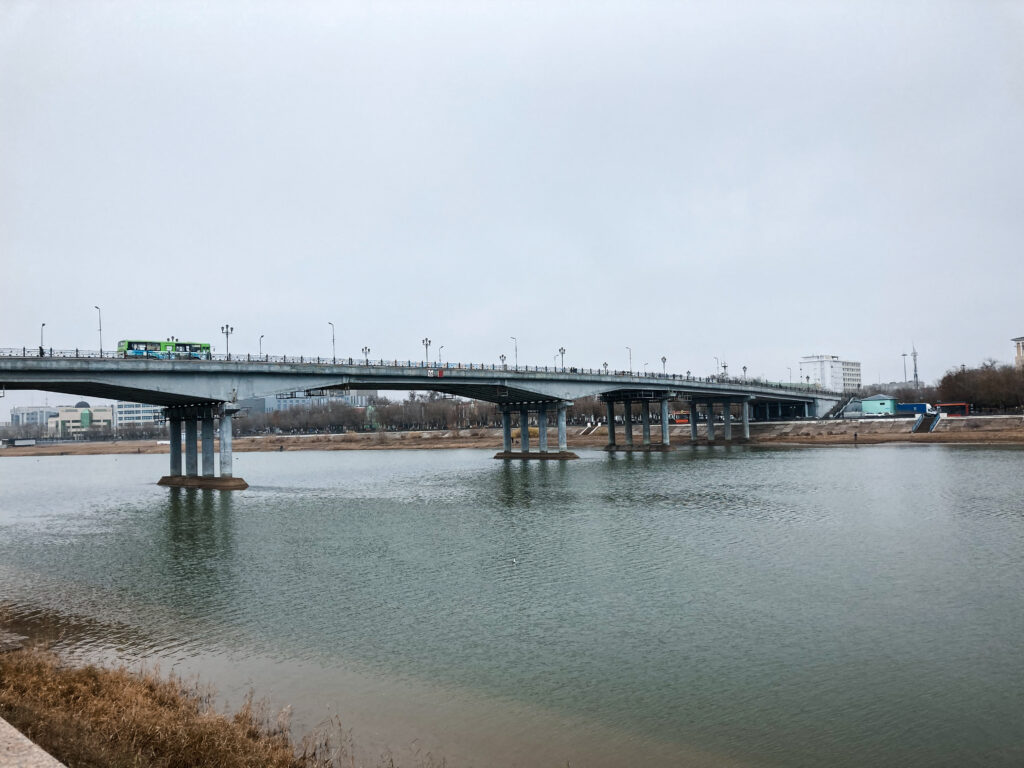 Ural River between Europe and Asia in Atyrau
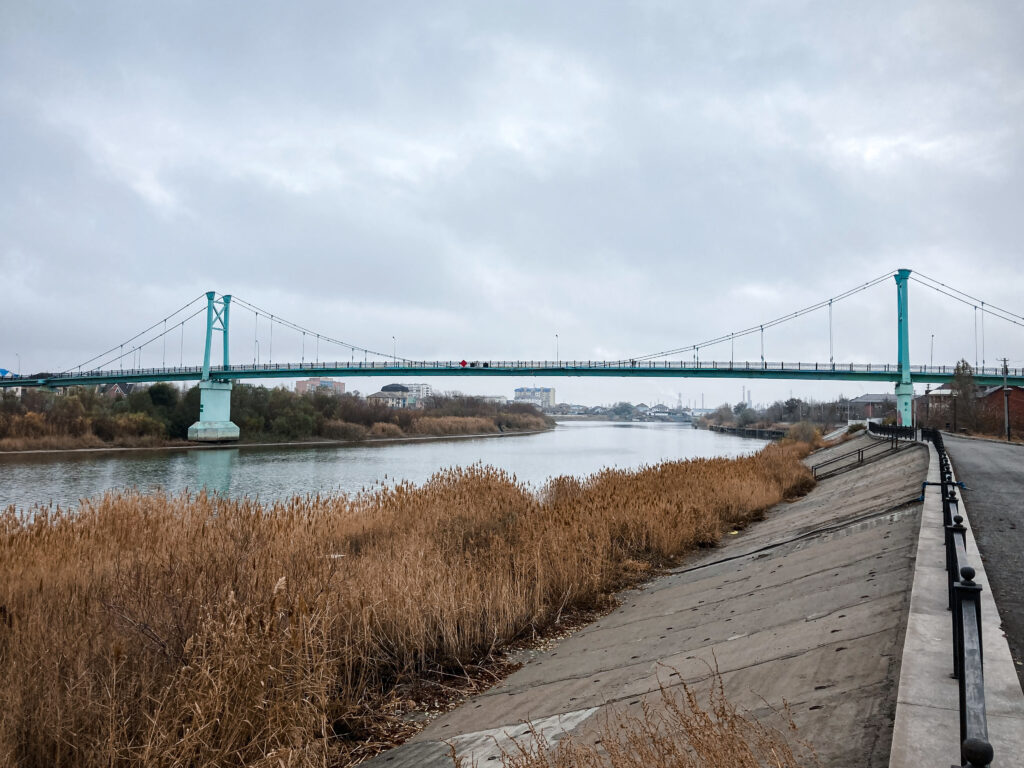 Ural River between Europe and Asia in Atyrau
This is either meditative or maddening and often both. The trick is to stop expecting the scenery to change and start paying attention to what’s happening inside the carriage instead. On that particular journey I spent most of the time trying to type on my computer, which the bumpy journey didn’t make it easy, watching the other travellers, and occasionally being force-fed by a local family. By the end of it I felt I understood something about daily life in Kazakhstan that no city or tourist site could have given me.
The 24-hour Almaty to Astana train is more manageable and a good introduction to the system if you’re doing shorter hops. Astana in November is extraordinarily cold and a wind that made the futuristic skyline feel particularly surreal, but the train itself was so warm that it felt like a sauna.
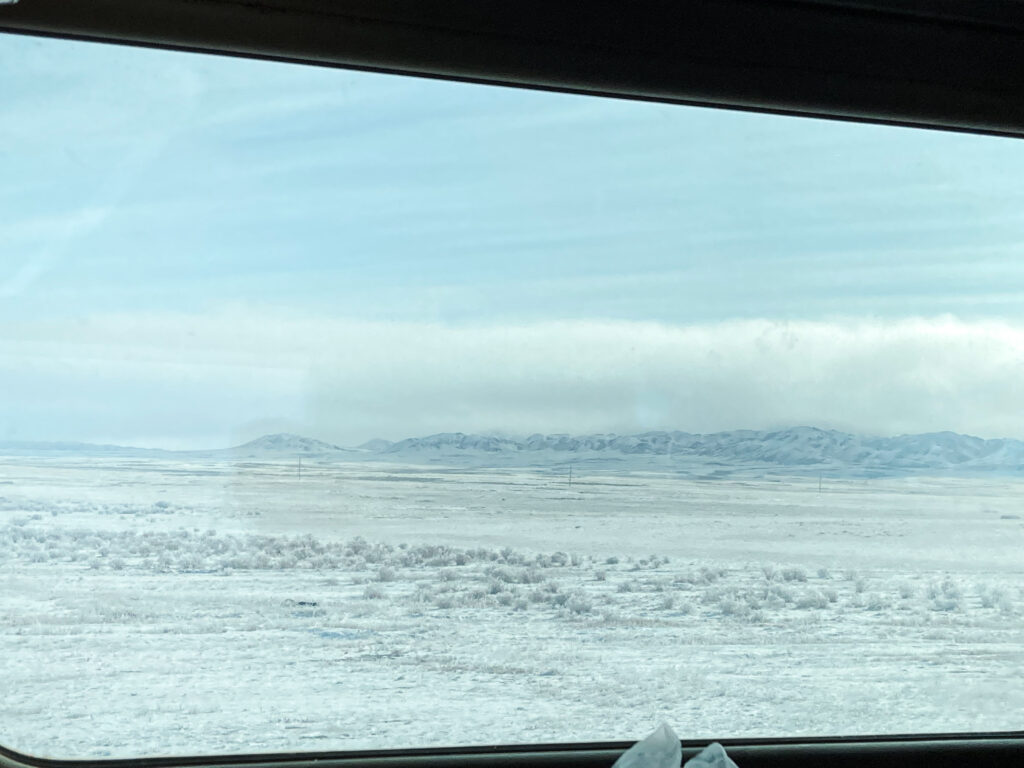
The 17-hour Atyrau to Aktau leg is different again: you follow the north Caspian coast and the landscape shifts from steppe to something more desert-like, pale and flat and strange. By the time Aktau appears it feels like arriving at the edge of the world.
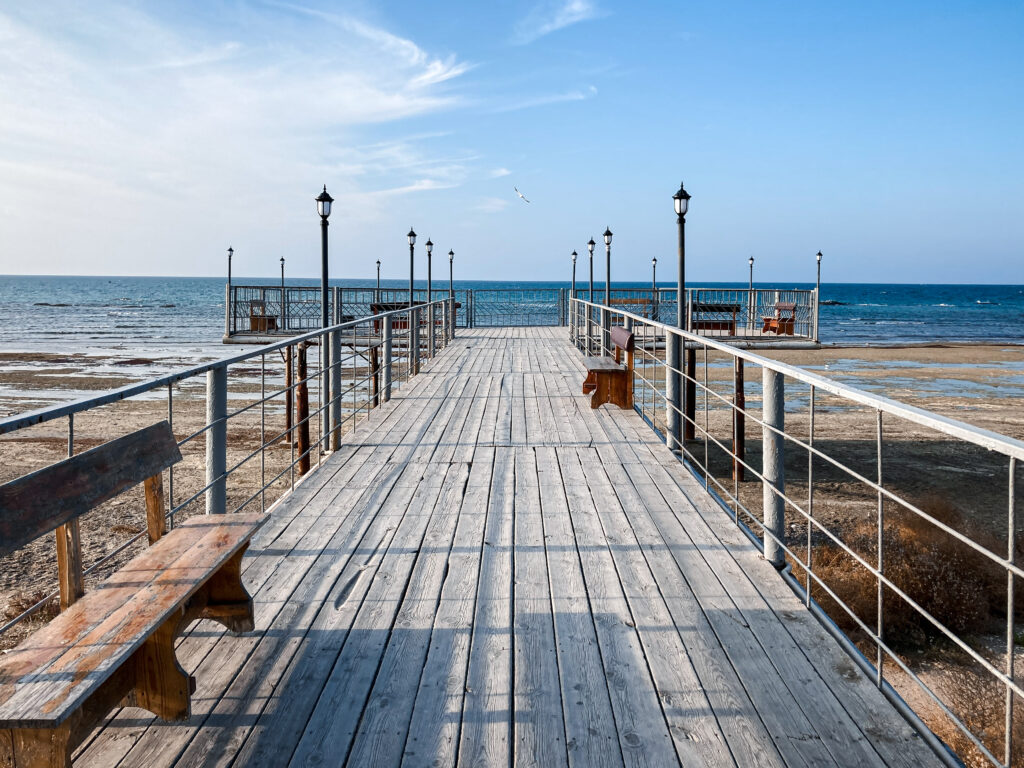 Caspian Sea in Aktau
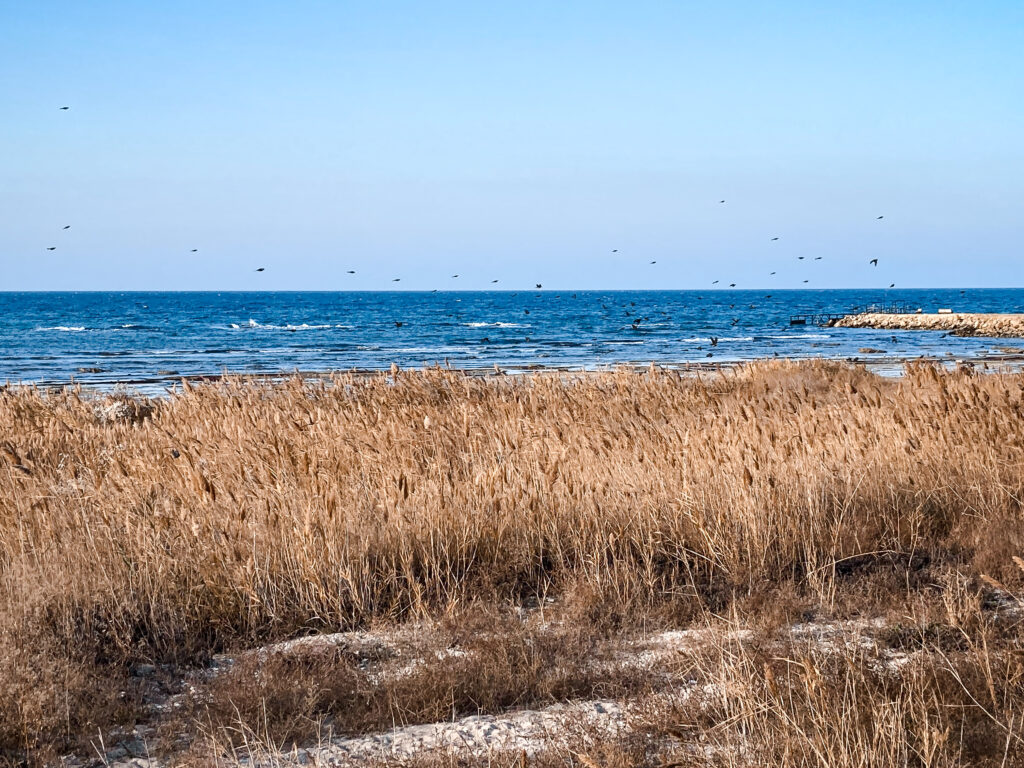 Caspian Sea in Aktau
Crossing into Kazakhstan by train
The overland crossing from Bishkek to Almaty is straightforward and underused by foreign travellers. There are buses and shared taxis that cover the route in around four hours, with a relatively quick border crossing at Korday. It’s not technically a train crossing but it’s the natural continuation of the Kyrgyz rail-free travel experience.
The Almaty to Tashkent overnight train crosses the Uzbek border at Chernyaevka. Border officials board the train, collect passports, and return them once checks are complete: a slightly nerve-wracking wait but generally smooth. Both Uzbekistan and Kazakhstan are visa-free for most Western passport holders, which makes this one of the easier international rail crossings in the region.
Practical Details for Travelling Kazakhstan by Train
Booking: tickets.kz (English, accepts international cards). Create an account with your passport number before you need it.
Classes: Platzkart (open bunk, cheapest, most social) and kupé (four-bunk compartment, more privacy) are the main options on long-distance Soviet-era trains. Talgo trains have assigned seating.
Cost: Platzkart from Almaty to Astana around €10-15. Almaty to Aktau around €25-35. These vary with availability and how far in advance you book.
Avoid ATM fees with Wise
The card I use for all my travel withdrawals – real exchange rate, low fees.
Use Revolut to avoid ATM fees
Good alternative to Wise – I carry both as a backup.
Luggage: There’s storage under the lower bunks. Large bags fit but you’ll want to keep valuables with you.
Safety: Kazakhstan is a safe country to travel by train. Keep your passport on you (you’ll need it at the carriage door) and be sensible with valuables in the open platzkart carriage, as you would anywhere.
Don’t skip travel insurance!
I use SafetyWing for most trips – solid coverage for adventure travel.
Language: Russian is the working language of the train system. Station announcements, carriage signs, and conversations with provodniks will be in Russian or Kazakh. Having Cyrillic script recognition helps for reading platform signs. Google Translate works fine for basic communication.
Time zones: Kazakhstan spans two time zones (UTC+5 and UTC+6). Train timetables are listed in local time for both departure and arrival, but confirm this when booking as it can catch people out.
Is train travel in Kazakhstan worth it?
For the right kind of traveller, unequivocally. If you need to get somewhere efficiently, fly. If you want to understand the country you’re passing through, get on the train and stay there.
Kazakhstan is a place that rewards slow travel specifically because so much of it looks, at first glance, like nothing at all. The steppe is an acquired taste and the train is the only way to acquire it properly. By the time you’ve crossed it once, at ground level, over two days, you’ll understand why Kazakhs have a complicated relationship with distance and why a country this size thinks about space and movement differently from anywhere else.
Riding the trains in Kazakhstan won’t give you the most photogenic memories of Central Asia. But they’ll probably be among the most lasting.
More from Central Asia
Looking for the big picture? Check out my ultimate Central Asia Itinerary: 3 Weeks Across the Silk Road to see how to connect all these destinations, navigate remote borders using local transport, and budget for the ultimate mountain adventure.
Uzbekistan
How to Backpack Uzbekistan: Budget Travel Itinerary: the full overland route through the Silk Road cities, which connects directly with the Almaty-Tashkent train.
Visiting Tashkent: A Complete Budget Travel Guide: the first stop after the overnight train from Almaty.
Samarkand: A Complete Budget Travel Guide
How to Visit Bukhara: A Complete Budget Travel Guide
How to Visit Khiva: A Complete Budget Travel Guide
Kyrgyzstan
Kyrgyzstan Travel Guide: Independent Itineraries and Tips: the natural starting point before crossing into Kazakhstan overland via Bishkek.