
Islamabad travel guide posts tend to oversell the city or skip it entirely. The honest version sits somewhere between the two. Islamabad is not Pakistan’s most exciting destination. It is a planned capital built in the 1960s with wide, tree-lined streets, well-organised sectors, and none of the layered historical chaos of Lahore or Peshawar. What it is, and what matters far more for most travellers passing through, is the best-organised, most navigable, and most comfortable city in Pakistan. It is where you sort your logistics, withdraw your cash, recover from a long flight, and prepare for the north. Done well, two days here sets up everything that follows.
What Kind of City Islamabad Actually Is
Understanding Islamabad requires letting go of what most Pakistani cities are. There is no old city. There are no ancient mosques embedded in medieval lanes. The city was planned from scratch by Greek architect Constantinos Doxiadis in the late 1950s and built through the 1960s. A grid of lettered and numbered sectors on a gentle slope at the foot of the Margalla Hills, with Rawalpindi expanding messily to the south.
The result is a city that feels unlike anywhere else in Pakistan: clean, quiet by local standards, green in a way that surprises people arriving from the dust of the KKH, and organised enough that navigating it as a foreigner is genuinely straightforward. Wide roads, clear sector grids, and a concentration of embassies, government buildings, and middle-class residential areas give it an almost surreal calm after the intensity of Lahore or the remoteness of the northern valleys.
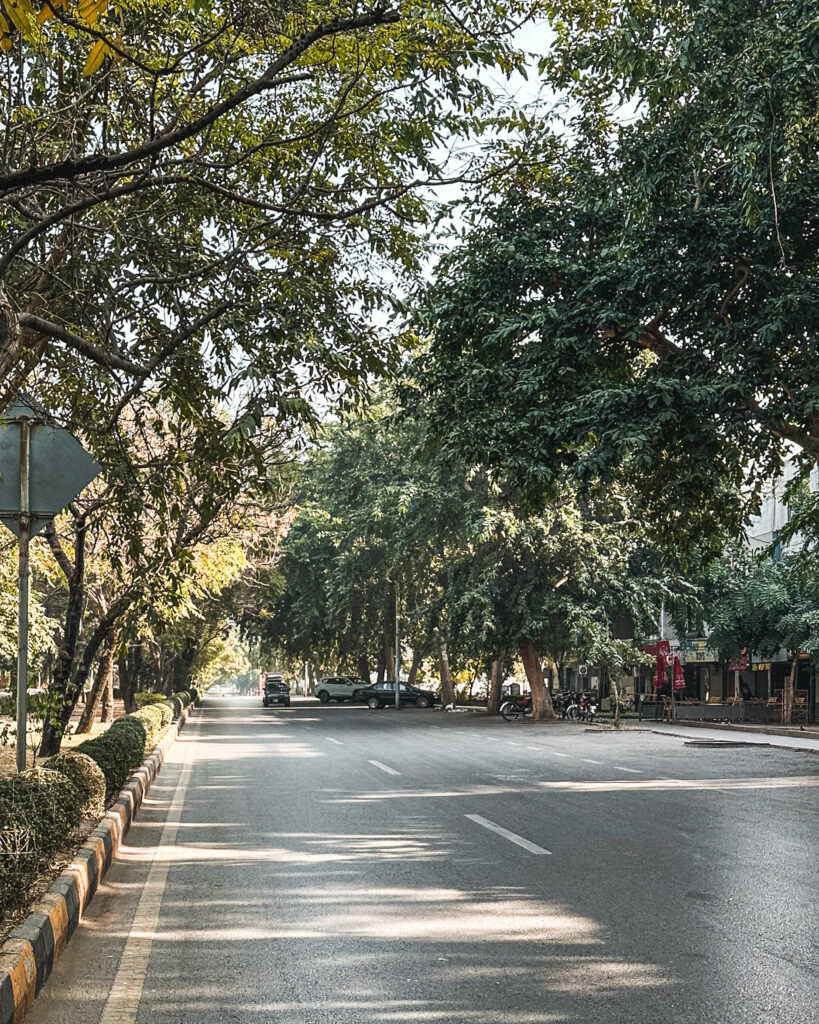
This is not a criticism. Islamabad’s calm is a feature, not a deficiency. After weeks in the mountains, arriving here feels like resurfacing. Hot showers work reliably. Multiple restaurants and coffee shop options similar to any other big city. The city gives you space to breathe, process, and organise before or after the harder, more demanding travel that surrounds it.
Rawalpindi, Islamabad’s older, louder twin city directly to the south, is where the real urban Pakistan energy is, and it’s worth a half-day at minimum for the contrast alone.
When to Visit Islamabad
Islamabad sits at around 500 metres above sea level at the foot of the Margalla Hills, which gives it a more temperate climate than Lahore but none of the extreme cold of the north.
October to March: The Best Window
This is the most pleasant time to be in Islamabad. Temperatures are mild, between 8°C and 22°C, the air is clear, and the Margalla Hills are green and accessible for hiking. The city’s parks and outdoor spaces are at their most pleasant. If you’re timing a Pakistan trip to start or end in Islamabad, the October to March window works well on both ends of a northern Pakistan journey.
April and May: Warm and Still Manageable
Spring in Islamabad is pleasant in April, getting warm by May. Temperatures push towards 30°C in May afternoons. The hills are still green and hikeable in the morning. A good window if you’re starting a summer northern Pakistan trip and arriving via Islamabad before heading north quickly.
June to September: Hot but Functional
Islamabad gets hot in summer, regularly 35-38°C, though not to the brutal extreme of Lahore. Most travellers passing through in summer are using Islamabad purely as a gateway and don’t linger. If you’re returning from the north in August or September, the city feels oppressive after the altitude. Use it as a transit point and move on.
Getting to Islamabad
By Air: Islamabad International Airport
Islamabad International Airport handles most international arrivals into northern Pakistan. Direct connections from major European hubs via Turkish Airlines, Qatar Airways, and Emirates are the most common routes for Western travellers; a connection through Istanbul, Doha, or Dubai is standard.
ATM warning on arrival: None of the ATMs at the airport accept foreign cards. Bring cash in USD, EUR, or GBP to exchange at the airport. There is a one exchange office at the departures terminal which is above the the arrivals terminal. This gives you enough rupees to reach your accommodation and cover the first day without depending on a working ATM.
Then, once in the city, you can find Standard Chartered and Bank Alfalah, which are the only banks that accept foreign cards.
The airport is around 25-30 km from the city centre. inDrive and Careem both operate from the arrivals area. Agree on a price before getting in any unmarked taxi.
From Lahore
Daewoo Express and Faisal Movers run frequent air-conditioned buses between Lahore and Rawalpindi throughout the day. The journey takes 4-5 hours and costs approximately 1,500-2,000 PKR. Buses arrive at Rawalpindi’s Pir Wadhai terminal. From there, take inDrive to your accommodation in Islamabad (F-7 or wherever you’re staying).
From Gilgit or the KKH
The standard overland route from Gilgit to Islamabad takes 12-18 hours depending on whether you take a shared car or NATCO bus. Shared cars are faster (around 12 hours) and more expensive; NATCO buses are slower (15-18 hours) and cheaper. Both depart from Gilgit’s main transport hub.
As of 2026, other companies besides NATCO can carry foreigners on this route, Faisal Movers being one. Check at the bus station in Rawalpindi or Gilgit for current options. Buses depart from Gilgit in the late morning and arrive in Rawalpindi in the early hours. An overnight bus is therefore the most time-efficient option. You sleep through the journey and arrive ready for a morning in the city.
Bring passport copies: there are over 15 military checkpoints between Gilgit and Islamabad and having photocopies speeds up each one significantly.
By Train
Pakistan Railways connects Rawalpindi to Lahore and other major cities. Trains are slower than buses but more comfortable for overnight journeys and the experience itself is worthwhile. The Rawalpindi to Lahore route runs multiple times daily. Check the Pakistan Railways website for current schedules. They change frequently and the site is not always reliable, so confirming at the station the day before is wise.
By Air from Skardu or Gilgit
Domestic flights connect Islamabad to Skardu, Gilgit, Lahore, and Karachi. Flying to Skardu is significantly more reliable than flying to Gilgit. Gilgit flights are cancelled frequently due to cloud and mountain weather. If time is the constraint, the Islamabad-Skardu flight is around 1 hour and costs approximately 8,000-15,000 PKR. Book well in advance in peak season (July-August) as seats go fast.
Getting Around Islamabad
inDrive and Careem
As in Lahore, inDrive is the most practical and stress-free way to get around Islamabad as a foreigner. The city’s sector grid means addresses are clear and logical, and inDrive removes all price negotiation from the equation. Download it before you arrive. Careem also operates across the city with fixed pricing. Both are available 24 hours.
Rickshaws
Less dominant in Islamabad than in older Pakistani cities, the wide roads and spread-out sectors make it less rickshaw-friendly, but available and useful for shorter distances in busier areas like F-7 Markaz and around the old Rawalpindi bazaars. Always agree on a price before getting in.
Walking
Within individual sectors, particularly F-7 and F-6, walking is genuinely pleasant. Wide pavements, shade trees, and a relatively low density of traffic make Islamabad more walkable than any other major Pakistani city. Between sectors, distances are large enough that inDrive is more practical.
Where to Stay in Islamabad
F-7 Sector: The Best Base for Travellers
F-7 is the neighbourhood I’d recommend without hesitation as a base, particularly for solo female travellers. It’s centred around F-7 Markaz, a compact commercial area with restaurants, cafés, a supermarket, and shops, all within walking distance of each other. It’s safe, pleasant to walk in at any hour, and close to the Faisal Mosque. The atmosphere is noticeably more relaxed than the area around some of the older budget hostels, and the range of food options, from local dhabas to decent coffee shops, makes it easy to spend time here without feeling like you need to go elsewhere.
Guesthouses and budget hotels in F-7 start from around 4,000-6,000 PKR for a clean private room. Mid-range options go up to 8,000-12,000 PKR with reliable hot water, Wi-Fi, and air conditioning.
Budget Hostels
Backpackers Hostel Islamabad is the most established budget option and the social hub for independent travellers in the city. It operates more like a shared apartment than a traditional hostel. A spacious common room, shared kitchen, good Wi-Fi, and genuinely helpful staff who know Pakistan travel well. It books out frequently, particularly in summer; book ahead. Dorm beds from around 1,500-2,000 PKR.
Coyote Den Travellers Hostel is another solid option: smaller and quieter than the Backpackers Hostel, with a similar independent traveller crowd.
A Note on Neighbourhood Safety
The area immediately around some of the budget hostels near the older parts of the city is less comfortable for solo female travellers than F-7. If you’re staying somewhere outside F-7, use inDrive after dark rather than walking, and apply the same general urban awareness you would in any large city. Islamabad is safe, but that doesn’t mean all areas feel equally comfortable at all hours.
Don’t skip travel insurance!
I use SafetyWing for most trips – solid coverage for adventure travel.
What to Do in Islamabad
Islamabad’s sightseeing list is shorter than Lahore’s, this is a planned modern city, not a historical one, but what it has is genuinely worth your time, and the surrounding hills add an outdoor dimension that most Pakistani cities lack entirely.
Faisal Mosque
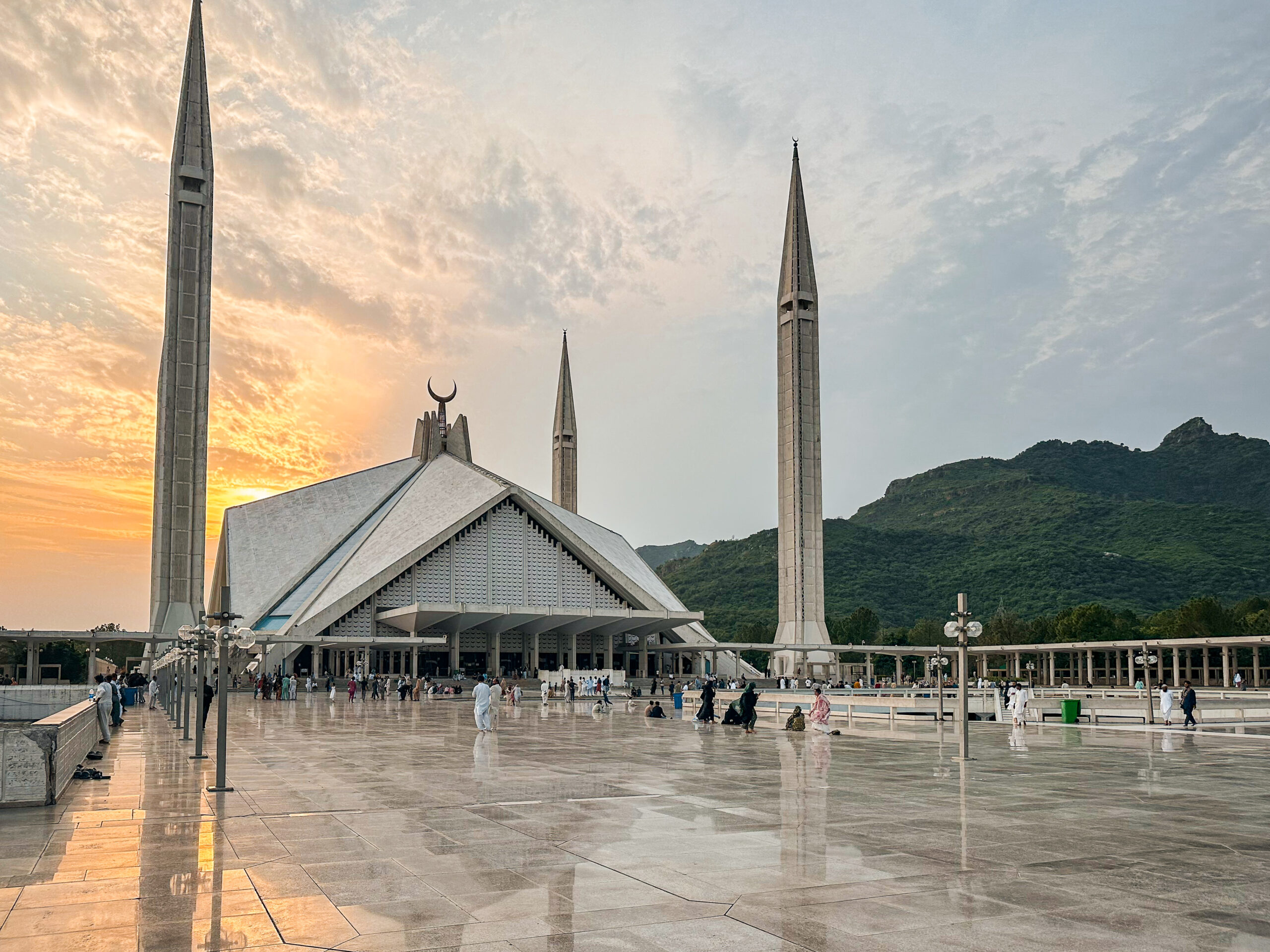
The Faisal Mosque is Islamabad’s defining landmark and one of the most architecturally striking mosques in the world. Designed by Turkish architect Vedat Dalokay and completed in 1986, it breaks entirely from traditional mosque design: no dome, instead a vast tent-like structure of white marble with four pencil-thin minarets rising to 90 metres on each corner. Set against the backdrop of the Margalla Hills, it has a particular quality at dusk when the white marble catches the last light and the hills go dark behind it.
The mosque is the largest in Pakistan and one of the largest in the world, with a courtyard capacity of around 100,000 worshippers. It is open to non-Muslim visitors outside of prayer times, dress modestly and remove shoes at the entrance. Entry is free.
Go early morning or at sunset. Midday is busy with domestic visitors and the light is flat. The walk up through the landscaped grounds to the mosque entrance is part of the experience.
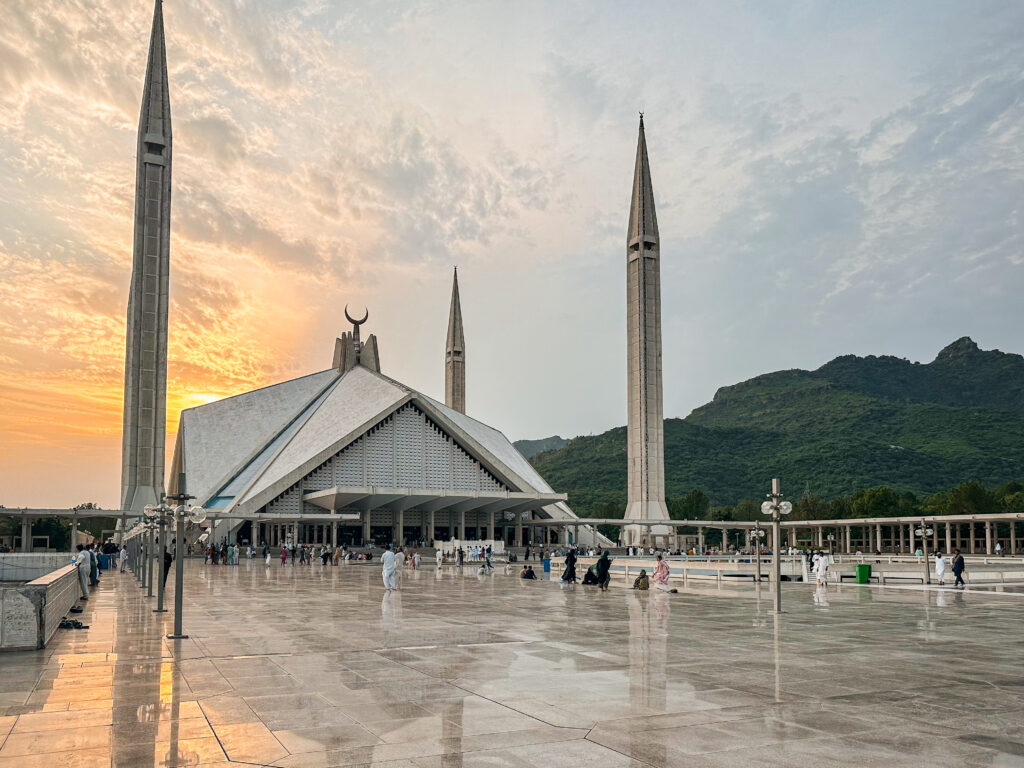 Faisal Mosque at sunset
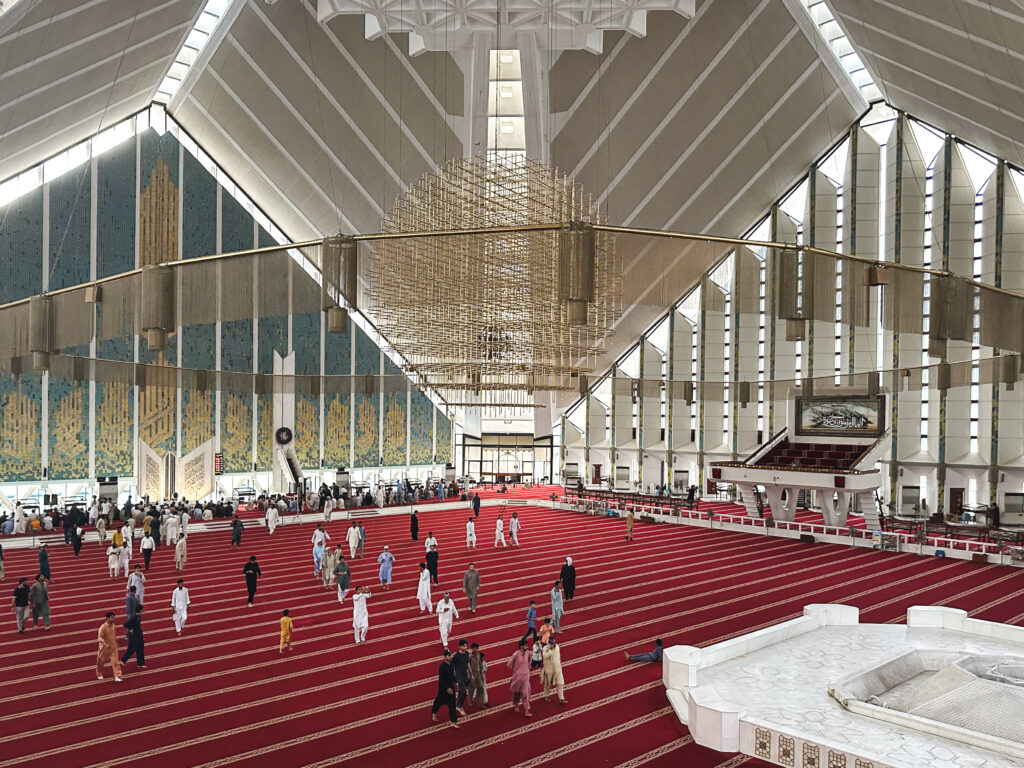 Faisal Mosque Interior
Margalla Hills National Park
The Margalla Hills rise directly behind Islamabad and are one of the city’s defining features and genuine pleasures. A network of trails runs through the forested hillside, starting from various trailheads accessible by inDrive from anywhere in the city. The most popular is Trail 3, which starts near the Margalla Hills road and climbs to a viewpoint over the city, around 45 minutes to an hour at a moderate pace. Trailhead parking areas are well-signposted.
The hills are forested with pine and deodar cedar, and the air, even 20 minutes from the city, shifts noticeably. Monkeys are common on the lower trails; don’t feed them. Snakes are present but rarely encountered. Go in the morning for the best light and the coolest temperatures.
For a longer day out, Trail 5 is less crowded and more scenic, running deeper into the hills with better views. The trails are well-maintained and clearly marked, no guide needed for the standard routes.
Daman-e-Koh
A viewpoint and park on the lower slopes of the Margalla Hills, Daman-e-Koh gives the best panoramic view of Islamabad’s grid layout and the flat Punjab plains beyond. It’s accessible by road, inDrive up and back is the easiest option, and gets busy with domestic visitors on weekends. Go on a weekday morning for the view without the crowds. There’s a small café at the top serving chai and snacks.
Pakistan Monument
The Pakistan Monument sits on a low hill in the western part of the city and is one of Islamabad’s most significant national landmarks, a star-shaped structure with petals representing the four provinces of Pakistan, completed in 2007. The interior houses the Pakistan Monument Museum, which covers the independence movement, partition, and the formation of the Pakistani state in well-curated detail. The digital simulation of 14th August 1947 is genuinely affecting.
Entry fee is approximately 100-200 PKR. Visit in the late afternoon when the light is warm and combine with a walk around the grounds at sunset.
Rawalpindi: The City Next Door
Rawalpindi is not Islamabad: it is older, louder, denser, and operated at a completely different pace. The two cities share a border and a metro line, but Rawalpindi is unplanned urban Pakistan in a way that Islamabad absolutely is not. A half-day in Rawalpindi gives you everything Islamabad doesn’t: a packed bazaar (Raja Bazaar is the main one), narrow lanes, streetfood at every corner, and the sensory overload of a city that has been accumulating itself for centuries rather than being designed from scratch.
Use inDrive to get there from Islamabad, or take the Rawalpindi-Islamabad Metro Bus (cheap, frequent, and a reasonable experience in itself). Spend a few hours in Raja Bazaar and the surrounding area, eat at a local dhaba, then return to Islamabad before dark. Rawalpindi rounds out your understanding of what Pakistani urban life actually looks like beyond the planned capital’s clean grid.
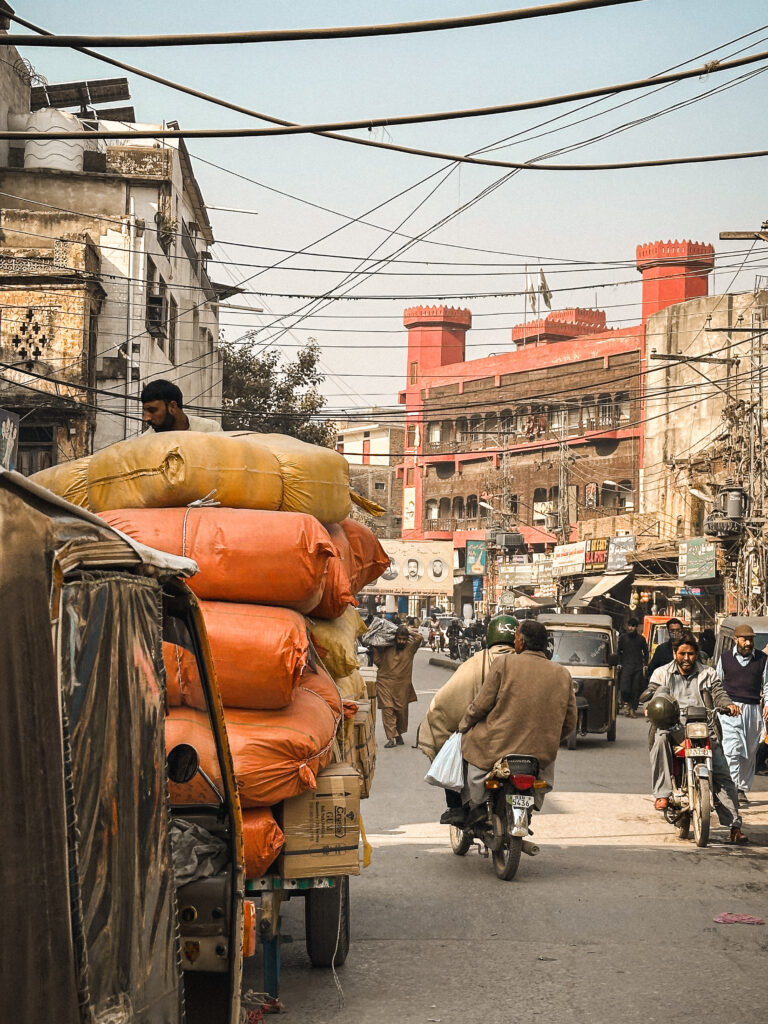 Chaotic Streets of Rawalpindi
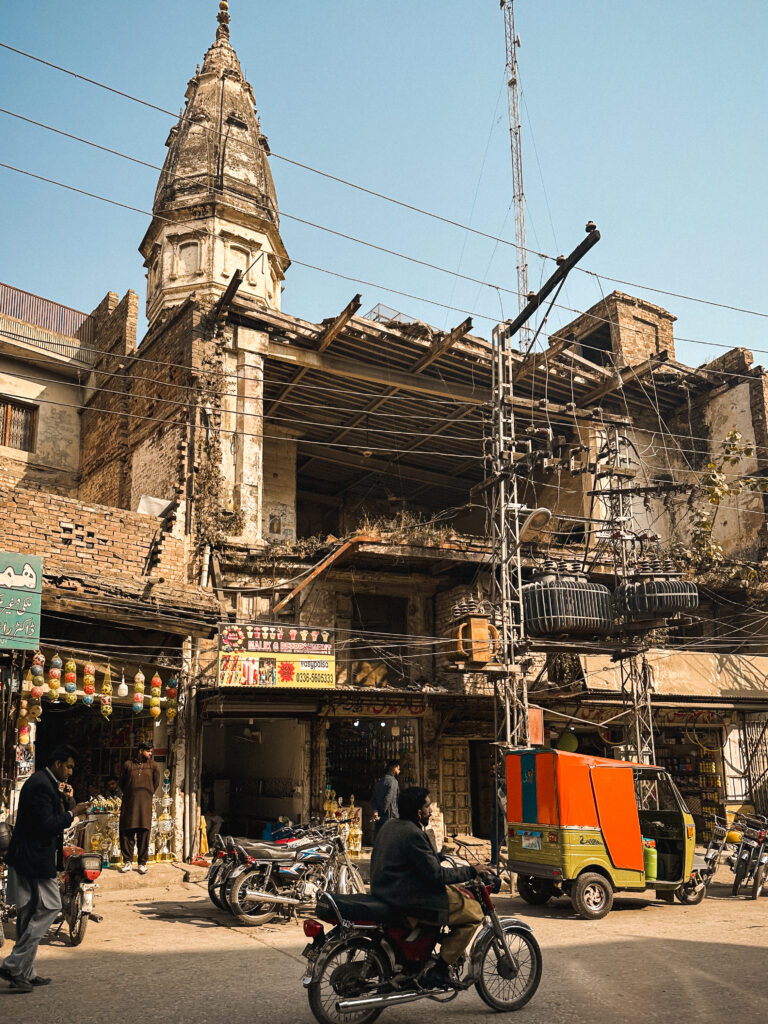 Streets of Rawalpindi
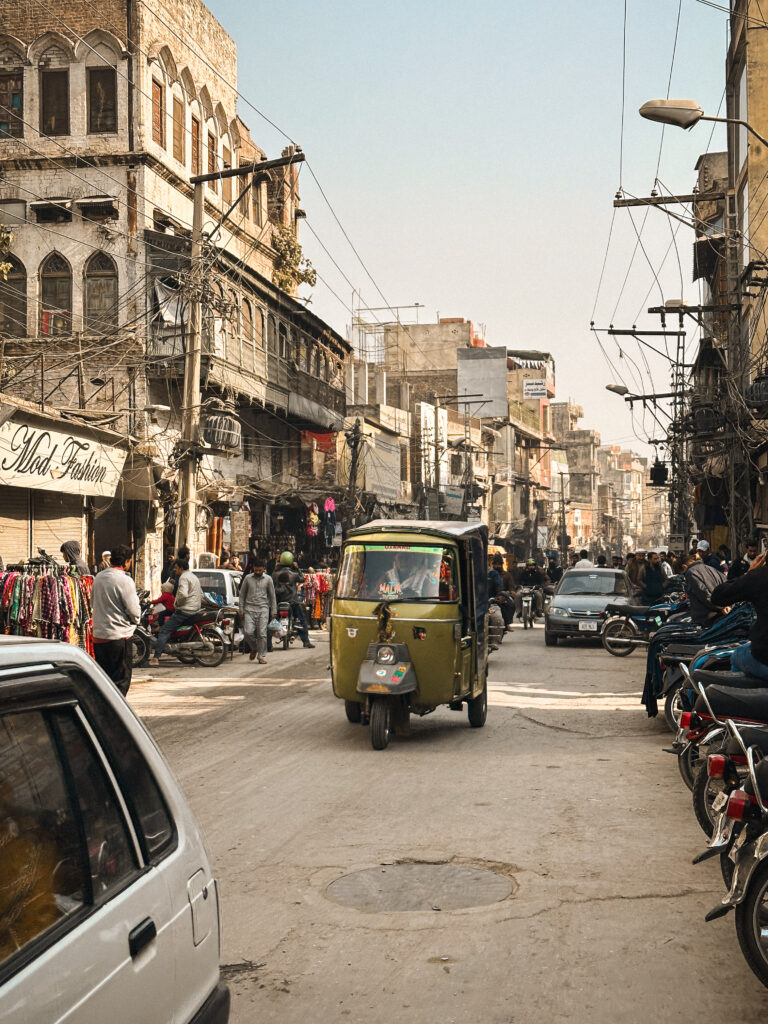 Streets of Rawalpindi
While You’re Here: Don’t Skip Peshawar
Islamabad is the practical base. Peshawar, four hours to the northwest, is the one that stays with you.
It was my favourite city in Pakistan, and I say that having spent time in Lahore, Islamabad, Gilgit, and Skardu. Peshawar is older, rawer, and more itself than any of them. The Qissa Khwani Bazaar, the ancient Street of Storytellers, is one of the most extraordinary urban spaces in the country: a working Silk Road trading hub that has barely shifted its character in centuries. The food is Pashtun and outstanding. The old city is dense, atmospheric, and genuinely unlike anywhere else on a Pakistan itinerary.
From Islamabad, Peshawar is around 2-3hours by shared car or bus. Easy as a two-night add-on before or after the capital. Most travellers skip it because it sits slightly off the main northern route. That’s exactly why it’s worth going.
For everything you need to plan the visit: where to stay, what to eat, honest safety information, and what the city is actually like as a solo female traveller, the full guide is here: Peshawar Travel Guide: A Solo Female Traveller’s Experience →
Where to Eat in Islamabad
Islamabad has the most developed restaurant and café scene of any city in northern Pakistan. The F-7 area in particular has a concentration of options that makes it easy to eat well for any budget.
Kabul Restaurant (F-7)
An Afghan restaurant that I’d recommend to anyone passing through. The Afghan BBQ, whole cuts of meat cooked over charcoal, and the qabili pulao (slow-cooked lamb over rice) are outstanding. It’s slightly more expensive than a local dhaba but still very affordable by any international standard, and the quality is a level above most options in the city. Get there early in the evening, it fills up quickly.
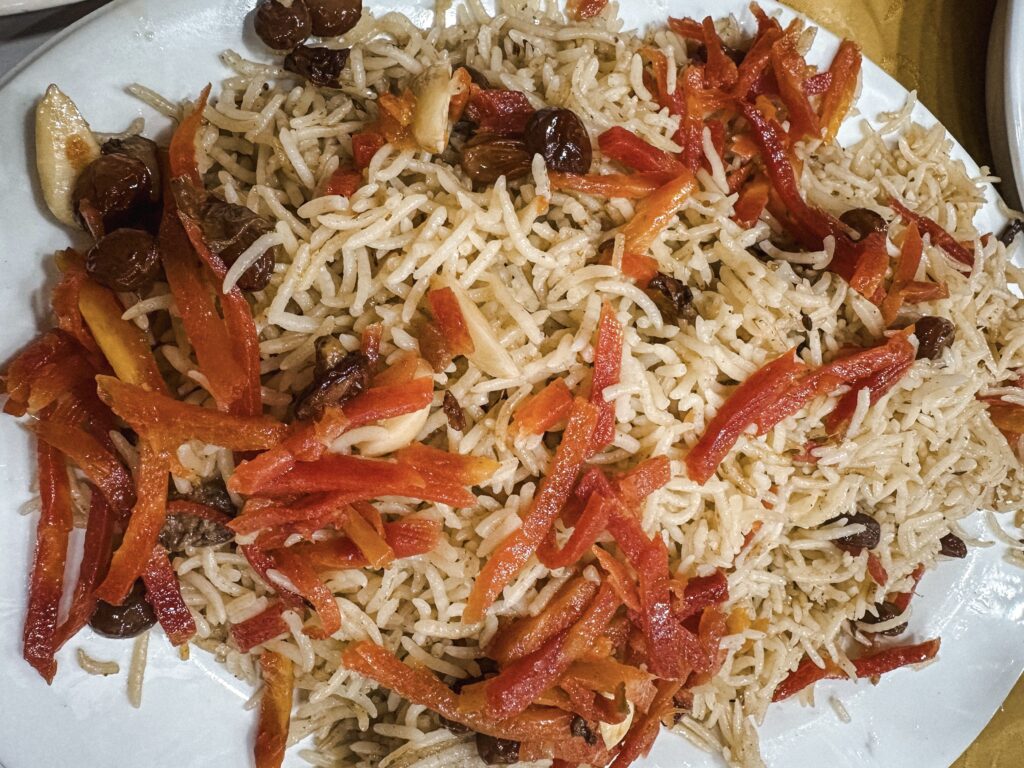 Qabili Pulao
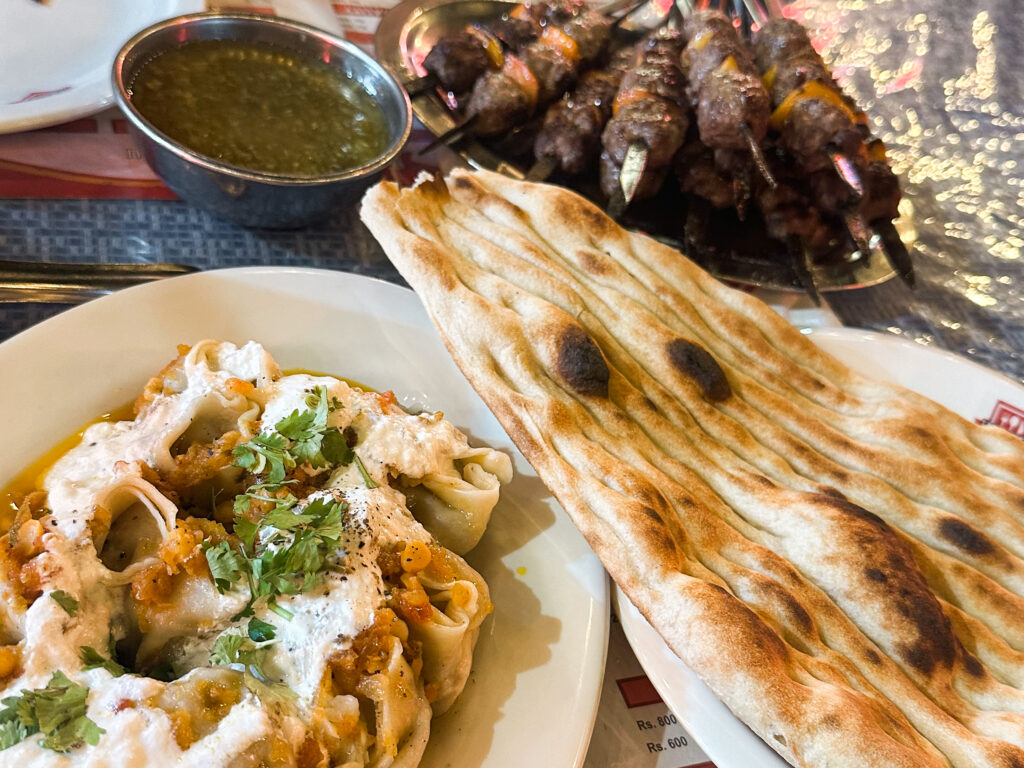 Manti, Afghan BBQ and Bread
Quetta Chai (Multiple Locations)
A local favourite for chai and parathas. The parathas here: layered, flaky, served with achaar and a cup of thick, milky chai, are some of the best I had anywhere in Pakistan. Go in the morning for the full breakfast experience. Multiple branches across Islamabad; the F-7 (location for the F-7 branch) and G-9 locations are the most convenient for most travellers.
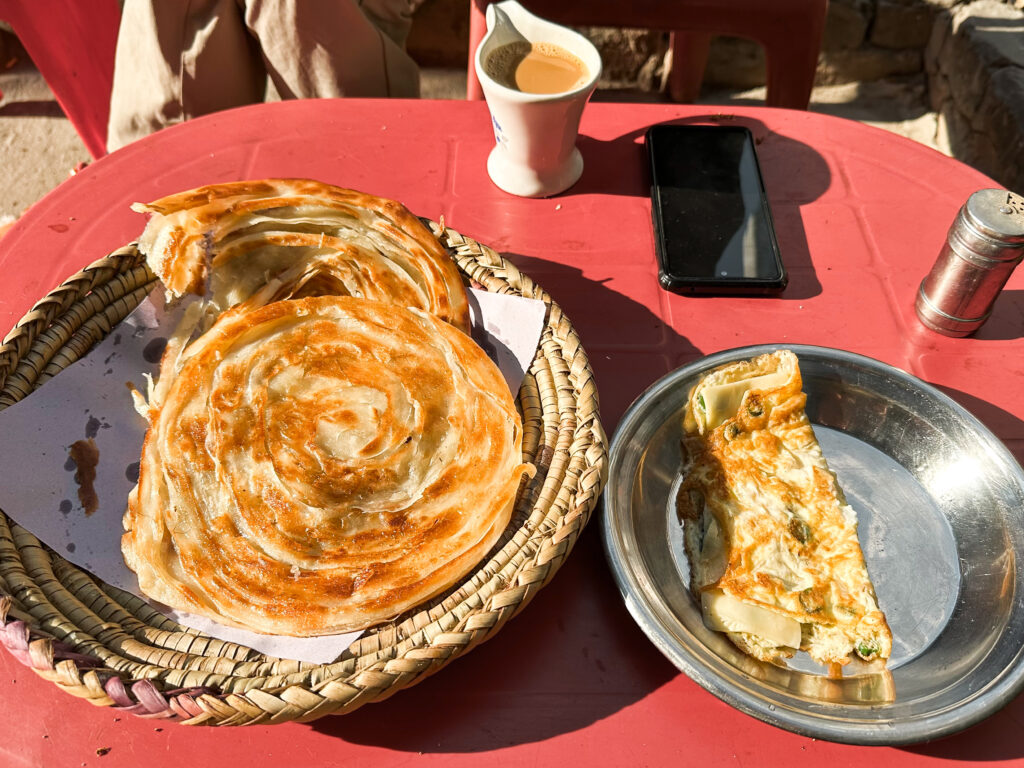
Crumble Cookies (Multiple Locations)
Warm, fresh-baked cookies that are unreasonably good and completely incongruous with the surrounding landscape. Multiple branches in Islamabad.
Street Food Around F-7 Markaz
The streets around F-7 Markaz have a cluster of dhabas and street stalls that are cheap, busy with locals, and representative of Islamabad’s mix of Punjabi and Pashtun food cultures. Look for nihari (slow-cooked beef), seekh kebab, and channa (spiced chickpeas with flatbread). Eat where the queue is longest.
Coffee Shops and Cafés
Islamabad has a growing coffee shop culture, unusual in Pakistan and concentrated almost entirely here. The F-6 and F-7 areas have several decent cafés serving proper espresso drinks, which is worth knowing if you’ve been in the mountains for weeks and are craving something specific. Don’t go to Pakistan expecting coffee culture, but in Islamabad it’s there if you want it.
Practical Logistics: What to Sort in Islamabad
This is where Islamabad earns its place in a northern Pakistan itinerary. Several things are significantly easier to arrange here than anywhere else in the country.
Cash
Bank Alfalah ATMs are the most reliable for foreign cards in Islamabad. Standard Chartered also works and is the only reliable option beyond Bank Alfalah — both are available in the city. Withdraw a large amount here before heading north. ATMs in Gilgit and Karimabad exist but are less reliable; beyond those towns, cash is the only option and carrying enough to cover your entire northern Pakistan stay is the strategy. Don’t count on being able to withdraw again once you leave the capital corridor.
Avoid ATM fees with Wise
The card I use for all my travel withdrawals – real exchange rate, low fees.
Use Revolut to avoid ATM fees
Good alternative to Wise – I carry both as a backup.
SIM Card
If you’re heading to Gilgit-Baltistan, get your SCOM SIM in Gilgit, not in Islamabad. SCOM is the only network with meaningful coverage along the KKH and in the remote valleys, and it cannot be purchased outside its coverage area. For the Islamabad and Lahore legs of your trip, a Telenor, Zong or Jazz SIM works well and is available at the airport or any phone shop. Swap to SCOM when you reach Gilgit.
Need data before you land? Try Saily eSIM
Use code RITAHE1486 for $5 off your first plan.
Bus Tickets North
Buses to Gilgit depart from Pir Wadhai Bus Terminal in Rawalpindi. NATCO is the operator historically used by foreigners. As of 2026, Faisal Movers and some other companies also carry foreign passengers. Check at the terminal for current options. Buses depart in the late afternoon or evening and arrive in Gilgit the following morning. Book the day before or on the morning of travel, seats fill quickly in peak season. Your hostel or guesthouse can usually call ahead to confirm availability.
The bus journey from Rawalpindi to Gilgit follows the Karakoram Highway and takes 18-20 hours. It is long and uncomfortable but deeply scenic in daylight. Sit on the right side going north for the best valley views.
Alternatively, shared taxis to Gilgit can be arranged at Pir Wadhai. Faster (around 12 hours), more expensive, and harder to sleep through. If time is more important than cost, this is the option.
Domestic Flights
Both PIA, AirBlue and private carriers operate domestic flights from Islamabad International Airport. The Islamabad-Skardu route is the most useful for travellers: around 1 hour, scenic (the flight passes close to Nanga Parbat on clear days), and significantly more reliable than the Islamabad-Gilgit route which cancels frequently. Book as early as possible for summer dates. Prices fluctuate significantly and booking a few weeks in advance tends to give better rates than last-minute.
How Much Does Islamabad Cost?
Islamabad is slightly more expensive than smaller Pakistani cities but still affordable by international standards. The main variable is accommodation. You pay more here than in a remote valley guesthouse, but you get significantly more in return.
| Expense | Cost (PKR) | Cost (approx. EUR) |
|---|---|---|
| Dorm bed (budget hostel) | 1,500-2,500 | ~5-8 € |
| Private guesthouse room (F-7 area) | 4,000-6,000 | ~12-18 € |
| Street food / dhaba meal | 300-600 | ~1-3 € |
| Restaurant meal (Kabul Restaurant etc.) | 1,000-2,500 | ~3-8 € |
| inDrive ride (cross-sector) | 200-1500 | ~0.70-4.50 € |
| inDrive from airport to F-7 | 1,500-2,500 | ~4-8 € |
| Faisal Mosque entry | Free | — |
| Pakistan Monument Museum | 100-200 | ~0.30-0.60 € |
| Bus to Gilgit (NATCO/Faisal Movers) | 5,500-8,000 | ~16-25 € |
| Total per day (budget) | ~3,500-5,500 PKR | ~11-17 € |
| Total per day (mid-range) | ~7,000-12,000 PKR | ~21-37 € |
The budget figure assumes dorm accommodation, street food, and inDrive for transport. Mid-range assumes a private room in F-7 and one or two restaurant meals per day. Neither figure includes the bus north, which is a one-off cost.
Practical Tips for Visiting Islamabad
Sort your logistics first, sightseeing second. Islamabad is where you set up your Pakistan trip. Withdraw cash, buy a SIM, book your bus north, sort any permits. Get this done on your first afternoon and first morning. Then the rest of your time here is genuinely free for the mosque, the hills, and Rawalpindi.
F-7 is the right base. The area around F-7 Markaz is safe, walkable, well-served by restaurants and cafés, and close to the Faisal Mosque. It’s particularly suitable for solo female travellers who want to be able to move around comfortably without taking transport for every short trip.
Don’t rely on airport ATMs. Bring cash to exchange on arrival. Bank Alfalah in the city is reliable; Standard Chartered works for foreign cards too. Withdraw more than you think you’ll need until you reach Gilgit or Skardu before you leave the capital.
Get your SCOM SIM in Gilgit, not here. Zong or Jazz covers Islamabad fine but neither works reliably in GB. SCOM can only be purchased in Gilgit. Don’t waste time trying to arrange it in Islamabad.
Rawalpindi is worth half a day. Don’t leave Islamabad without spending at least a few hours in Rawalpindi. The contrast with the planned capital is total, and Raja Bazaar is one of the most interesting markets in northern Pakistan.
Hike in the morning. The Margalla Hills trails are best in the first two hours of daylight: cooler, quieter, better light. Trail 3 is the standard; Trail 5 is worth it if you have more time. No guide needed for either.
inDrive for everything. Download it before you land. It removes every transport hassle in a city this size and is significantly better value than flagging down taxis or negotiating with rickshaw drivers on the street.
Power outages are real even in Islamabad. Better than the north, but load-shedding still happens. A power bank is useful. Budget guesthouses may have intermittent power; mid-range hotels generally have generators.
FAQ: Islamabad
How many days do you need in Islamabad?
One to two days is enough for the city itself. One full day covers the Faisal Mosque, a Margalla Hills hike, and an evening in Rawalpindi. Two days allows you to add the Pakistan Monument, Lok Virsa Museum, and more time in the hills.
Is Islamabad safe for solo female travellers?
Yes, it is the most comfortable large Pakistani city for solo female travellers. The F-7 area in particular is genuinely walkable at any hour, and the city’s organised layout and inDrive availability make getting around easy and low-stress. It is significantly more relaxed than Lahore or Peshawar in terms of street attention.
What is there to do in Islamabad for a day?
Morning hike on Trail 3 in the Margalla Hills, visit the Faisal Mosque at dusk, dinner in F-7: that covers a single day well. Add Rawalpindi’s Raja Bazaar in the afternoon if you want contrast. The Pakistan Monument Museum is worth adding if you have a second day.
Can I fly from Islamabad to Skardu?
Yes. PIA and AirBlue operate the route. Around 1 hour and significantly more reliable than the Islamabad–Gilgit flight.
Where do buses to Gilgit depart from?
Pir Wadhai Bus Terminal in Rawalpindi. Take inDrive from anywhere in Islamabad. NATCO is the traditional operator for foreigners; Faisal Movers also runs the route as of 2026. Buses depart in the late afternoon or evening and arrive in Gilgit the following morning.
Is Rawalpindi worth visiting from Islamabad?
Yes, for half a day. The contrast with the planned capital is complete and Raja Bazaar is one of the most interesting urban markets in northern Pakistan. Go by inDrive or the Metro Bus, spend a few hours walking and eating, and return to Islamabad before dark.
What is the best neighbourhood to stay in Islamabad?
F-7 Sector, particularly around F-7 Markaz. Safe, walkable, good food options within walking distance, and close to the Faisal Mosque. The best base for independent travellers and particularly suited to solo female travellers.
Do I need a visa on arrival for Pakistan?
Most nationalities require a visa in advance via the Pakistani e-visa system. As of 2026 an LOI (Letter of Invitation) is again required for many nationalities, though this changes frequently. Check the official Pakistan visa portal before applying. Approval typically takes less than a week.
Final Thoughts
Islamabad won’t be the part of your Pakistan trip that you tell stories about. The Shimshal road will be. The evening watching the sunset with views of Nanga Parbat. The moment the Naltar lakes come into view will be. Islamabad is where you arrive, sort yourself out, and begin. And where you return to, recover, and decompress before going home.
But give it its due. The Faisal Mosque at dawn is genuinely nice. The Margalla Hills an hour into Trail 3 are genuinely peaceful. And Rawalpindi, messy, loud, real, is worth the ride. Two days here, done well, sets everything that follows up perfectly.
Need help planning your Pakistan trip?
Custom itineraries, local guide sourcing, and on-trip support from someone who’s done it.
More Pakistan Travel Guides
If you’re planning to travel Pakistan independently, these in-depth guides will help you navigate the country, travel on a budget, and explore far beyond the usual routes:
Have questions about Chapursan valley? Drop them in the comments. I read every single one.