
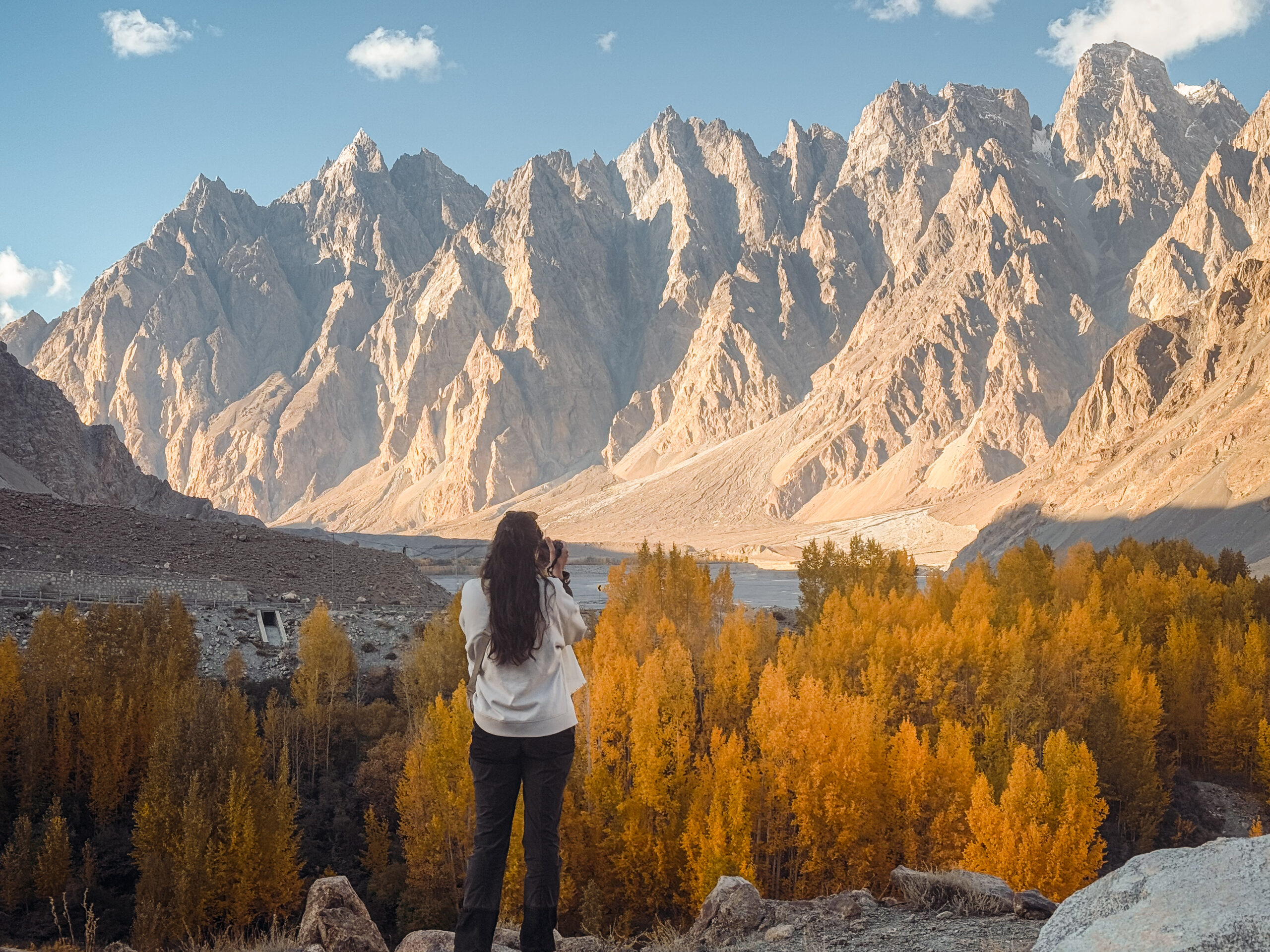
When I tell people I’ve solo travelled through Pakistan, Kyrgyzstan, Middle East, remote Sulawesi, and across the Caucasus, the reaction is almost always the same. A pause. Then: “Alone? As a woman? Is that… safe?”. It’s a question rooted in concern, but also in assumptions about solo female travel safety in places that rarely make it into mainstream travel narratives.
I understand the reaction. These aren’t the destinations that come up in mainstream travel content. They don’t have the glossy Instagram infrastructure of Bali or the well-worn backpacker trails of Southeast Asia. And so the assumption fills the gap: they must be dangerous.
Here’s what I’ve actually found: the places that scare people the most are often the places where I’ve felt the safest, the most looked after, and the most genuinely welcomed. That’s not naivety. That’s experience.
This post isn’t about pretending risk doesn’t exist. It does, everywhere, including the cities most people consider completely safe. It’s about replacing vague fear with specific, practical knowledge. Because the biggest threat to solo female travellers isn’t usually the destination. It’s going in underprepared.
Here’s everything I actually do to travel safely, alone, in places most people wouldn’t dare.
First: Let’s Talk About the Reputation Gap
Pakistan is one of the most searched “dangerous destinations” on the internet. It’s also the country where strangers have gone most out of their way to help me, feed me, and make sure I was okay. I’ve been invited into homes, guided to bus stations by people who walked twenty minutes out of their way, and treated with a level of hospitality that genuinely moved me.
Oman, where I spent two weeks being hosted through Couchsurfing, staying with locals, was similarly disarming. The kindness was overwhelming and completely at odds with what the average Westerner imagines when they think of the Middle East.
Central Asia: Kyrgyzstan, Uzbekistan, Kazakhstan, Georgia, Armenia. Places where hitchhiking is normal, where you can fall asleep on a night train without gripping your bag, where people in remote mountain villages offer you tea and a bed before they’ve even asked your name.
Remote Sulawesi in Indonesia: islands with almost no tourist infrastructure, where I arrived as the only foreigner anyone had seen in weeks, and where people were curious and warm rather than predatory.
None of this means danger doesn’t exist. It means the mental map most people carry of these places is wrong, shaped by biased news cycles and geopolitical anxiety rather than ground-level reality. The first step to travelling safely as a solo woman is calibrating your perception of risk accurately, rather than defaulting to fear.
1. Research the Specific Place, Not the Country
One of the most common mistakes is treating an entire country as a monolith. “Is Pakistan safe?” is not a useful question. “Is Gilgit safe for a solo female traveller in October?” is a useful question.
Every country has areas that are more welcoming, more tourist-accustomed, and lower risk for solo women, and areas that are genuinely more challenging. The research that matters is granular: read recent reports from other solo female travellers (blogs, travel forums, Facebook groups), check government travel advisories for specific regions rather than the blanket country-level warnings, and ask in communities where people actually travel these routes.
Facebook groups are genuinely one of the best resources here. Groups dedicated to solo female travel, or destination-specific travel groups, are full of people who’ve just come back from exactly where you’re going and will answer specific questions honestly.
2. Know Where You’re Going Before You Get There: Offline Maps Are Non-Negotiable
The single most disempowering thing that can happen in an unfamiliar city is not knowing where you are. It makes you look lost, it makes you feel vulnerable, and it makes you dependent on whoever is nearest, which is not always who you’d choose.
I use two apps for navigation, and I download everything offline before I arrive:
Google Maps offline: download the map of your destination region before you get on the plane or bus. Works without any data connection. I use this for navigating cities on foot, finding my accommodation, checking if a driver is taking the right route.
Maps.me: an alternative offline map app that often has better detail in rural and remote areas where Google Maps gets sparse. Particularly useful in Central Asia and parts of Indonesia where you’re moving through areas with minimal infrastructure. I use both and they complement each other.
Knowing exactly where you are at all times changes how you carry yourself. You walk with purpose. You’re not stopping on street corners looking confused. And if a taxi or ride is going the wrong way, you know immediately.
Practical habit: the moment you arrive anywhere new, a bus station, an airport, a town you’ve just hitchhiked into, open your offline map, orient yourself, and locate your accommodation before you start moving. Thirty seconds of preparation changes the entire dynamic of arriving somewhere unfamiliar.
3. Use Ride-Hailing Apps Instead of Street Taxis
I cannot overstate how much safer this makes getting around, especially at night or when arriving somewhere new. Street taxis, particularly those that cluster around airports, bus stations, and tourist areas, are where the vast majority of transport-related problems happen for solo travellers: overcharging, taking longer routes, occasionally something more serious.
Ride-hailing apps eliminate almost all of this. The driver is identified, the route is tracked, the price is fixed before you get in, and there’s a record of the journey. You don’t negotiate, you don’t debate, you just get in and go. Here’s what I use by region:
Yandex Go: essential across Central Asia and the Caucasus. This is the app that locals in Georgia, Armenia, Uzbekistan, Kyrgyzstan, and Kazakhstan use every day. Prices are dramatically lower than anything a street driver will quote you, and the safety element is real, your route is logged and tracked.
inDrive: widely used in the Middle East, South Asia and parts of Africa and Latin America. You propose a fare and drivers accept or counter. Particularly good for longer routes between cities where fixed pricing apps don’t always operate.
Grab: the dominant app across Southeast Asia including Indonesia. Use it in Makassar and Manado when moving around Sulawesi’s cities. GrabBike (motorcycle taxi) is perfect for short hops and very cheap. As a solo woman, having a named, rated driver with a tracked route is far preferable to flagging down whoever stops.
Additional safety habit with ride-hailing apps: share your live location with someone you trust before you get in. Most ride-hailing apps have a built-in share function: use it. If yours doesn’t, drop a WhatsApp message with the driver’s name, plate number, and your destination before the car moves. It takes ten seconds and it matters.
4. Dress and Behave With Context, Not Uniformity
This is the tip that sounds the most obvious and gets executed the worst, because people interpret it as “cover up everywhere” or “abandon your identity.” Neither is right.
Dressing with context means understanding what’s normal in the specific place you’re in and calibrating accordingly, not because you owe anyone compliance, but because blending in is a practical safety tool. It makes you less conspicuous, it signals respect for local culture, and it significantly reduces unwanted attention.
In Pakistan and Oman, this meant wearing loose, long clothing and covering my hair in more conservative areas. A lightweight scarf takes up zero space in a bag and makes an enormous difference. In Kyrgyzstan and Georgia, the dress code is far more relaxed. In rural Sulawesi, modest clothing was necessary because it was simply what people wore and showing up otherwise would have made me stand out unnecessarily.
The general rule I follow: observe what local women are wearing and pitch slightly more conservative, not less. You’ll find the right balance quickly.
Beyond clothing: read the room on behaviour too. In some places, sitting alone at a restaurant is completely fine. In others, it draws more attention than it’s worth and eating from a market stall or street food spot is both more normal and more comfortable. This isn’t about limiting yourself but it’s about understanding the social landscape you’re moving through.
5. Trust Your Gut
Your instincts are a real safety tool and you should trust them. If something feels wrong, a person, a situation, a route – leave. You don’t owe anyone an explanation. Create distance first and process it later.
But it’s worth being honest with yourself about the difference between instinct and inherited bias. Feeling nervous around a man in a shalwar kameez in Pakistan, or uncomfortable in a medina in Oman, or tense in a shared marshrutka in Kyrgyzstan, that’s not necessarily instinct. It might be unfamiliarity and media-shaped fear presenting as intuition. Real gut feelings are specific: this person, this situation, right now. Vague background anxiety about a place is something else, and it can cause you to misread genuinely safe situations and miss out on extraordinary experiences.
The more time you spend in a place, the better calibrated your instincts become. Give yourself time to settle into the rhythm of a destination before you make judgements about it.
6. Tell People Where You’re Going
Not everyone, not in detail, but someone should always know your rough plan.
My system is simple: I have a couple of people at home who know my general itinerary. When I’m doing something more remote: a multi-day trek, a long journey into an area without reliable signal, a hitchhiking stretch, I message before I leave and when I arrive. Nothing elaborate. Just enough that if I go quiet for longer than expected, someone knows where to start looking.
In areas without signal, download your maps offline before you leave, tell your accommodation where you’re going and when you expect to be back, and if possible, travel with at least one other person for the most remote sections. This isn’t paranoia, it’s the same common sense that applies to hiking anywhere in the world.
7. Get Travel Insurance
If you’re solo travelling remote destinations, the argument for travel insurance isn’t abstract. It’s specific: if you get sick, injured, or need evacuating from somewhere genuinely off the beaten path: a mountain in Kyrgyzstan, a remote island in Sulawesi, a rural area of Pakistan, the cost without insurance could be tens of thousands of euros. Solo, with no one there to help navigate the logistics.
I use SafetyWing, which is designed for long-term independent travellers. It’s billed monthly, covers most of the destinations I travel to including some that other insurers exclude, and is genuinely affordable at around €40-50 a month.
Get it before you go. Not after you’ve been somewhere a week and decided you like it.
8. Connect With Other Solo Female Travellers
The solo female travel community is one of the most genuinely useful resources out there, not for reassurance, but for real, specific, recent ground-level information.
Before any new destination, I search for recent posts from solo women who’ve just been there. What did they actually experience? What would they do differently? Which areas, which guesthouses, which transport routes? This information is worth more than any guidebook and it’s almost always freely shared.
Good places to find it: Facebook groups for solo female travel, destination-specific travel groups, travel blogs written by women travelling similar routes. The community is generous. And if you ask a specific question, you’ll almost always get a specific answer.
The Honest Summary
I’ve travelled alone through Pakistan, Kyrgyzstan, Uzbekistan, Georgia, Armenia, Azerbaijan, Oman, Turkey, and remote Sulawesi. I’ve hitchhiked, taken overnight buses, stayed with strangers through Couchsurfing, slept in yurts and guesthouses and island homestays. I’ve done most of it without a fixed plan, without a tour, and without anyone waiting at the other end.
And I’ve been fine. More than fine: I’ve had the kind of experiences that simply don’t happen on a curated itinerary.
That’s not luck and it’s not recklessness. It’s preparation, awareness, and a willingness to let go of the fear that’s been projected onto these places by people who’ve never been to them. The world is more welcoming than the news makes it look. Solo female travel in “difficult” destinations is more achievable than most people believe.
Go. Be smart about it. But go.
Quick Reference: Tools I Actually Use
Related Posts You Might Like
Travelling solo to one of these destinations and have a specific question? Leave it in the comments. I answer every one.