
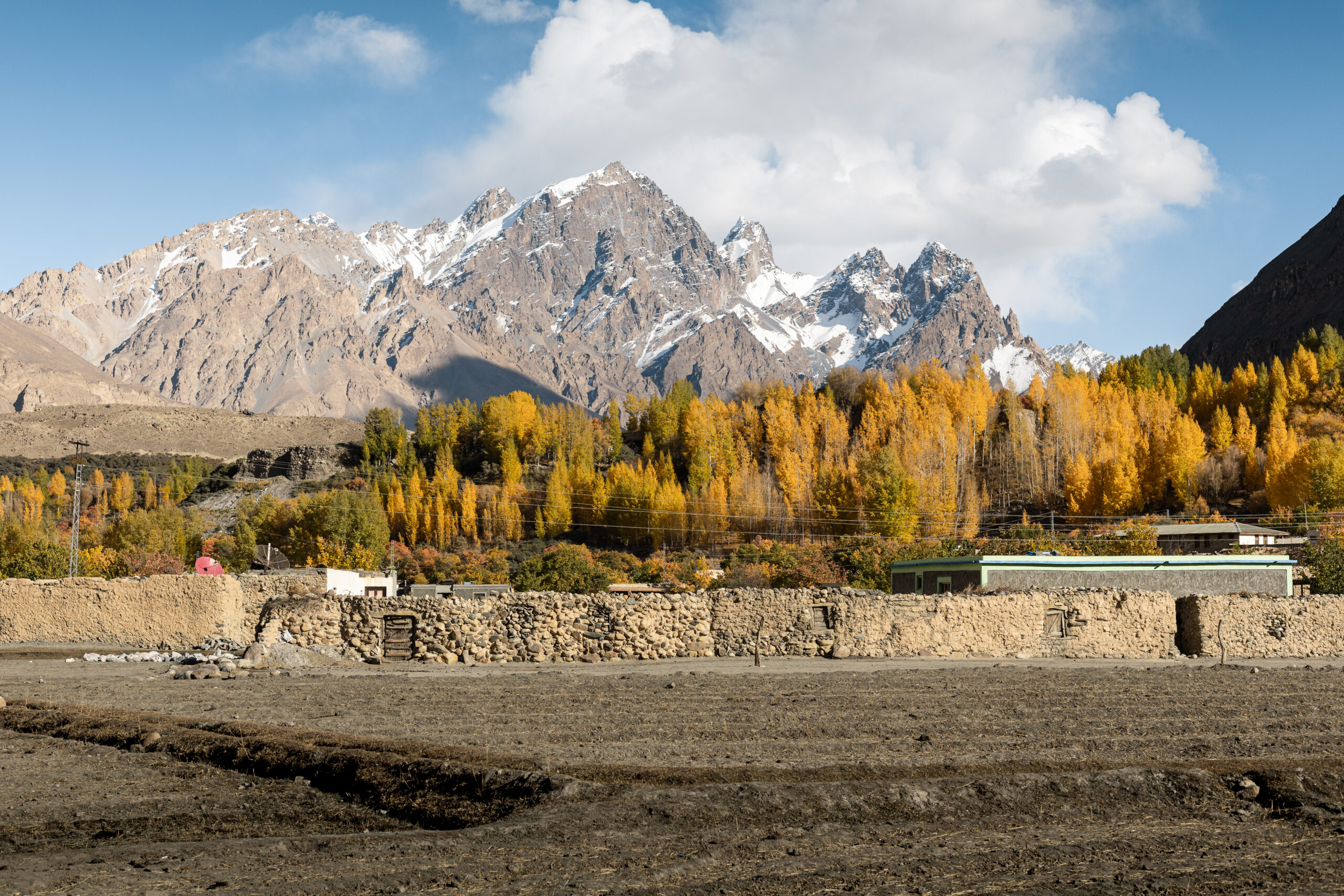
This Shimshal Valley travel guide starts where every account of this place has to start: with the road. You can read about the valley itself: the glaciers, the mountaineers, the yaks on the high pastures, but none of it lands properly until you understand what it takes to get there. A 56-kilometre track carved into sheer cliffs above the Hunza River, completed in 2003 entirely by the community who lives at the end of it, with drop-offs that make you grip whatever is nearest and turns that require reversing on the edge of nothing. I got there on a motorbike, inching along sections where the cliff fell away directly below the front wheel. It is one of the most extraordinary things I have done in northern Pakistan, and the valley waiting at the end of it is worth every metre.
What Makes Shimshal Valley Worth the Journey
Shimshal sits at 3,100 metres above sea level in the northeastern corner of Hunza, It’s the highest permanent settlement in the district, and by some measures the most remote valley in Gilgit-Baltistan. It borders China’s Xinjiang province to the east and is surrounded by peaks that exceed 7,000 metres, including Distaghil Sar at 7,885 metres, one of the most technically demanding mountains in the Karakoram.
The valley is known as the Valley of Mountaineers, and the reputation is not exaggerated. Shimshal has produced an extraordinary number of high-altitude climbers and porters, locals who have summited 8,000-metre peaks, often without the recognition given to international expeditions. Mountaineering here is not an industry or a career choice. It is a way of life passed down through generations, as natural to the community as farming or tending animals. Talking to people in the village about it, over tea, recalibrates your sense of what human beings can do in mountains.
Beyond the climbing history, Shimshal offers something that even the most popular valleys in the north rarely deliver: the sense that the mountains are genuinely in charge. The scale here is absolute. Glaciers descend into the valley on multiple sides, the village sits in a wide bowl of grassland surrounded by walls of rock, and the silence is total.
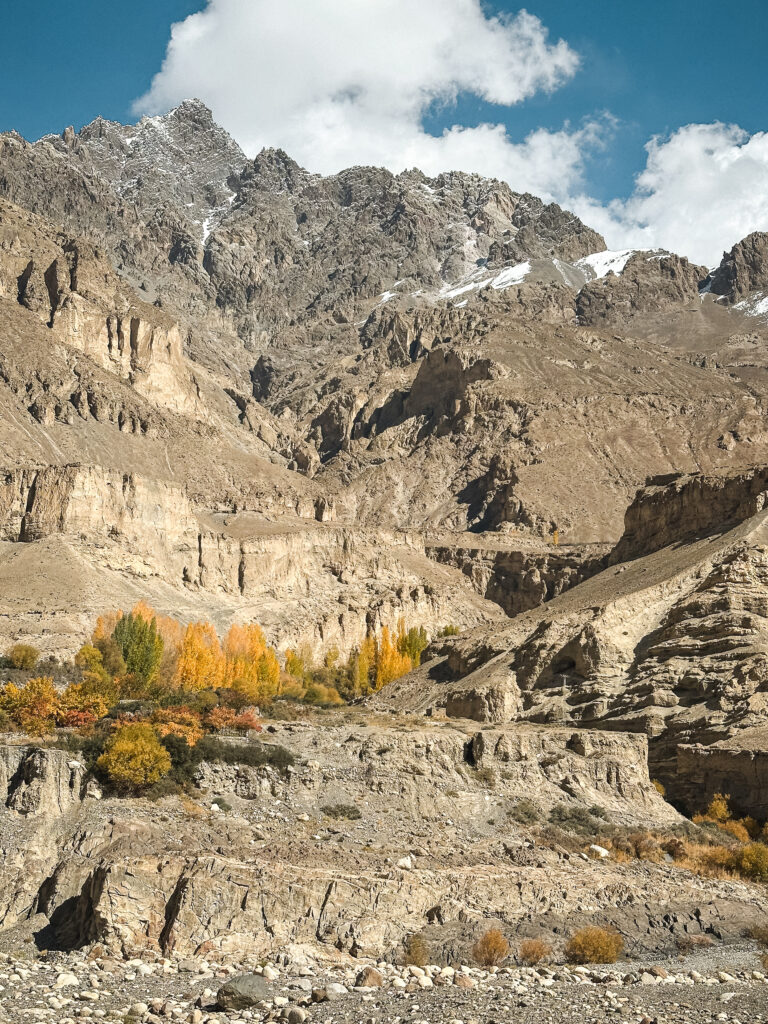 On the road to Shimshal
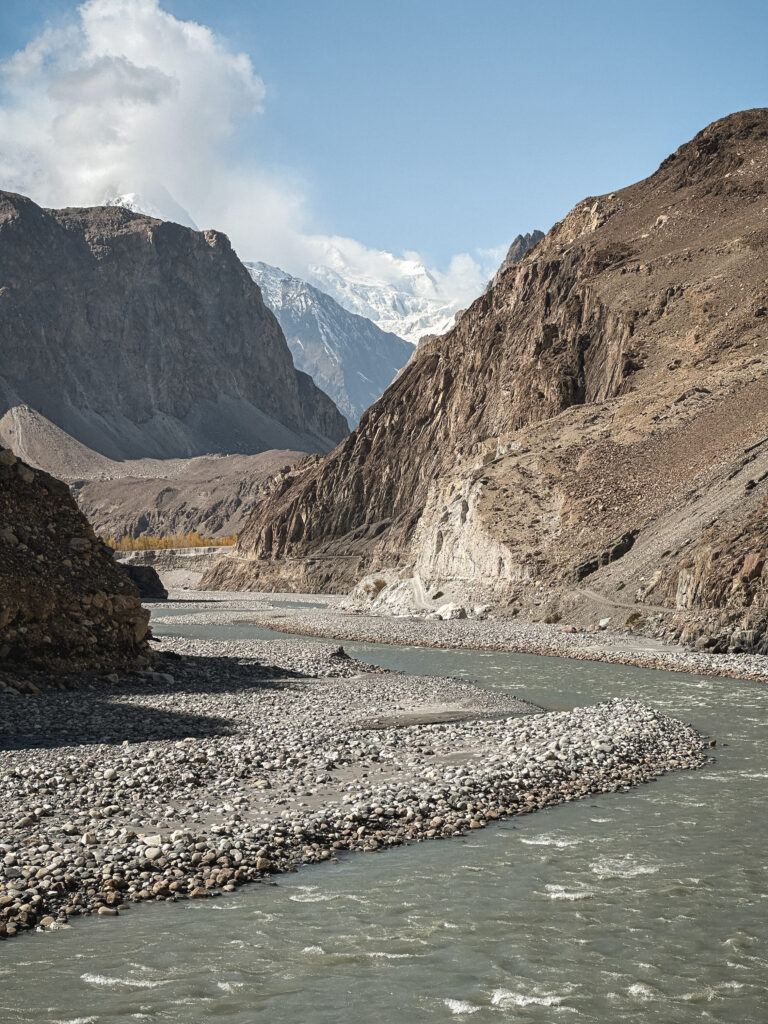 On the road to Shimshal Valley
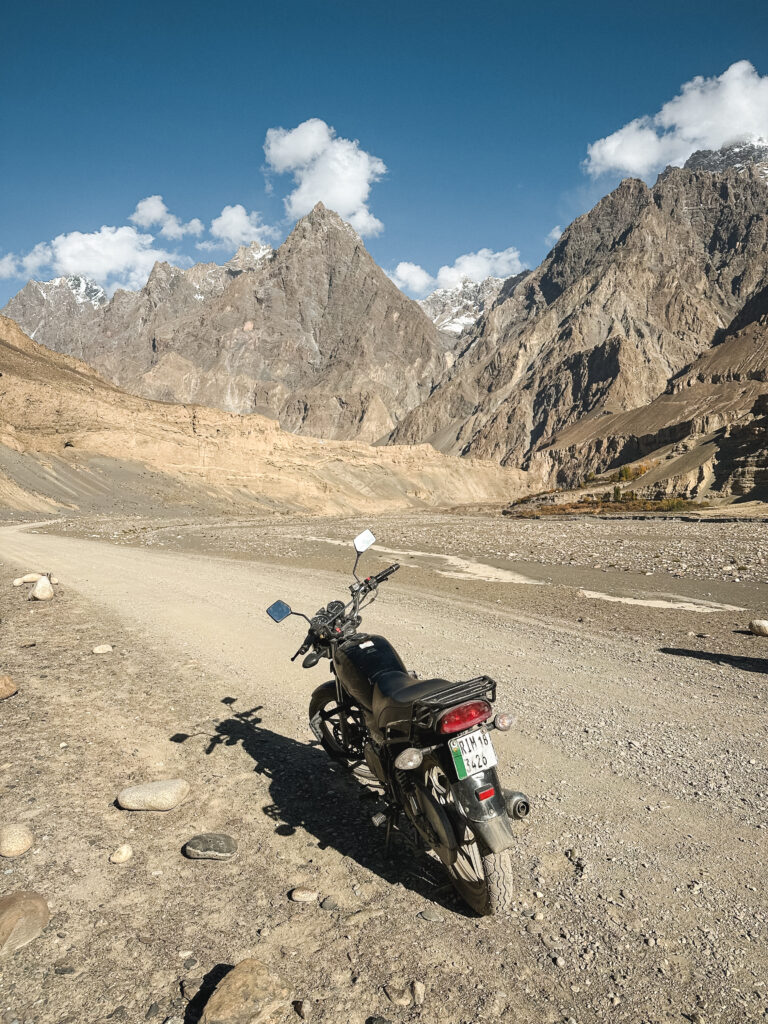 My Motorbike for the Shimshal road
When to Visit Shimshal Valley
Summer: June to August
The main season, and the most accessible window. The road is fully open, the high pastures above the village are occupied by shepherds and their herds, and temperatures during the day are pleasantly cool at altitude. This is the best time for trekking, for seeing the valley at its greenest, and for witnessing daily life in full swing. July and August bring the longest days and the clearest skies for photography.
The village sees more visitors in summer than at any other time, though “more” remains a relative term, Shimshal is never crowded. Accommodation books out faster in peak summer, so heading to a guesthouse or asking locally as soon as you arrive is wise.
Autumn: September and October
My preferred window, and the one I visited in. October brings clear skies, cold mornings, golden afternoon light, and almost no other travellers. The road is still fully open in October, and the valley in this light is extraordinary.
Temperatures drop sharply after sunset in October, expect near-zero nights, but days are crisp and clear. Bring proper layers and you’ll have the best possible version of Shimshal largely to yourself.
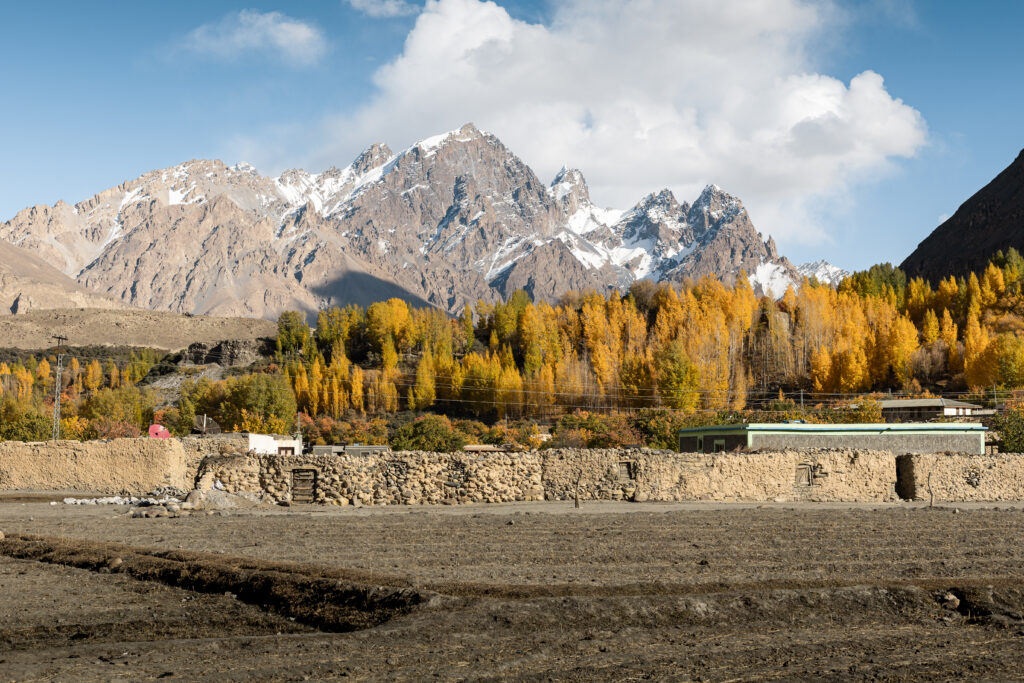
Spring: May
The snow is retreating, the road is usually open by mid-May, and the valley is just waking up. Facilities are limited, some guesthouses may not be fully operational, and the high pastures are still snowbound. But it’s quiet, the air is sharp, and the valley has a particular energy in spring. Worth considering if you’re passing through Hunza in May and have flexibility.
Winter: November to April
The road becomes unreliable after November and impassable for extended periods in winter. The village effectively closes to outside visitors, guesthouses shut, and temperatures are extreme. Unless you have specialist cold-weather experience and specific reasons to be there, winter is not the season for Shimshal.
How to Get to Shimshal Valley
Shared Public Jeep from Aliabad or Passu (recommended)
The shared jeep is the standard way to reach Shimshal and how most independent travellers get there. Jeeps depart from Aliabad bazaar in central Hunza, typically around midday, picking up passengers anywhere along the KKH up to Passu. They depart when full and leave for the return journey from Shimshal early in the morning, usually around 5-6am.
The cost is approximately 500-800 PKR per seat, slightly more for the front seat. Your guesthouse in Hunza or Passu can almost always help you book a seat the evening before.
The journey takes around 5-7 hours to the village. It is not comfortable: jeeps are packed, the road is rough, and the altitude means thin air, but the views through the window and windscreen are extraordinary. For passengers who are not driving, the road is exhilarating rather than terrifying.
Motorbike (for experienced riders only)
This is how I reached Shimshal and how I would return. The road on a motorbike is one of the most visceral travel experiences I have had anywhere. The drop-offs immediately beside you, the engine noise echoing off cliff walls, the cold air through Shimshal gorge, and the moment the valley opens out ahead of you after hours of narrow, exposed track.
Motorbikes can be rented in Gilgit or Karimabad. A 125cc is technically sufficient but a larger bike with better suspension is much more comfortable on the rocky surface. Carry basic tools and a spare tube. Start early. You want to arrive in daylight, and you want time to stop for the landscape. Do not ride this road at night under any circumstances.
This is emphatically not suitable for inexperienced riders. The road demands full attention and confident bike handling. If you have any doubt about your ability, take the shared jeep.
Private Jeep from Passu or Karimabad
A private jeep gives you flexibility over timing, stops, and pace. Arrange one through your guesthouse in Hunza or Passu. Worthwhile if you’re a group of three or more, where the per-person cost becomes reasonable; less so for solo travellers.
The Shimshal Road: What to Expect
No section of this guide is more important than this one. The road to Shimshal is not simply a way to reach a destination, but the actual experience in itself. And understanding what it involves changes how you prepare and approach the journey.
A Road Built by the Community
Before the road existed, reaching Shimshal meant a four-day walk on mountain paths that could, and did, take lives. For years, the community petitioned the government for a road connecting the valley to Passu and the Karakoram Highway. The government’s response was not a budget allocation or a construction timeline. It was a suggestion to relocate, to abandon the valley entirely and move somewhere more accessible.
The community refused. And then they built the road themselves.
Work began in 1985, the entire project funded and executed by the people of Shimshal with minimal outside support. They blasted and carved 56 kilometres of track into the mountainside. Through sheer cliff faces, across glacial rivers, along gorges where the rock barely offered a foothold, and the road was finally completed in 2003. Eighteen years of work, driven entirely by the refusal to be told that their home was not worth connecting to the world.
Knowing this as you ride changes how the road feels. Every sheer face, every carved ledge, every wooden bridge over rushing glacial water is evidence of what a community can do when the alternative is erasure.
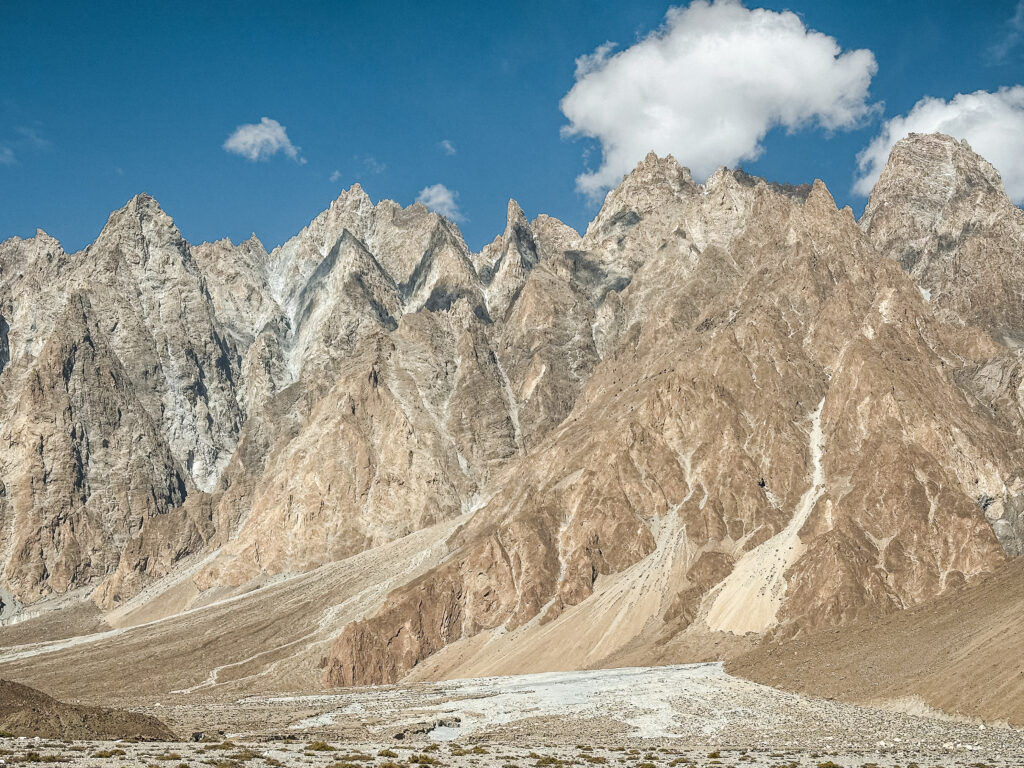 Shimshal Road starts right next to the Passu Cones
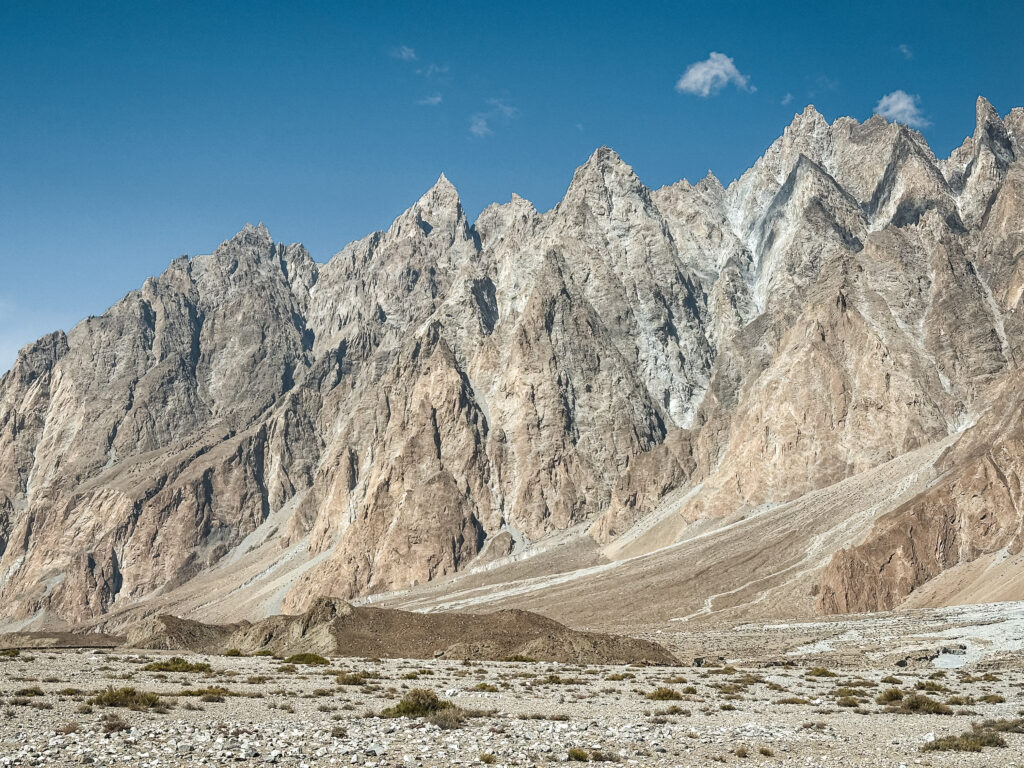 Passu Cones
Section by Section: What Riders Should Know
Section 1: The Gorge
The road leaves the KKH and immediately enters a narrow gorge, winding along the edge of the cliff face above the Shimshal River. The track is carved directly into rock in places, the river loud and visible below. The surface here is rough but manageable, mostly hard-packed dirt with loose stones. Take this section at pace and use it to calibrate your confidence and your bike. The gorge is dramatic but not yet technically demanding.
Section 2: The Wooden Bridge and the Climb
The road crosses the Shimshal River on a wooden bridge: the kind that flexes slightly under the weight of a vehicle and makes you acutely aware of the water below. After the crossing, the road begins to climb steeply. The surface gets looser here, the turns tighter, and the drop on the river side starts to open up below you. This is where you begin to understand what the road is.
Section 3: The Exposed Cliff Section
This is the part of the Shimshal road that people mean when they call it one of the most dangerous roads in the world. The track narrows to little more than a vehicle’s width, cut into the face of a sheer cliff with a long, vertical drop to the river gorge far below. There are no barriers. There is no margin. A wrong line on a loose patch of gravel, a moment of overcorrection, and the consequences are immediate and final.
On a motorbike, ride this section slowly and deliberately. Hug the cliff face rather than the edge. Do not stop mid-section unless there is a safe widening. This is not the place for photographs from the saddle. Pull over at a safe point and take them on foot. The section takes longer than you expect and demands every bit of your attention for the duration.
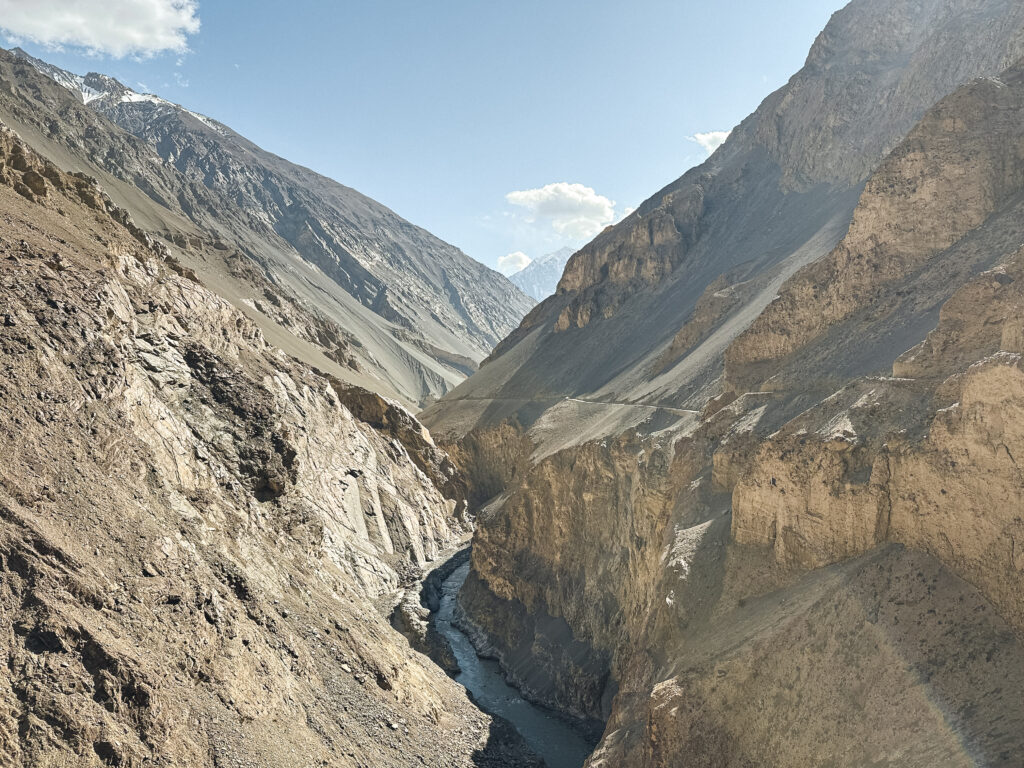
Section 4: The Wide Open Plateau
After the intensity of the cliff section, the road descends into a broader valley and the landscape opens out suddenly. The drop-offs are gone, the cliffs pull back, and you are riding through wide, rocky terrain with views in every direction. The relief is genuine. The surface here is extremely rough and rocky, bone-jarring even at low speed, but the danger level drops dramatically. This is a good place to stop, breathe, drink water, and process what you just rode through.
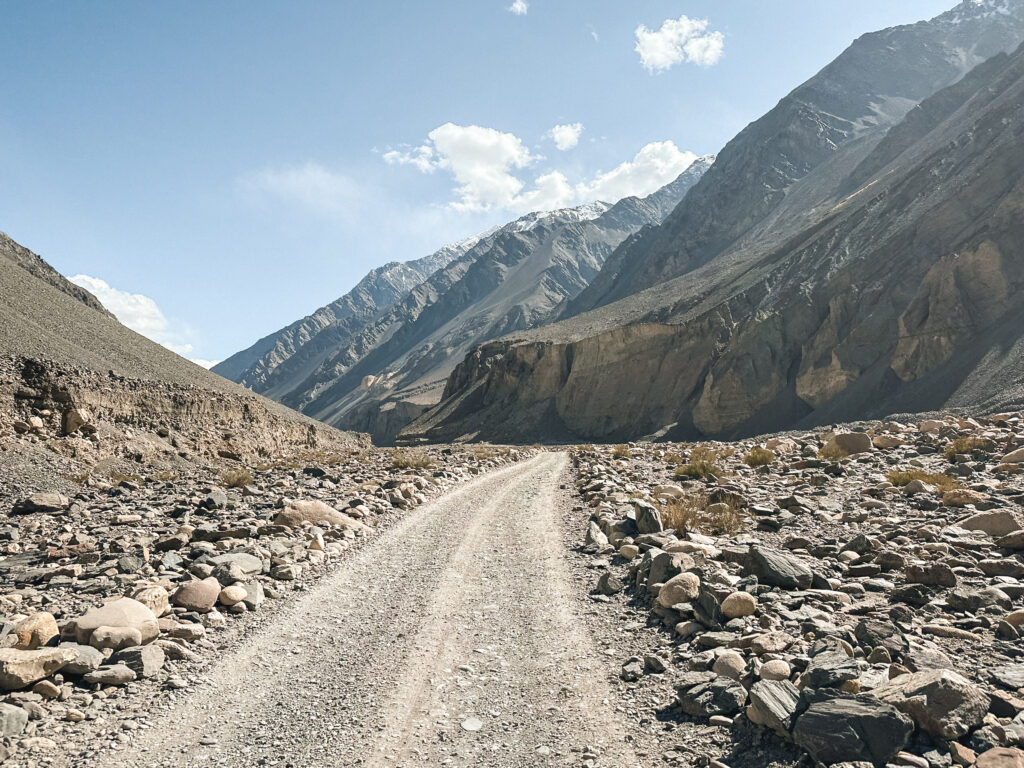
Section 5: The Power Station
A small hydroelectric power station appears on the road here, the only real sign of infrastructure between Passu and Shimshal village. The section around it involves some tricky navigation on a motorbike: a combination of loose gravel, awkward camber, and surfaces disrupted by the construction and maintenance of the station. Nothing technically extreme, but it catches you off guard after the open plateau.
Section 6: The Glacier Views
The road begins climbing again and the landscape shifts dramatically. The massive glacier appears on your right. First glimpsed between peaks, then visible in full, pouring down from the mountains above. This is among the most extraordinary riding in northern Pakistan: a rough dirt track with one of the world’s great mountain environments unfolding in every direction. The surface is challenging but the views make every jolt irrelevant. Stop here. Take your time. This is what you came for.
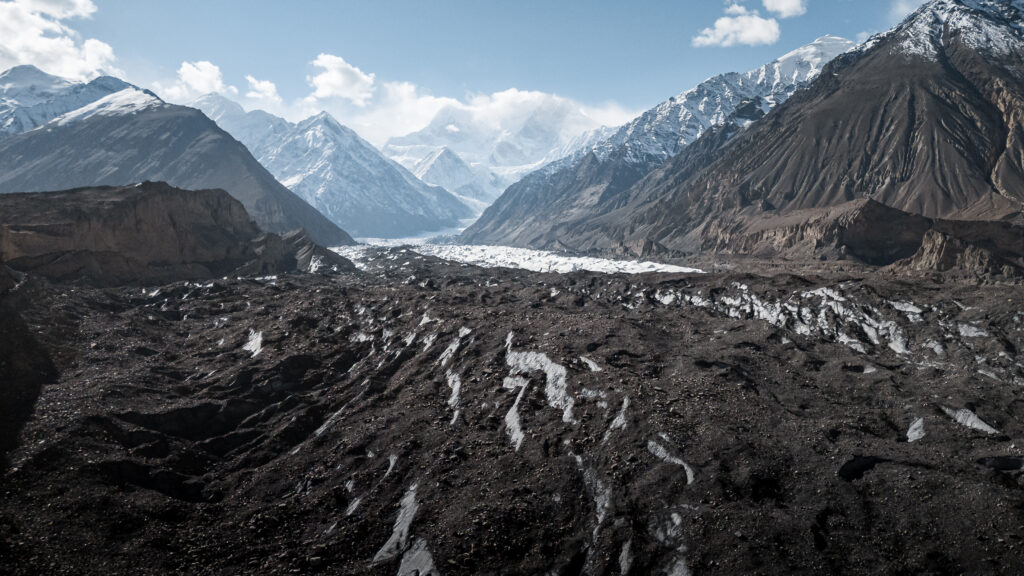
Section 7: The Sand and the Final Stretch
The last eight kilometres or so flatten out as you enter the Shimshal Valley proper. The cliff faces and landslide zones are behind you, the gradient eases, and the road widens. But this section has its own challenge: deep sand. Patches of loose, fine sand sit across the track and can be surprisingly difficult on a motorbike. Keep momentum but stay alert, steer loosely, and don’t brake hard in sand. The danger is low compared to what came earlier, but a dropped bike in deep sand after four hours of riding is still a frustrating way to end the journey.
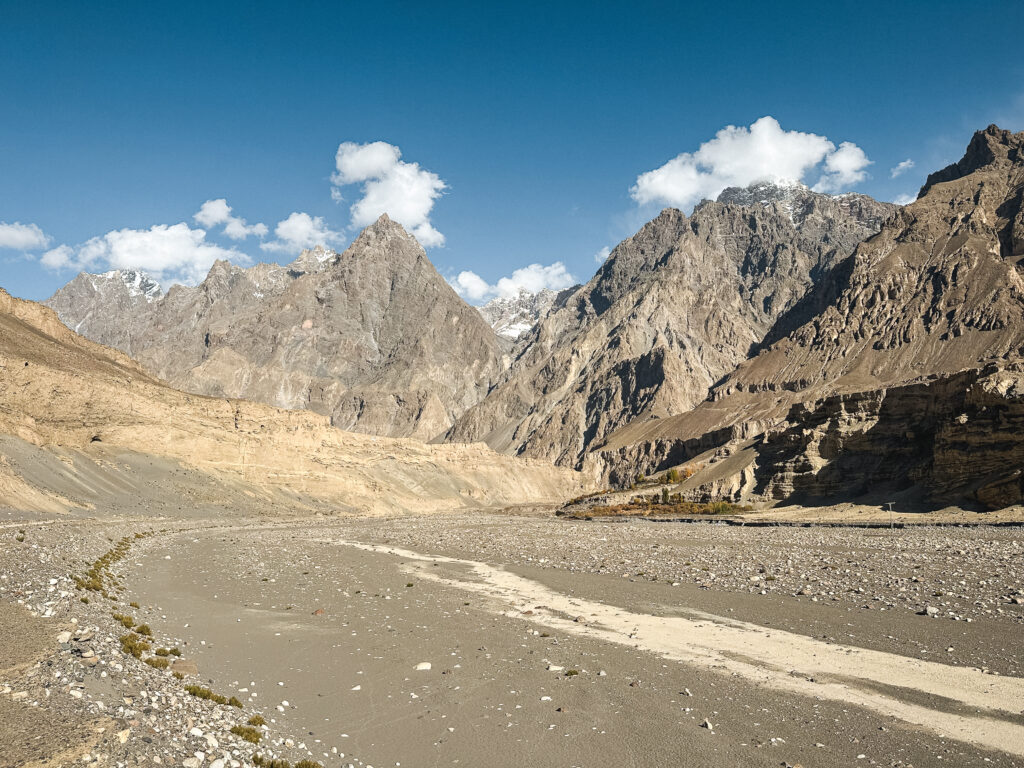 Final Section on the road to Shimshal Valley
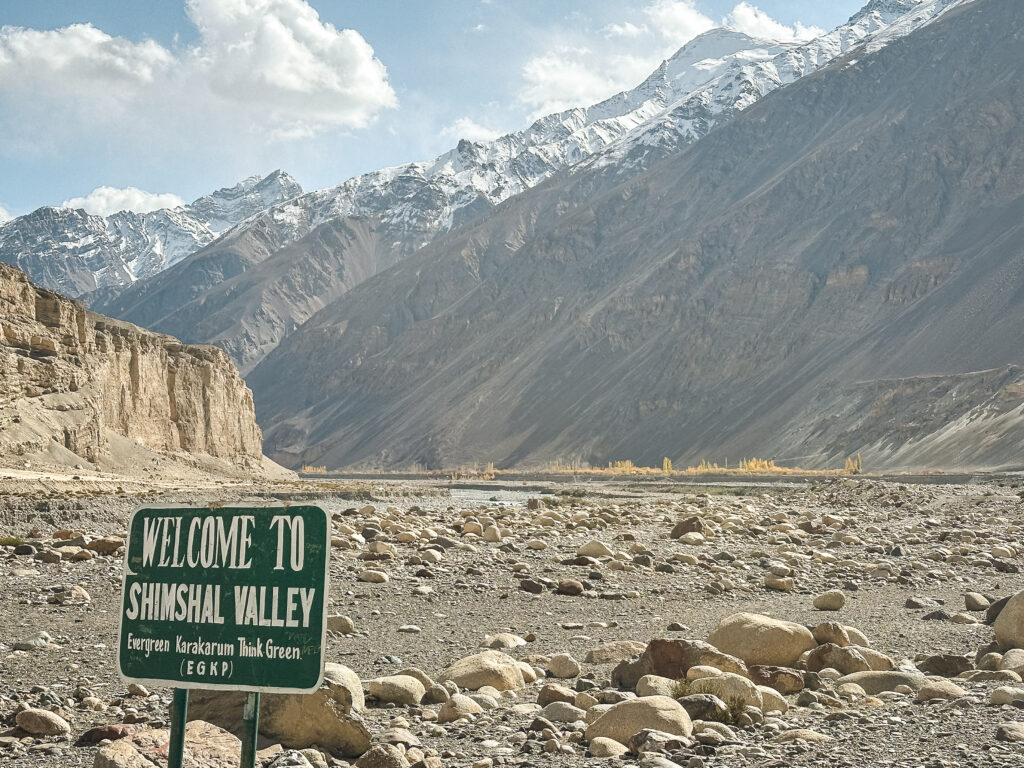 Entering Shimshal Valley
Then, almost without announcement, the villages start to appear. Stone houses scattered across a wide green valley, yaks on the hillsides, peaks rising on every side. Nearly four hours after leaving the KKH, you have arrived.
Getting Around Inside the Valley
Shimshal village is more sprawling than it first appears. It stretches across a wide bowl of grassland and is larger than most remote villages in the north. The main settlement area is navigable entirely on foot, and walking is by far the best way to experience it. There are no vehicles for hire within the village itself.
For reaching the Yazghil Glacier (a 3-hour walk each way from the village) or accessing the high pastures, local guides can be arranged informally in the village. For the multi-day Shimshal Pass trek and routes beyond, a guide is strongly recommended and certain routes require an NOC obtained in advance in Gilgit.
What to Do in Shimshal Valley
Walking Around the Village
The simplest activity, and one of the most rewarding. Shimshal village is vast for its altitude: stone houses scattered across the valley floor, irrigation channels threading between fields, yaks wandering at the edges. Walking without a plan for a full day, talking to people, watching how the light moves across the peaks, is enough reason alone to stay multiple nights.
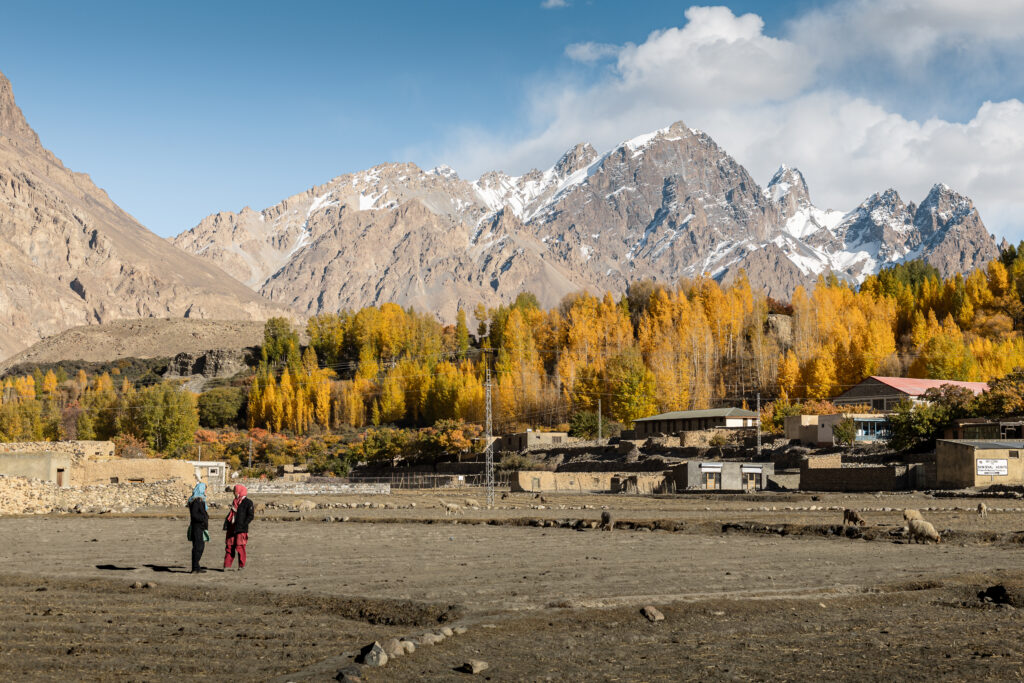 Village in Shimshal Valley
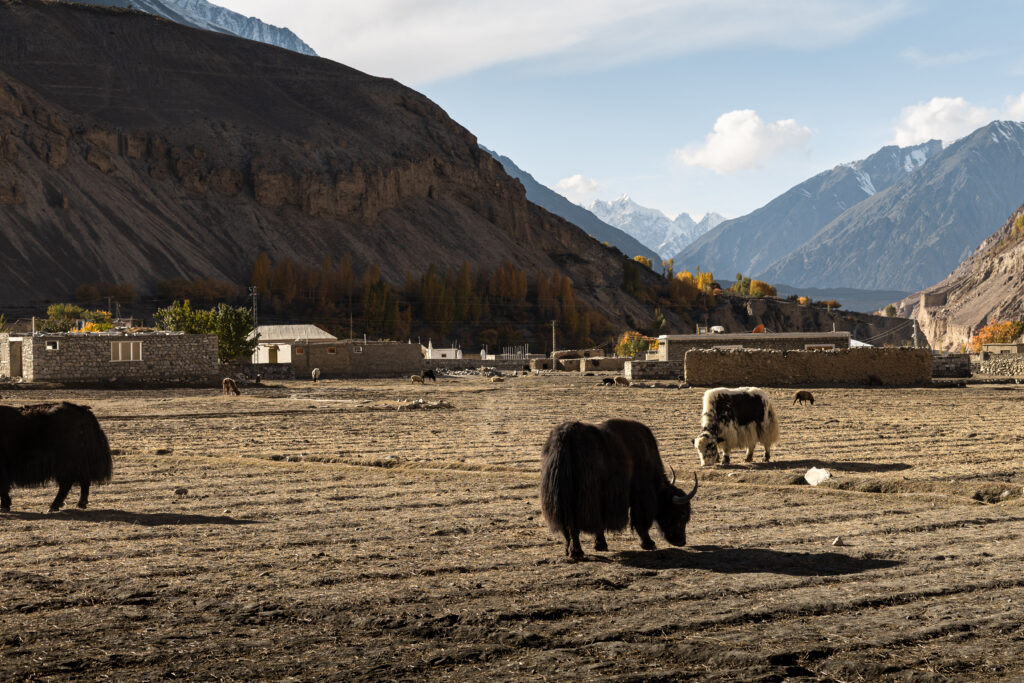 Yaks Grazing in Village in Shimshal Valley
Yazghil Glacier
The most accessible major trek from the village and the one I would point most travellers towards first. The walk from Shimshal to the Yazghil Glacier takes around 3 hours each way along a well-worn path. No guide required, no permit needed. The glacier itself is vast, and the peaks visible beyond it include some of the highest in the Karakoram. Allow a full day and start early for the best light.
Crossing the glacier requires ice experience and is not recommended without a local guide. The walk to the glacier edge and back is entirely manageable for anyone in reasonable fitness.
Shimshal Pass Trek
The valley’s signature multi-day route, the Shimshal Pass trek typically takes 7-10 days and leads through high-altitude grasslands, past the Shimshal lake, and across the pass at over 4,700 metres with views deep into the surrounding Karakoram.
Cultural Life and the Mountaineering Community
One of the most genuinely valuable things you can do in Shimshal is simply talk to people. The village has a density of mountaineering knowledge and experience that is unlike anywhere else in northern Pakistan. The people who live here have been on expeditions most climbers only dream of. Conversations over chai in someone’s kitchen: about the mountains, about the road, about what life looked like before 2003. A kind of education money can’t buy and no tour can arrange.
Where to Stay in Shimshal Valley
Accommodation in Shimshal is basic, guesthouse-style, and limited. There are no booking platforms and no Wi-Fi. You show up, ask, and a room is found.
Shimshal Embassy Guesthouse
One of the most consistently mentioned guesthouses in the village, the Shimshal Embassy offers basic private rooms with attached bathroom for around 2,000-3,000 PKR per night. Hot water is not reliably available, but boiled water can be requested. The guesthouse is well-positioned for access to the main village area and the trails beyond.
Minglig Guesthouse
Another well-regarded option in the village, with basic rooms and the characteristic warmth of Wakhi hospitality that defines every stay in Shimshal. Similar pricing to the Shimshal Embassy. Both guesthouses are known for meals served to guests, simple, home-cooked Wakhi food: chapati, lentils, potatoes, local dairy, and chai.
Homestays
As with Chapursan, staying with a local family is an option and, for many travellers, the preference. Ask around when you arrive. The hospitality of Shimshal’s Wakhi community is well-documented. Being taken in for tea and then dinner and then offered a bed is a realistic outcome here, not a fantasy.
Two nights minimum. One night in Shimshal is not enough. The road takes most of a day each way, and the valley needs time. Two nights lets you walk to the glacier, explore the village properly, and have unhurried time with people. Three is better if you have it.
How Much Does Shimshal Valley Cost?
Shimshal is not the cheapest valley in the north. Due to its remoteness, and the logistics involved, it means food and supplies cost more to bring in. That said, it remains affordable by any international standard.
| Expense | Cost (PKR) | Cost (approx. EUR) |
|---|---|---|
| Shared jeep from Aliabad/Passu (one way) | 500-800 | ~2 € |
| Private jeep (return) | 15,000+ | ~45+ € |
| Motorbike Fuel | 2,300 | 7 € |
| Guesthouse + meals (per night) | 6,500 | ~20 € |
| Yazghil Glacier walk | 0 | — |
| Total for 1 nights / 2 days | ~7,000-10,000 PKR | ~22-70 € |
Budget Tips
Bring all cash from Gilgit or Karimabad. There are no ATMs anywhere near Shimshal. Bank Alfalah in Aliabad is the most reliable option for foreign cards. Carry enough for your full stay plus contingency. Road closures can occasionally strand you for an extra day.
Practical Tips for Visiting Shimshal Valley
Take the shared jeep if you have any doubt about the road. If you are not a confident, experienced rider or driver on mountain tracks, the shared jeep with a local driver is not the fallback option, it is the right option.
Book your jeep seat the evening before. The jeep leaves Aliabad at midday and fills up quickly. Your guesthouse in Hunza or Passu can usually call ahead and reserve a seat.
No NOC needed for the village, but get one in Gilgit for trekking. You do not need a permit to visit Shimshal or to walk to the Yazghil Glacier. For the Shimshal Pass trek and routes beyond, an NOC obtained in Gilgit is required. Sort this before you travel if trekking is on your agenda.
There is a police checkpoint at the valley entrance. Straightforward: show your passport and visa and you’re through. Have it accessible.
Mobile signal is minimal. A cell tower exists but the connection is unreliable and slow. SCOM fares better than other networks, but treat Shimshal as off-grid. Download offline maps before you leave Passu.
An eSIM bridges the gap before you switch to a local SCOM SIM, useful for the Islamabad portion of your Pakistan trip.
Need data before you land? Try Saily eSIM
Use code RITAHE1486 for $5 off your first plan.
Altitude. At 3,100 metres, Shimshal is high. If you’ve come directly from lower altitudes, take the first day slowly. Headaches and fatigue are common on arrival. Drink water, rest, and don’t push hard on day one.
Respect the community. Shimshal is a close-knit Wakhi Ismaili village. Dress modestly, ask before photographing people, and follow the lead of your hosts in any domestic or social setting. Women traditionally sit separately from men in homes. If you’re invited in, observe what’s happening around you before sitting down.
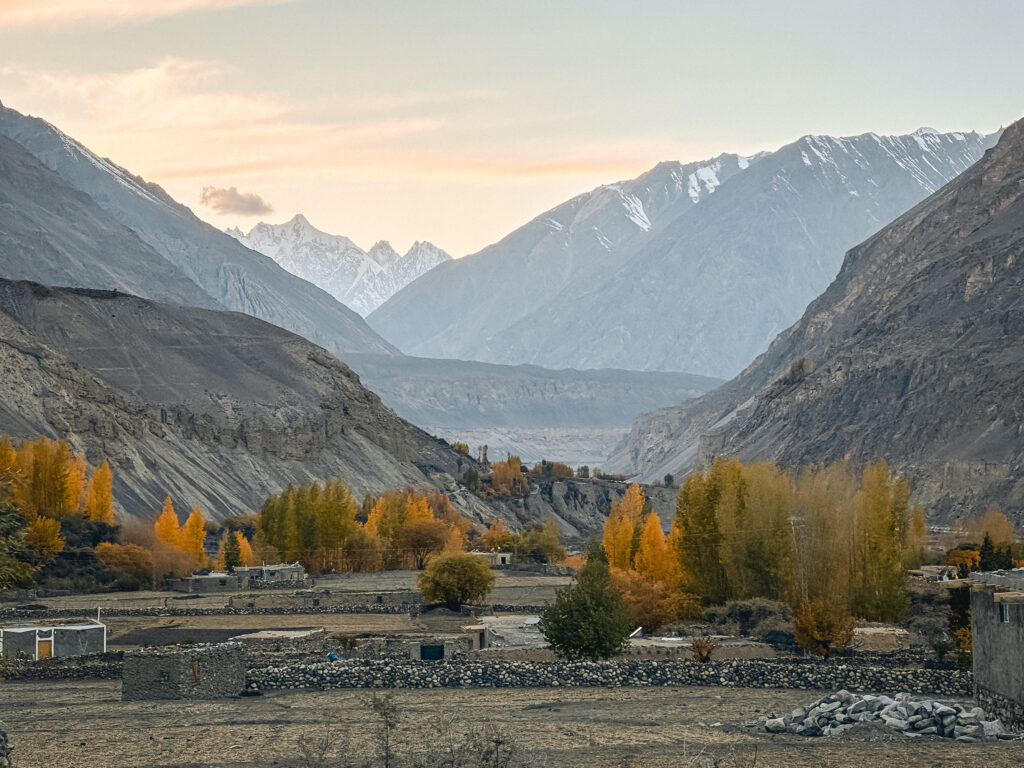
FAQ: Shimshal Valley
Can you visit Shimshal Valley without a tour?
Yes. There’s a daily shared jeep from Aliabad. This guide is based entirely on independent travel.
How do I get to Shimshal Valley from Hunza?
Take the shared jeep from Aliabad bazaar in central Hunza, which departs around midday. It passes through Passu on the KKH before turning onto the Shimshal road. Total journey time is 5-7 hours.
Do I need a permit for Shimshal Valley?
No permit is required to visit the village or trek to the Yazghil Glacier. For the Shimshal Pass trek and multi-day routes beyond the village, a permit might be necessary.
Is the Shimshal road really that dangerous?
It is a serious mountain road with sheer drop-offs, narrow sections, and no barriers. Experienced drivers and riders with knowledge of mountain tracks manage it regularly. If you have any doubt about your ability, travel by shared jeep with a local driver. The road demands full attention and should never be driven at night.
Is Shimshal Valley safe?
Yes. Crime is extremely rare and the community is welcoming. The road is the primary risk, which is managed by choosing your transport carefully. Solo travellers, including solo women, visit Shimshal without issues.
Don’t skip travel insurance!
I use SafetyWing for most trips – solid coverage for adventure travel.
How long should you spend in Shimshal Valley?
A minimum of two nights. The road takes most of a day each way, and one night in the valley is not enough to do it justice. Two nights lets you walk to the glacier and spend time in the village. Three nights is better if you have the time.
Is Shimshal Valley worth it if I don’t trek?
Yes, completely. The journey alone is worth the trip. The village, the Yazghil Glacier walk, the cultural life, and the views are enough for two or three days of full, rewarding travel without any technical trekking.
Need help planning your Pakistan trip?
Custom itineraries, local guide sourcing, and on-trip support from someone who’s done it.
Final Thoughts
There’s a moment on the Shimshal road, somewhere in the middle section, where the gorge narrows and the cliff face rises directly above you and the river is loud far below. And where the scale of what the community built becomes fully real. Every bend carved by hand. Every bridge placed across glacial water by people who had no other choice. The road exists because the village needed it to exist, and nothing about it was given.
That spirit, of endurance, of capability, of doing extraordinary things in extraordinary conditions, is present in Shimshal itself. The mountaineers it has produced, the life people maintain at 3,100 metres, the warmth extended to strangers who have made the effort to arrive. Coming here changes something about how you understand what mountains are and what people are capable of inside them.
Give it time. Ride or drive slowly. Stay at least two nights. Walk to the glacier. Drink the chai.
More Pakistan Travel Guides
If you’re planning to travel Pakistan independently, these in-depth guides will help you navigate the country, travel on a budget, and explore far beyond the usual routes:
Have questions about Shimshal valley? Drop them in the comments. I read every single one.